The Nation Appoints Veteran Journalist Razia Iqbal to Its Editorial Board
“The Nation” Appoints Veteran Journalist Razia Iqbal to Its Editorial Board
The esteemed broadcaster joins an advisory board committed to expanding the terms of debate and upholding the ideals of democracy at a legacy publication.
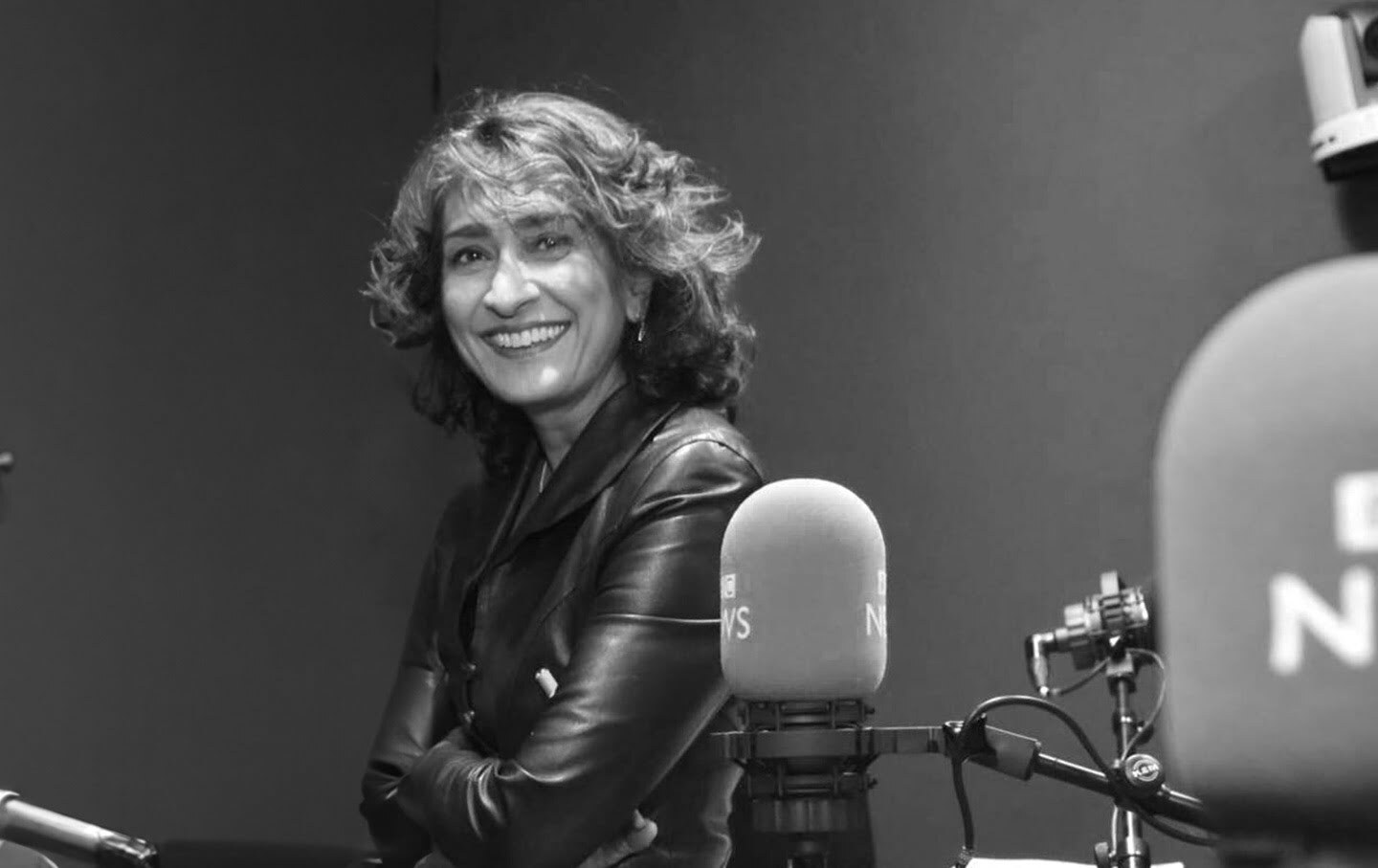
Razia Iqbal
(Courtesy of Razia Iqbal)Contact: Caitlin Graf, The Nation, press [at] thenation.com, 212-209-5400
New York, NY—April 4, 2024—The Nation, America’s leading source of progressive politics and culture, today announced that Razia Iqbal (@raziaiqbal) joins our esteemed editorial board to advise on issues of democracy, diplomacy, and dissent, drawing from her decades-long career working in independent public interest journalism.
“As the former voice of the BBC World Service Razia Iqbal was a part of my mornings for many years,” says Nation editor D.D. Guttenplan. “Now that she’s based in North America, we’re thrilled to have a journalist of her depth of experience and breadth of interests to help shape our coverage.”
“Joining the editorial board of The Nation is particularly exciting at this moment in the US and the world,” adds Iqbal. “A moment that requires both clarity and commitment, given the challenges to democracy, western hegemony, and conventional structures of power. And also a moment that demands rigorous interrogation of what kind of society and world we want to have a say in shaping. I’m delighted to be in such stellar company.”
Iqbal is the John L. Weinberg Professor at Princeton University in the School of Public and International Affairs (Princeton, NJ). She has been a journalist with the BBC for more than 30 years, on both radio and television, where she most recently anchored the flagship international current affairs program Newshour on BBC World Service Radio. She has reported on US presidential elections, and has experience reporting in Turkey, Pakistan, India, Sri Lanka, Saudi Arabia, Israel, Germany, and many other places. Iqbal was previously the BBC’s Arts correspondent, covering international and UK culture for more than a decade.
In her first published piece for The Nation, Iqbal demonstrates how Israel’s incursion into Gaza a decade ago reveals problematic assumptions underpinning media coverage of the current conflict. Namely: the willingness to defer to the nation-state; in the case of Israel and Palestine (a name she notes is not even used in BBC coverage), this unfairly advantages the former. “‘Let’s Wait Till Israel Says Something’: Why the Media Has Failed the Test of the War in Gaza” assesses the nuances of achieving a balanced approach while raising essential questions about how we use language and whose stories and lives the news spotlights.
The Nation’s editorial board is comprised of leading American and international journalists, academics, and activists charged with implementing the magazine’s 159-year-old mandate to uphold “true democratic principles in society and government, and the advocacy and illustration of whatever in legislation or in manners seems likely to promote a more equal distribution of the fruits of progress and civilization.” Iqbal joins fellow editorial board members Emily Bell, Deepak Bhargava, Kai Bird, Frances FitzGerald, Bill Fletcher, Jr., Eric Foner, Bill Gallegos, Greg Grandin, Richard Kim, Tony Kushner, Elinor Langer, Malia Lazu, Richard Lingeman, Deborah W. Meier, Walter Mosley, Khalil Gibran Muhammad, Pedro Antonio Noguera, Richard Parker, Elizabeth Pochoda, Albert Scardino, Rinku Sen, Waleed Shahid, Zephyr Teachout, Dorian T. Warren, and Gary Younge.
For interview requests or further information, please see contact information above.
About: Razia Iqbal is a Nation editorial-board member. She was a special correspondent at the BBC for over three decades; from 2011 to 2023 she also anchored Newshour on the BBC World Service, the corporation’s flagship current affairs program. She is currently teaching at the Princeton School of Public and International Affairs, where she holds the John L. Weinberg/Goldman Sachs & Co. Visiting Professorship.
Founded by abolitionists in 1865, The Nation has chronicled the breadth and depth of political and cultural life from the debut of the telegraph to the rise of Twitter, serving as a critical, independent, and progressive voice in American journalism.