
What Israel’s Destruction of the Great Omari Mosque Means
Yes, it’s a crime against cultural heritage. But more importantly, it’s part of a campaign of total annihilation.
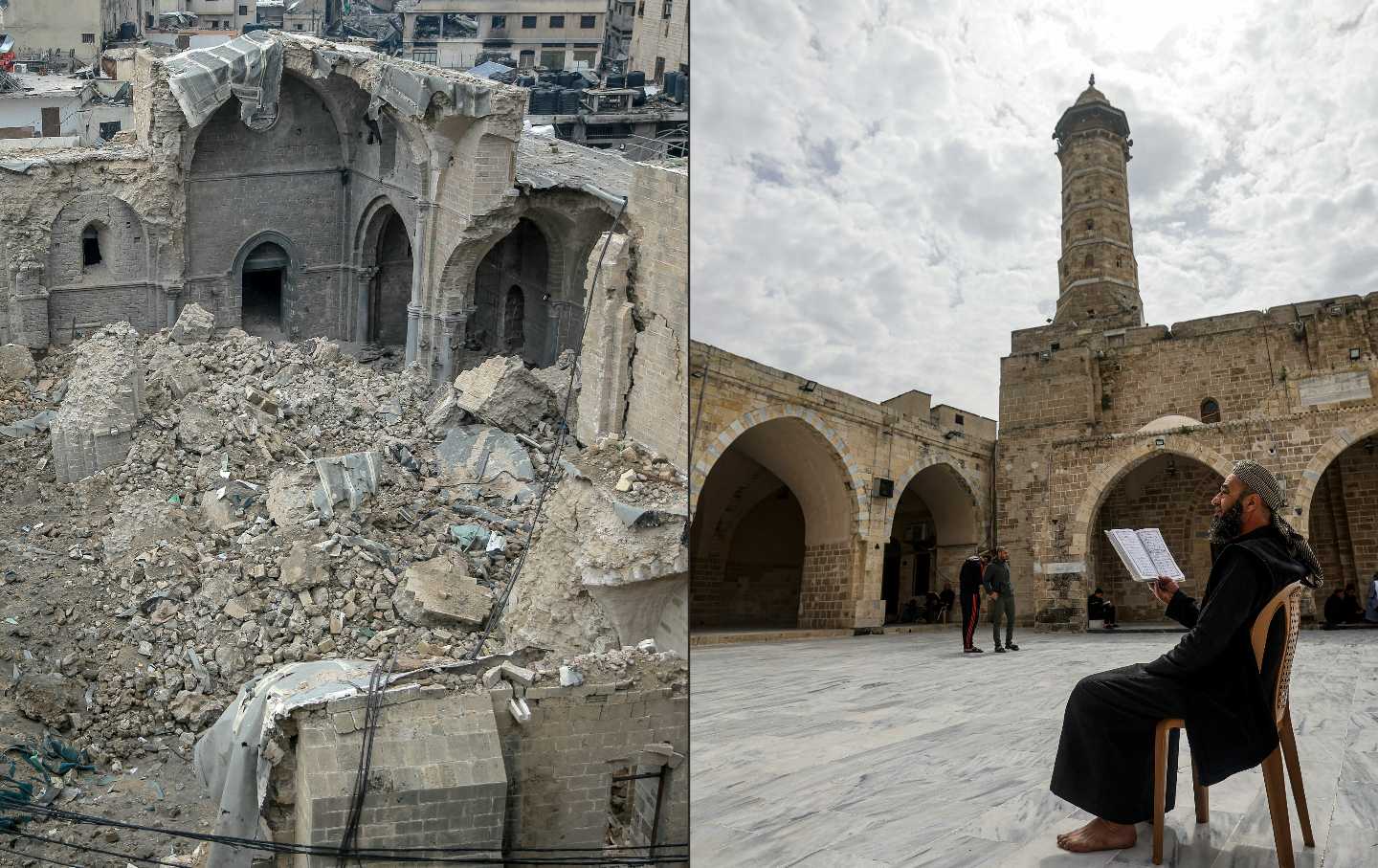
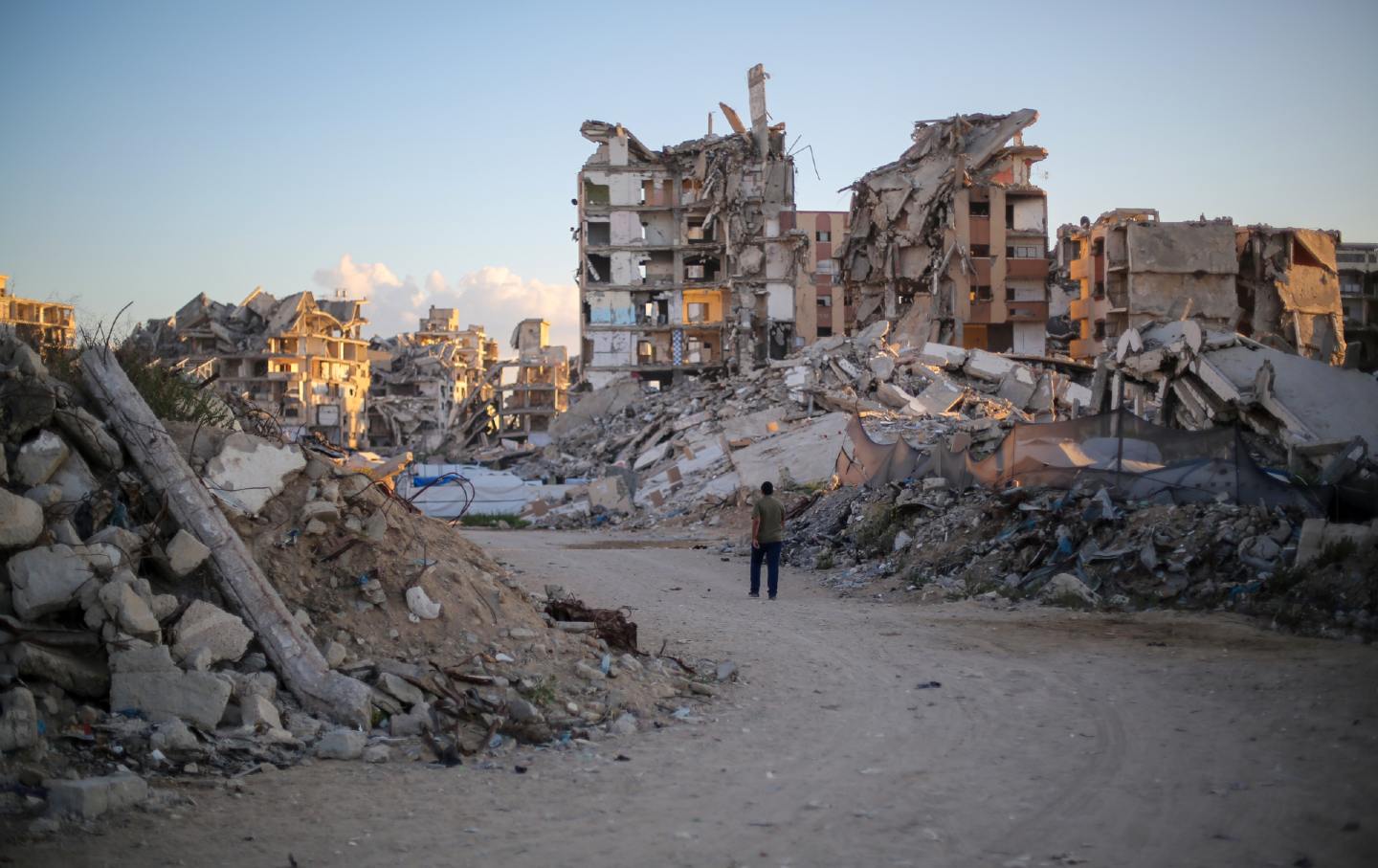
If you look at images of Gaza now, instead of cities where thousands of people lived, all you’ll see is rubble. The remnants of homes and apartment buildings lie strewn about, mangled beyond recognition. Shops, hospitals, schools, universities, religious buildings, whether ancient or new (it makes little difference now)—all have been reduced to unsalvageable heaps of rock and steel, some bombed beyond recognition, legible now only in the memories of those who knew them. There is a word for when buildings and cities are destroyed as part of a campaign of ethnic cleansing: “urbicide.” It is a tactic used to make sure there is nothing left to return to, nothing that can be cherished or latched on to. Its goal is a total colonization of the landscape that erases whatever used to be.
Since Israel began its assault on Gaza in the wake of Hamas’s October 7 attack, one of the most devastating architectural victims has been a historic, centuries-old mosque. Initially constructed as a Byzantine church in the fifth century, it became known as the Great Omari Mosque in the seventh century, the first-ever mosque to be established in Gaza during the period of Islamization. Gaza’s strategic coastal location has allowed it to bear witness to many changes: 11th-century Crusaders converted the mosque back into a church, which was converted to a mosque again a century later. The region has weathered much conflict, having played a role in many different empires.
“Gaza was actually a sizable city under the Byzantines and, before them, the Romans, and was a [political] center…for the Mamluk Empire in the 13th through 15th centuries. And that’s when it probably reached its highest level of administrative power,” Nasser Rabbat, the director of the Aga Khan Program for Islamic Architecture at MIT, tells me. “Gaza was the place where the [Mamluk] army would congregate on the way to their campaigns in northern Syria, in the Euphrates region, or in Anatolia against its host of enemies.”
The Great Omari Mosque reflected this history. It had been damaged and rebuilt many times over the centuries: attacked by the Mongols in the 13th century, battered by an earthquake a few decades later, restored and expanded in the Ottoman era, and partially destroyed by British bombs in World War I, only to be restored once more. Now it’s been effectively obliterated; only some walls and one minaret remain. This is—make no mistake—a deliberate element of the Israeli campaign to erase all traces of Palestinian life.
After news of its destruction was reported, multiple tweets went viral comparing the widespread outcry over the 2019 fire that claimed part of the Notre-Dame Cathedral in Paris with the relative silence over the loss of the historic mosque. There’s undoubtedly something to this, and it’s symptomatic of Islamophobia and the ignorance of Islamic culture in the West more broadly. Yet there’s a deeper point to be made about architectural loss as it relates to war. Notre-Dame, after all, is a unique case: It is widely famous in mass popular culture (very few buildings have a Disney movie made about them), and the fire was a simple accident, not a deliberate act of demolition.
Meanwhile, we have been living with at least a century of rhetoric associated with continued episodes of mass destruction. If the fire at Notre-Dame was the result of an accident, war—while always a destroyer of the built environment—has increasingly been seen as a legitimate reason for architectural destruction. Blatant attacks on sites of cultural heritage are justified using Cold War terminology like “preemptive strike” or “in the interest of national security.” The devaluation of tangible culture, of course, is premised on the same treatment of the people who built it: as tragic but necessary losses. Buildings and people are both denuded, depersonalized, reduced to statistics. Twenty-three thousand are dead in Gaza at the time of this writing. The Great Omari Mosque was nearly 1,500 years old. These figures inure us to the horror of destruction, as the numbers grow bigger and more unfathomable, abstracted.
In times of war, we cling to art, architecture, and other forms of culture for many reasons: to show that things and people mattered, that culture was meant to endure, that the evisceration of something priceless is a shameful crime. We are shocked by losses such as the Great Omari Mosque not only because they are terrible and sad, but also because we believed that those in power might have more respect for art and for history deemed legitimate by their own institutions than they do for human life. But, of course, this is not true: If human life is worth nothing, then neither is architecture, itself the cumulative achievement of and testimony to countless human lives. In a campaign of urbicide, nothing matters. The end goal is a blank slate.
Not all buildings are historic or priceless, but in a way, each is irreplaceable. The loss of any building that sheltered people or gave them spiritual sustenance, that served as a backdrop of everyday life and stability, is terrible. The destruction of the Great Omari Mosque is not so different from that of an apartment complex: The same crime is being committed against the same people for the same reason. The destruction of both must be seen within the context of urbicide and ethnic cleansing, not separated into crimes against cultural heritage versus inevitable collateral damage to the landscape during a conflict. The destruction of both are choices made by Israel and aided and abetted by the United States. The slaughter of Palestinians and the evisceration of their cultural sites are part of the same goal of destruction, which we must do everything in our power to stop.
More from The Nation

Progressives Are Backing Puerto Rican Independence. It’s About Time. Progressives Are Backing Puerto Rican Independence. It’s About Time.
More and more leftists are concluding that statehood for the island is not enough.
The Saudi Phase of the Iran War Signals More Chaos to Come The Saudi Phase of the Iran War Signals More Chaos to Come
The conflict that Donald Trump has repeatedly proclaimed an unequivocal American victory keeps spiraling out of control.

Andy Burnham’s Speech to the Labour Party Conference Could Be the Start of a Positive Social-Democratic Politics Andy Burnham’s Speech to the Labour Party Conference Could Be the Start of a Positive Social-Democratic Politics
But the autumn budget to be released at the end of October will offer needed details.
Why Navi Pillay’s Receiving the Nobel Peace Prize Is So Important Why Navi Pillay’s Receiving the Nobel Peace Prize Is So Important
She believes that human rights and international law are universal principles that must be enforced regardless of violator’s ideology, ethnicity, or geostrategic alignment.
Writing About War as Bombs Fall Writing About War as Bombs Fall
While the Israeli government launched a well-orchestrated offensive of disinformation and hyperbole that would make the illegal permissible in the war on Gaza.

