Understanding Life for Black Israelis
The conversation about Israel’s devastating war in Palestine should also urge a discussion about the state of the country’s Black residents.
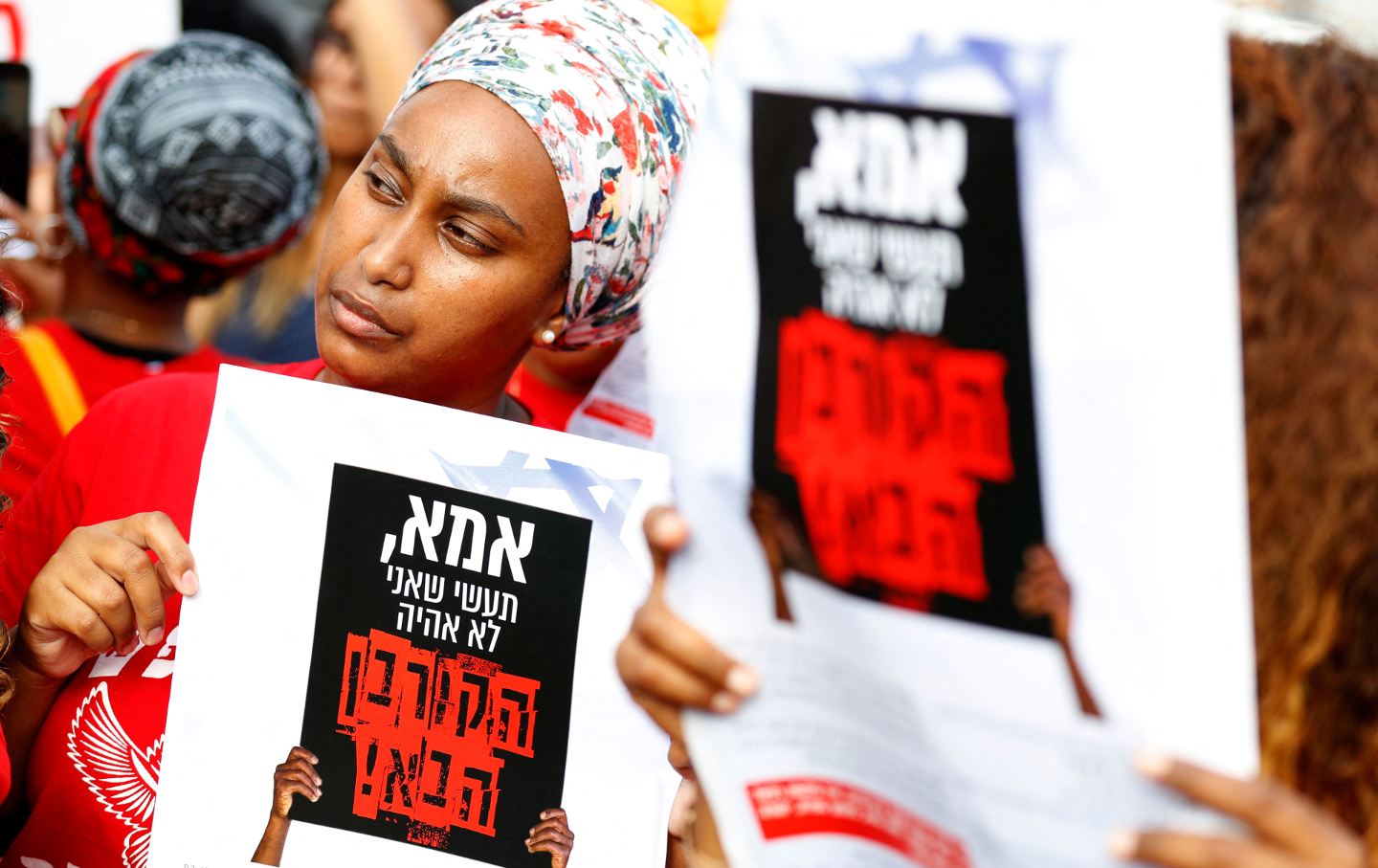
Yehuda Biadga, a 24-year-old Israeli of Ethiopian descent, was suffering from combat-induced PTSD—which had curtailed his military service two years earlier—when he was gunned down by Israeli police in January 2019. In June of that year, Solomon Tekah, an 18-year-old Ethiopian Israeli, was shot dead by an off-duty police officer. A 2020 New York Times article reported on “Israel’s festering police brutality problem,” noting that “lethal force, while rare, is wielded almost exclusively against Arabs and other minorities.” With the killings of Biadga and Tekah, Israeli police snuffed out the lives of two young Black men in just six months.
After both shootings, Ethiopian Jews took to the streets by the thousands, just as they had after two earlier instances of police misconduct against their community. The protesters decried not just Israeli police brutality but the pervasive anti-Blackness that causes the community to be overpoliced yet so underprotected that “their blood [can] be spilled with impunity,” as the Ethiopian Israeli journalist Danny Adeno Abebe writes. Protests also erupted this past August, after the fatal hit-and-run of a 4-year-old Ethiopian boy garnered a slap on the wrist for the driver.
The conversation about Israel’s devastating occupation and war in Palestine should perhaps also urge a discussion about the state of the country’s Black residents. In addition to nearly 170,000 Jewish citizens of Ethiopian heritage, they include some 10,000 Muslim Afro-Bedouins; 3,000 Black Hebrew Israelites, who are not Jewish but claim Israelite ancestry; and nearly 30,000 African nationals seeking refuge from political persecution in Eritrea and the ravages of war in Sudan, most of whom emigrated between 2006 and 2014.
Israel does not have America’s legacy of Black chattel slavery and the one-drop rule. Still, in effect, a nation-state founded primarily to deracialize Ashkenazi European Jews inevitably created an inverse racial order with the Ashkenazim on top. Mizrahim, or Middle Eastern and North African Jews (along with Sephardim, originally used as a term to designate Jews expelled from Spain but now sometimes used interchangeably with Mizrahim as a sort of catchall for non-Ashkenazi Jews), long suffered under discriminatory policies. Then the arrival of Ethiopian Jews beginning in the 1970s and continuing into the 1980s and ’90s firmed up a racial hierarchy in which “the Ethiopian community has the lowest status of Israel’s [multiracial] Jewish communities,” the Ethiopian Israeli scholar, activist, and writer Efrat Yerday, who is also chair of the Association for Ethiopian Jews, told me. The country’s estimated 200,000 people of African descent differ vastly in their ethnic, cultural, and religious identities and are not politically aligned. (In a state “where racism runs rampant and is statistically increasing,” the Israel-based journalist David Sheen has written, “any alliance with non-Jews is guaranteed to make the Ethiopian movement lose popularity amongst religious-nationalist Jewish Israelis.”)
And even that status was hard-won. Ethiopian Jews, despite practicing a 2,000-year-old, pre-rabbinic form of Judaism, were not counted among diaspora Jewry with a “right of return” until 1973. (Even then, an Israeli government report warned they were “completely foreign to the spirit of Israel.”) The difference in treatment, Yerday writes, illustrates “the State of Israel’s desire to secure a Jewish majority and at the same time [its prioritization of] the European component of the immigrant identity over the Jewish component.” Ethiopian Jews continue to need special permission from the Israeli government before migrating—unlike Jews making aliyah from the US or elsewhere—and must undergo a conversion to the dominant rabbinical Judaism to attain citizenship. And there have been scandals, such as in 1996, when it emerged that Magen David Adom, Israel’s national blood bank, had been dumping donations from Ethiopian Jews due to fears over HIV/AIDS. In 2012, reports that Ethiopian women were forced to take a long-acting birth control injection—though denied by the government—sparked fears of attempted genocide.
A 2018 study from the Israel-based research nonprofit Myers-JDC-Brookdale Institute found that the average income of Ethiopian Israelis is 29 percent lower than the general population’s. Less than 4,000 Israeli students of Ethiopian descent are currently attending college, according to Israel’s Central Bureau of Statistics.
The plight of Eritrean and Sudanese African refugees, who make up more than 90 percent of Israel’s asylum seekers, is even starker. The government’s refusal to recognize them as refugees creates a legal limbo, enabling Israel to avoid openly flouting the prohibition under international law of deporting refugees to life-threatening homelands. (Just 31 Eritreans and Sudanese have been granted asylum as of this writing.) In 2012, Israeli immigration law was amended to define all incoming non-Jewish African migrants as “infiltrators,” and the government initiated a campaign to drive them out. Anti-migrant rallies have featured Miri Regev, of Netanyahu’s ruling Likud party, calling Sudanese migrants a “cancer,” and right-wing mouthpiece turned elected parliament member May Golan declaring that she was “proud to be a racist.”
Avera Mengistu is an Ethiopian Israeli soldier who has been held captive in Gaza since 2014. Last January, Moshe Tal, a former IDF official, acknowledged on a national radio broadcast that the return of “other citizens from other backgrounds and socio-economic statuses” would probably generate “a bit greater interest.” In November, as the Israeli bombardment escalated, Michal Worke, an Ethiopian Israeli artist, told NPR: “Avera’s story is my story, and it’s the story of the entire Ethiopian community. Nine years he’s been a hostage in Gaza, and no one cares.”