It’s Time for Gaza’s Journalists to Be Treated Like the Heroes They Are
They are reporting under unimaginable difficulties and being killed in record numbers. The journalistic community should be honoring them every day.
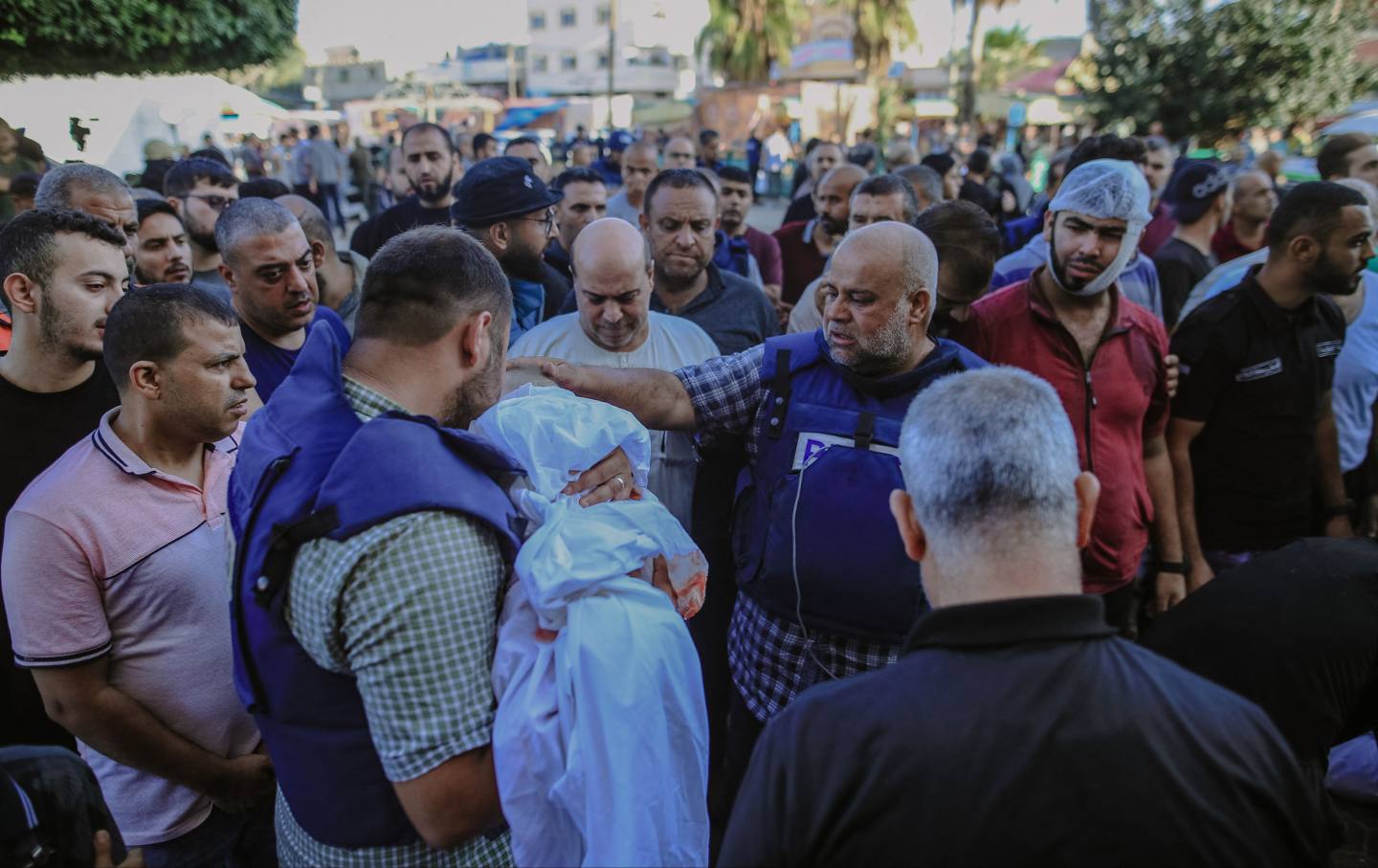
Al Jazeera correspondent Wael Al-Dahdouh bids farewell to his wife, son, and daughter during their funeral service in the heart of Gaza’s Nuseirat camp.
(Mohammed Zaanoun / Middle East Images / AFP via Getty Images)Five days after the Palestinian journalist Wael Al-Dahdouh found out during a live Al Jazeera broadcast that his wife, son, daughter, and grandson had been killed by an Israeli airstrike on the Nuseirat refugee camp in Gaza, a music distributor based in Jordan dropped a song that samples Al-Dahdouh’s now-famous response to the tragedy: “Maalish.”
The colloquial term means something akin to “There’s nothing to it,” or “That’s OK.” The implication of Al-Dahdouh’s use of the word in that context resonated with Palestinian society and spread across the Arab world. Its swift adaptation into a viral anthem is not evidence of a populace succumbing to despondency, or hardening its heart to loss, but rather perseverance through profound tragedy and grief. In no way is it OK. But it is a cost Palestinian journalists have paid at a staggeringly high price these last two months for the twin perils of being Palestinian and covering the war. And for those who have dedicated their lives to uncovering and sharing the stories of people who have suffered a 16-year blockade and have seen their Western and Palestinian colleagues killed, maimed, and imprisoned by the Israeli military and censored by its tech allies, maalish is a stoic statement of resignation, of fatalism.
Here in the United States, it can sometimes feel as though these reporters are working—and dying, and grieving, and fighting to survive—in the shadows. But it is time for them to be recognized as the journalistic heroes they so clearly are—as people embodying the most exalted ideals of our craft, operating through unimaginable pain, danger, and trauma to perform the most basic and essential function of journalism: telling us what is happening in a place we cannot access ourselves.
Local journalists have provided crucial firsthand reports of the conditions on the ground in Gaza throughout unprecedented violence. The handful of existing Gaza bureaus from major international outlets (Reuters, the BBC, the Associated Press, Al-Jazeera, Agence France-Presse, and others) are overwhelmingly staffed by Gazan residents.
As inhabitants of the community they report on, these journalists have access that has been denied to other reporters. Nearly a month ago, a coalition of major news organizations appealed to the governments of Israel and Egypt (which administers Gaza’s southern border under Israel’s direction) for access to enter. Those agencies are virtually unable to send their employees to report on the ground. Many of them have been working in Israel, sustained by the Palestinian stringers, fixers, and freelancers who live in the war zone. That same identity subjects them to a complicated combination of pressures: the requirements of their foreign employers, the risks of seeking and exposing truth under authoritarian governance, and the increased risk of being subjected to IDF violence for doing their jobs. Maalish.
The fact that the international journalists who briefly enter the Gaza Strip to report must assent to Israeli government censorship makes the work of Palestinian journalists especially valuable as stringers and freelancers for international news outlets. Working through a humanitarian crisis, these journalists demonstrate the remarkable tenacity and adaptability required of any war reporter, but with the added complication that they live, along with their families, in the war zone. The death toll among journalists shows the risks to Palestinians in particular. Of the 63 journalists killed since October 7, all but seven are Palestinians.
In Gaza, cameras, phones, and chargers are difficult to get, let alone safety equipment. Electricity and Internet access range from unreliable to nonexistent. Media offices have been targeted. The IDF has confiscated or destroyed the equipment reporters, photographers, and videographers use to gather news.
Compounding the challenges they face on the front end, the journalistic legitimacy—and thus protected status—of the Palestinian press is disputed by the Israeli and sometimes US governments, in a way that may intimidate them from doing their work. Last month the IDF warned Reuters and Agence France-Presse they could not “guarantee the safety” of their employees, and urged the outlets to take “all necessary measures for their safety.” It’s not a stretch to see that such a threat is intended to cause journalists to stop reporting from inside Gaza, or even to leave Gaza altogether. Indeed, Reuters said in a statement that “the IDF’s unwillingness to give assurances about the safety of our staff threatens their ability to deliver the news about this conflict without fear of being injured or killed.”
While the Committee to Protect Journalists says that for most of the war, there were no international journalists aside from those very recently embedded with the IDF in Gaza, the Biden administration hasn’t rushed to restore on-the-ground reporting capabilities. In fact, ahead of the recent temporary cease-fire, Politico reported that “there was some concern in the administration about an unintended consequence of the pause: that it would allow journalists broader access to Gaza and the opportunity to further illuminate the devastation there and turn public opinion on Israel.”
Less than two weeks later, the Israeli Communications Minister Shlomo Karhi claimed in a letter to four American news outlets that his staff had prior knowledge of Hamas’s October 7 attack. In response, Israeli Defense Minister Benny Gantz compared journalists to terrorists—effectively granting his military cover to kill media workers. (Karhi has also sought to sanction the Israeli paper of record, Haaretz, for what he characterizes as an anti-Israel bias in its reporting on the war.)
These journalists broadcast in an environment of constant mistrust cast primarily by the same military they say has left their community nowhere to go as it bombards more and more parts of the small territory they inhabit.
CPJ calls this a “deadly pattern,” a cycle of Israeli military attacks on journalists followed by denials, perfunctory and exculpatory investigations, and no one held accountable.
Popular
“swipe left below to view more authors”Swipe →It’s hard to imagine how this atmosphere could be more hostile or repressive. In its latest report, CPJ says that the outbreak of war has seen the deadliest month ever for media workers since it began keeping records in 1992. The total count will soon surpass the number of journalists killed around the world last year, when the highest death tolls were a horrific 15 journalists in Ukraine and 13 in Mexico.
Consequently, there will be less journalism. Fewer journalists are gathering reliable and accurate data and parsing facts from disinformation. There are fewer voices persistently revealing the Gazan reality to the rest of the world. There are fewer because so many of the people who were doing this work are dead, and so many of the ones who have not been killed are fighting a daily battle to survive along with their families.
Of those who remain, a few young ones have broadcast their in-depth reporting on social media. The caption of an Instagram post by 22-year-old journalist Plestia Alaqad, who has gained more than 4 million followers, reads:
I used to always wear my press vest and helmet.. but lately I stopped wearing them.. I don’t feel safe in Gaza no matter what, even while sleeping I don’t feel safe, but especially when wearing the press vest and helmet I don’t feel safe.. I hope this nightmare ends soon, I hope we don’t lose any more journalists..
When the reporter Salman Al-Bashir emotionally cast aside his press vest during a live broadcast after learning that his colleague, Mohammad Abu Hatab, had been killed alongside 11 of his family members, he spoke a harrowing truth. “No protection, no international protection at all, no immunity to anything, this protection gear does not protect us and not those helmet…. live on air…we await our turn, one after another.”
Local reporters in other conflicts around the world have been lifted up by the journalistic community. The journalists of Ukraine, for instance, were awarded a special Pulitzer Prize citation for their bravery in war. The very least that those of us can do now is bring that same level of solidarity, attention, and gratitude to the journalists of Gaza.
But solidarity can only do so much. Those who are still reporting from Gaza know what they’re up against. They know more of them will die along with their families. And they know that little, if anything, will save their lives, or the lives of their loved ones. Maalish.
More from The Nation
Hegseth’s Testosterone Program Is a Disservice to Men Hegseth’s Testosterone Program Is a Disservice to Men
By measuring manliness by muscle and testosterone levels, the defense secretary is peddling damaging stereotypes and legitimizing a narrow view of masculinity.
Liberals Are Shaming Howard Zinn’s Memory Yet Again Liberals Are Shaming Howard Zinn’s Memory Yet Again
Zinn saw firsthand what happened when liberals did more to fight the left than the right—they sabotaged their own power.

The Graduate Students Taking on the World’s Richest University The Graduate Students Taking on the World’s Richest University
In public, Harvard has waged a battle against the Trump administration. In private, workers say the university wants to appease it.
Our Court Jesters Are Disappearing Just When We Need Them Most Our Court Jesters Are Disappearing Just When We Need Them Most
In this authoritarian moment, we need defiant comedy more than ever.
America’s Crisis of “Death by Incarceration” America’s Crisis of “Death by Incarceration”
The US prison population is aging rapidly, and incarcerated seniors are not getting the care they need.
A New Trump Rule Would Lower Standards at Head Start and Exclude Immigrants From the Program A New Trump Rule Would Lower Standards at Head Start and Exclude Immigrants From the Program
The Trump administration is on the verge of releasing a proposed rule that would eliminate crucial quality standards at the nation’s preschool program for low-income children.

