
Las Vegas Hospitality Workers Have an Ace Up Their Sleeve
The image of the city as an adult playground has often meant extreme and erratic change for hotels, casinos, and restaurants. The Culinary Union has had enough.
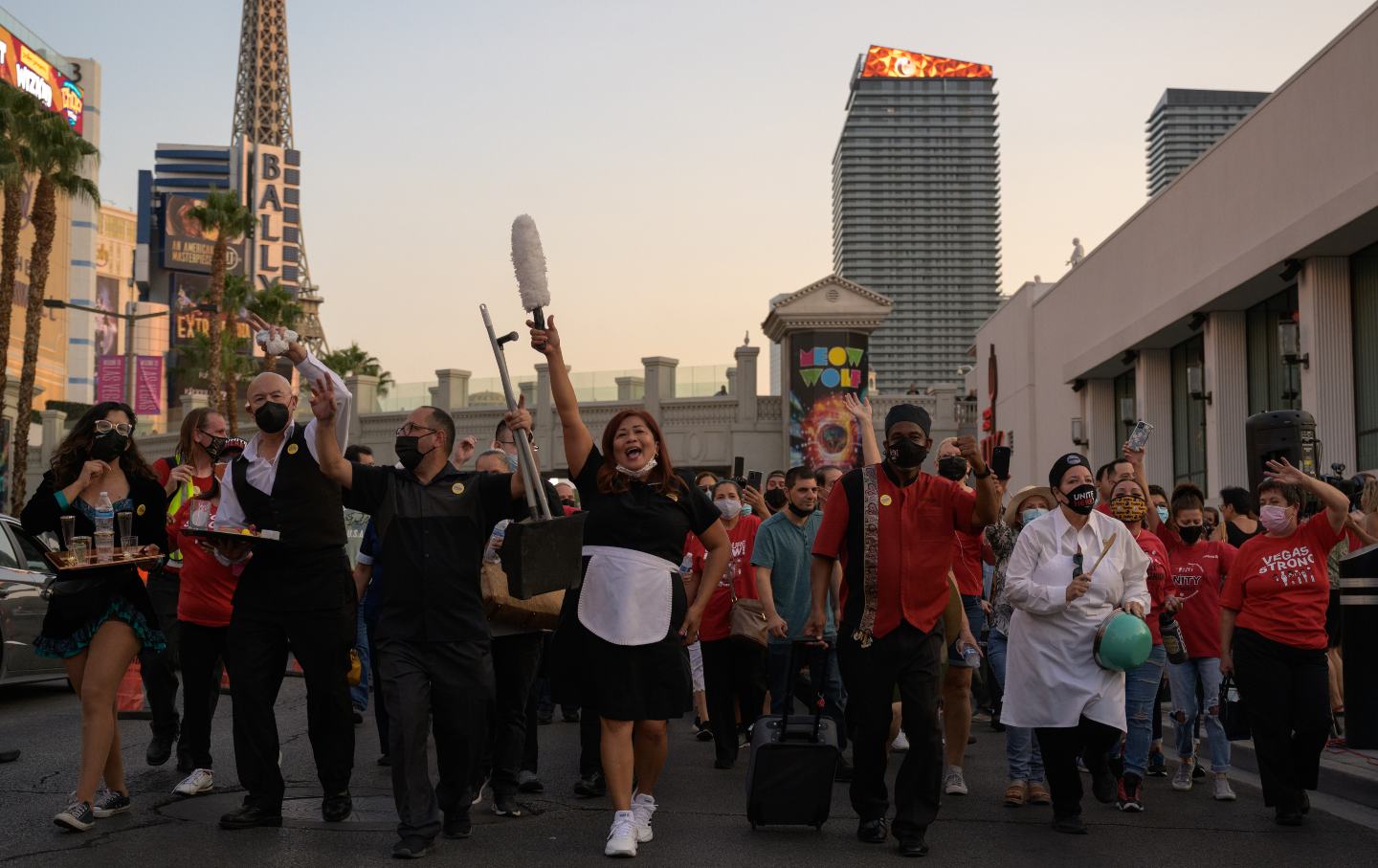
Union members and supporters march along the Strip during a Culinary Union “We Will Come Back Stronger!” rally in Las Vegas, Nev.
(Bridget Bennett / Getty Images)Las Vegas—On page 12 of the Monday edition of The New York Times, April 24, 1967, a small news item appeared next to an ad for the Field Brothers Clothing Company: “LAS VEGAS STRIKE SETTLED–Striking bartenders, cooks and waiters reached a tentative contract settlement with owners of the downtown casinos today, a union spokesman said.” The union in question was the Culinary Workers Union Local 226, which had been on strike for six days when a settlement was reached. More than half of the 12 casinos and hotels accounted for in the strike are still around half a century later.
In 1967, there were roughly 2,000 hotel, casino, and restaurant workers in Local 226: little more than during its founding in 1954, when Al Bramlet, the secretary-treasurer and president of the Culinary Union first led its operations—a role he held for over 20 years, until he was murdered in 1977. Bramlet was well-known for diversifying Las Vegas’s labor pool, fighting hard for better material benefits, and using decidedly aggressive, sometimes violent bargaining tactics. He disappeared after failing to pay affiliates of the Chicago mob for carrying out two bomb attempts in local restaurants.
This nascent period in Las Vegas’s history is one stop on a timeline that stretches from the monopoly of Howard Hughes through the Hoffa era of the Teamsters and into the present-day ubiquity of corporate ownership on the Strip. Labor is at the center of many of the city’s most profound changes and the Culinary Union, which continues to be a powerful political force in its own right, has brought storied Vegas establishments to their knees. In 1991, the organization conducted one of the longest strike in United States history, picketing against the Frontier Hotel for over six years. Today, Local 226 is the largest organized labor group in Nevada, now representing 60,000 members across the state, nearly 90 percent of which reside in Las Vegas. It had been over thirty years since the last strike and five years since the last strike vote—until yesterday, when union members casted their ballots to vote on another and 95 percent said “yes.”
“Our members are standing strong together. We’ve been negotiating with the three major companies–MGM, Caesar’s, and Wynn–since April. They have not been on board,” Ted Pappageorge, current secretary-treasurer of the union, told me. Pappageorge, born and raised in Las Vegas, comes from a family of hotel workers. Starting as a barback and busboy, he first got involved with the Culinary Union in 1990, during a nine-month strike against management at the Horseshoe Casino and Hotel, in which Pappageorge served as a picket captain and negotiating committee leader. His union involvement only grew from there: he was president before becoming secretary-treasurer. In the union’s high-profile statements, Pappageorge has become a familiar, seemingly tireless spokesman, speaking plainly about the downstream effects of company mergers and corporate greed on working-class laborers.
During the pandemic, the machinations of the Strip, always centered around the experience of the customer, came to a halt. Vegas, a city prized and fetishized for its outstanding customer service, and, by implication, tucked-away, difficult, thankless labor, struggled to pivot. This was a period during which locals like me could walk down empty lanes on the Strip and find ghostly vacated hotels. Hospitality workers in particular relied on the return of tourism for the return of their livelihood. As cocktail servers, bellmen, cooks, laundry workers, and guest-room attendants trickled back to their first post-shutdown shifts, the major conglomerates that own so many of the Strip’s properties began to squeeze more labor from fewer workers: “Companies got addicted to cuts during the pandemic,” Pappageorge explained. “They got addicted to these profit margins and the workers got the screws tightened on them. And now these companies are in competition for workers, especially with the gig economy. They’re scrambling to recruit, but not willing to pay fair wages.”
This past summer, the Culinary Union reached neutrality agreements with the newly built Sphere and the owners of the Palazzo, Venetian, and Venetian Expo, allowing for workplace unionization proceedings to go forward without management interference. Meanwhile, in late June, 3,500 workers and supporters marched down Las Vegas Boulevard in the push for a more robust, citywide contract.
As of September 15, the most recent five-year worker contracts for Las Vegas properties owned by MGM, Caesar’s, and Wynn/Encore, which include major establishments like the Bellagio, Waldorf Astoria, Planet Hollywood, Aria, and the Mirage, have expired. As the union noted in a press release on September 18, expired collective bargaining agreement terms still remain, including wages, benefits, and job security protections. However, 40,000 members of the Culinary Union as well as members of Bartenders Union Local 165 are no longer restricted by the previous contract’s no-strike clause.
The notion excited Elena Newman, a guest-room attendant at Mandalay Bay, which is owned by MGM Resorts International. “I’m so excited to vote ‘yes’ on Tuesday!” she told me before the strike vote occurred. “We’re fighting for our pension, our benefits. We want to retire with dignity.” Newman’s been working for Mandalay Bay since she first arrived in Vegas 20 years ago. “I moved here for love,” she said. “I thought Vegas was romantic. I’d also heard it was a place with many job opportunities.” It was her husband, a businessman from Minnesota, who urged her to look for a union job.
In her day-to-day life, Newman cleans eight suite rooms at Delano Tower, part of the gold-faced Delano luxury hotel operated by MGM Resorts International. “Depending on the day, a room can take me anywhere from 30 minutes to an hour.” A prominent action item in the Culinary Union’s current negotiations is a 25 percent work reduction, a direct response to what members have deemed grueling physical labor forced by floor managers who patently ignore the terms of the union’s contract. “I have coworkers who are being told to do 15 rooms, on different floors, in one day,” Newman told me. “It’s too much.”
Maria Espino, a casino porter at Caesar’s, noted an influx in newer clientele following lockdown. “There have been a lot more international visitors and families. Before, it was mostly people who came for the conventions.” Espino, who came from Tijuana and has lived in Vegas for 26 years, stressed that her contentment with her position has been contingent upon the support she’s received from the union. “I think everybody deserves a better future, and the union gives us that.”
In tandem with ongoing contract negotiations, the Culinary Union has recently begun efforts to organize some 10,000 non-unionized restaurant workers across the city. A key provision in the proposed contract is language protecting union members’ right to respect and join the picket lines of non-union workers.
Alejandra Lopez has been a cook at Eataly Las Vegas, housed within the Park MGM, for two years. Only half of Eataly’s employees are unionized because, when Eataly first opened, unionized workers negotiated for a contract that, when the company later expanded its footprint, no longer applied to new hires. Lopez, who worked as a unionized cook at Harrah’s for over 20 years, was forced to quit when the hotel’s restaurants didn’t reopen after lockdown. She says the work at Eataly is even more difficult and faster-paced. “A lot of us time ourselves when we go to the bathroom. I have a coworker who developed kidney problems from holding her bladder.” Lopez’s past experience in a union looms large for her. Without health insurance, she recently had to seek medical care in Mexico for five months, away from work and her son. “Every lady who works with me is a single mom. We’re not asking for much. We want health insurance and a little bit of a raise, that’s all.”
Popular
“swipe left below to view more authors”Swipe →Historically, the Strip’s casino owners have made it extremely difficult to push back against cost-cutting and the implementation of technologies that threaten worker job security and privacy, and to gain wages commensurate with inflation. The veneer of Vegas as an adult playground has often meant sudden and extreme change, with hotels razed and new fads chased, and hospitality workers bearing the weight of the transitions.
The last time the Culinary Union voted “yes” to a strike, in May of 2018, a new agreement was reached before any walkouts took place. What the union then described as a “historic” contract was, more specifically, in reference to new and strengthened immigration, sexual harassment, and automation and technology protections. Some workers expressed frustration that the strike had been averted, citing the same issues—being overworked, underpaid, harassed by management and guests—that “post-pandemic” union members are still struggling to overcome.
The Culinary Union’s rank-and-file are now demanding drastic changes, with even less room for concessions. Wage increases are back on the docket, along with more effective workplace safety protections and recall rights in the event of unforeseen stoppages, like a global pandemic.
Workers like Newman, the guest-room attendant, are genuinely thrilled at the prospect of striking, though Pappageorge has a more sober outlook. “There’s a massive gathering of wealth at the very top. It’s pretty standard that the companies are going to want to keep it,” he said. “The only chance middle- and working-class workers and families have to get a fair shot is by sticking together and fighting back. No one’s getting rich working in these hotel jobs.…But people deserve to be paid a fair wage and thrive.”
More from The Nation

Smoke and Mirrors: The Right's Latest Attacks Against Trans People Smoke and Mirrors: The Right's Latest Attacks Against Trans People
The MAGA movement is redoubling its attacks on trans healthcare in an attempt to win votes this November.

Is Blockbuster Video the Answer to Our Digital Privacy Woes? Is Blockbuster Video the Answer to Our Digital Privacy Woes?
The Supreme Court is weighing whether a 1988 video-store law can be used to protect our digital privacy.
How Congress Is Cashing In on the AI Boom How Congress Is Cashing In on the AI Boom
Roughly one in five members of Congress has household investments in the industry.
Obviously, the Knicks Should Not Visit the White House. Why Is This Even a Discussion? Obviously, the Knicks Should Not Visit the White House. Why Is This Even a Discussion?
The Knicks shouldn’t let their legacy include genuflecting to Donald Trump, one of the most hated figures in the very city printed on their jersey. New Yorkers deserve better.

The Real AI Threat Is Already Here The Real AI Threat Is Already Here
Never mind some future apocalypse—AI is being used right now to cause enormous suffering.
The Plundering Oligarch You Haven’t Heard Of The Plundering Oligarch You Haven’t Heard Of
Private-equity magnate Jeffrey Leerink has been busy pillaging healthcare and the life sciences.

