
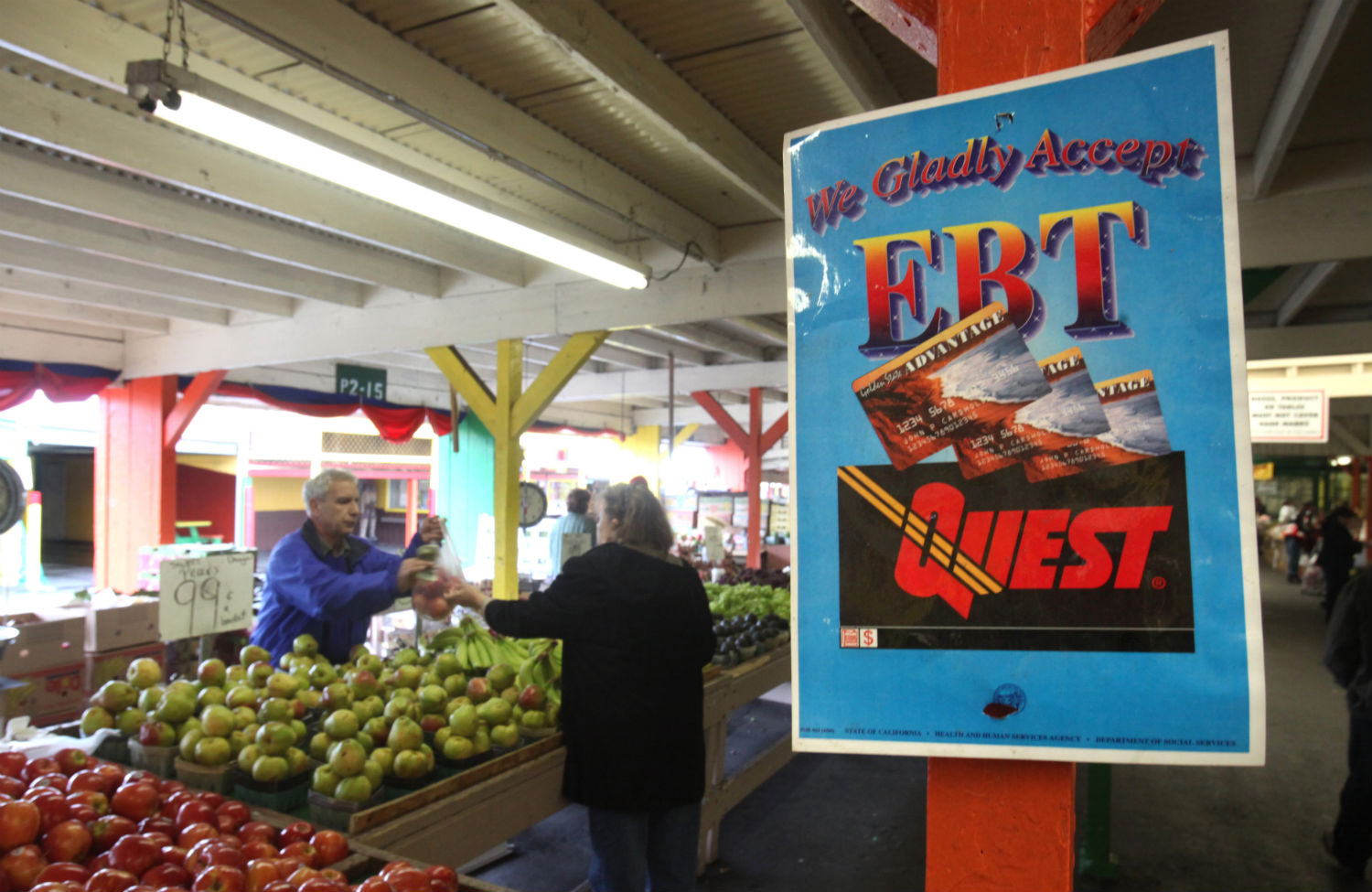
A sign announcing the acceptance of electronic Benefit Transfer cards at a farmers market in Roseville, California. (AP Photo/Rich Pedroncelli)
To follow the congressional debate about food stamp (SNAP) funding in the Farm Bill—and media coverage of that debate—you would think that the relevant issues are the deficit, rapists on food stamps, waste and abuse and defining our biblical obligation to the poor.
The only thing missing from that conversation is the state of hunger in America today and how we should respond to it.
“A good part of the food stamp debate in Congress and the media is not an evidence-based conversation, it’s fantasy-based,” says Jim Weill, president of the Food Research and Action Center (FRAC), a nonprofit organization working to improve public policies to eradicate hunger in the United States.
Weill insists that there is plenty that we know about food stamps that Congress and the media are busy ignoring, including from the government’s own data: a January 2013 Institute of Medicine (IOM)/National Research Council (NRC) report clearly described the inadequacy of SNAP benefits for most people struggling with hunger.
“The whole thrust of the report is that this is not a benefit allotment that’s adequate for people in most real world circumstances,” says Weill.
Since the average benefit for a SNAP recipient is just $4.50 per day, this conclusion shouldn’t come as much of a shock. But the authors—who comprised a blue-ribbon panel charged with conducting a scientific analysis of benefit levels—did a good job breaking down exactly why the benefit allotment might come up so short.
For starters, there is the “Thrifty Food Plan” (TFP) itself—a theoretical “market basket of food” that is supposed to represent “a nutritious diet at minimal cost.” The plan assumes that a consumer is able to mostly “purchase less expensive, unprocessed ingredients—such as vegetables and meat to make a stew.” It points out, however, that these ingredients require “substantial investment of the participants’ time to produce nutritious meals…inconsistent with the time available for most households at all income levels.”
Popular
"swipe left below to view more authors"Swipe →
But even if one did have time to shop and then slow-cook that family recipe for Granny’s Goodness Stew handed down through the generations—and not many low-wage workers or workers period do—the Thrifty Food Plan also assumes the availability of an assortment of “supermarkets and other food stores that offer a variety of healthy foods at a lower cost.” The authors note that “low-income and minority populations are more likely than other groups to experience limited access to supermarkets and other large retail outlets…that offer a broad range of healthy foods at reasonable cost.… In addition, a lack of transportation infrastructure commonly leads to limited food access in small towns and rural areas.”
There is also a bizarre assumption in the SNAP program that food prices are consistent across the nation—from Snohomish County, Washington, to Neodesha, Kansas, to New York City. Benefits are adjusted only for Hawaii and Alaska.
“SNAP participants who live in locales with higher food prices find it difficult to meet their needs with the current benefit,” reads the report. (I would argue that SNAP participants who live anywhere in America find it difficult to meet their needs with a benefit of $4.50 a day.)
This problem of an unrealistic measure of food prices is compounded by the fact that the inflation cost adjustment for food stamps has a lag time of sixteen months. As the report notes, “Because of the impact of inflation and other factors on food prices, this lag in the benefit adjustment can significantly reduce the purchasing power of SNAP allotments.”
Any one of these factors would be sufficient reason to revise upward the amount of assistance offered to hungry families, but there is more.
Even the way a family’s monthly net income is calculated is flawed. For families with earnings, Social Security or other income, there is a shelter deduction capped at $469 (unless there is an elderly or disabled member of the household). The report notes “considerable evidence that [SNAP] households face housing costs in excess of the current cap on the shelter deduction, which results in overestimation of the net income participants have available to purchase food.” Translated, SNAP families are paying more for housing—and have less income available for food—than the government is assuming; the SNAP benefit is lower for many families than it should be due to flawed assumptions about their net income.
In calculating net income there are also no deductions permitted for out-of-pocket medical costs for nonelderly, nondisabled SNAP participants.
“The fact that these out-of-pocket healthcare costs are not considered particularly concerns me as a pediatrician,” says Dr. Deborah Frank, founder and principal investigator of Children’s HealthWatch, a research organization analyzing the effects of economic conditions and public policy on young children seeking care in emergency rooms and clinics around the country. “Parents with children with special healthcare needs are less able to work many hours and have higher out-of-pocket healthcare related expenses. That means they are at particularly high risk of food, energy and housing insecurity, so there is a reciprocal relationship between children’s poor health and poor nutrition.”
Weill sees a willful ignorance at play “in some corners of Congress” when it comes to examining current benefit levels.
“It’s possible that the inadequacy of SNAP benefits might have better come to Congress’ attention if the House of Representatives—among its numerous hearings on the Farm Bill—had held a single hearing on the food stamp program, which it didn’t,” he says.
Also, for all of the GOP’s talk about designing welfare programs that move people towards self-sufficiency, it is completely ignoring (as are too many Democrats) new research showing that SNAP does exactly that.
University of California at Davis economist Hilary Hoynes and her colleagues looked at adults born between 1956 and 1981 “who grew up in disadvantaged families (their parents had less than a high school education)”, and the impact of access to food stamps early in life. The authors find that “access to food stamps in utero and in early childhood leads to significant reductions in metabolic syndrome conditions (obesity, high blood pressure, heart disease and diabetes) in adulthood and, for women, increases in economic self-sufficiency (increases in educational attainment, earnings, and income, and decreases in welfare participation).”
“The power of this study is that it goes all the way back to when the program was first being rolled out, county by county, and it looks all the way forward, to see how children’s decades-long trajectories changed as a result,” says Arloc Sherman, senior researcher, at the Center on Budget and Policy Priorities. “A baby girl fortunate enough to be born after food stamps had arrived in her particular county was doing significantly better, years later, in terms of health, education and all around self-sufficiency. Some in Congress may not realize it, but this program hasn’t been stifling long-term self-sufficiency, it’s been building it.”
And yet here we are, teetering on the edge of cutting $21 billion from a SNAP program that is assisting one in seven Americans; it’s a cut that would remove 2 million people from the program and cause more than 200,000 low-income children to lose access to school meals. Even the Democratic-led Senate is proposing a $4 billion cut, which the Congressional Budget Office estimates will result in 500,000 households losing $90 per month in SNAP benefits.
“More than two-thirds of SNAP benefits go to families with children,” says Frank. “This is trying to balance the budget with the bodies and brains of babies.”
“This farm bill is going to hurt poor people as one of the last sacrifices to the short-term deficit hysteria gods,” says Weill. “It reminds me of the famous line from John Kerry, ‘How do you ask a man to be the last man to die for a mistake?’ Well, not atypically, members of Congress are offering up poor people.”
You can let Congress know that current proposals to cut the SNAP program ignore all of the evidence—that we need to protect and strengthen the program. Participate in today’s National Call-In Day to Protect SNAP.
Workers at Guitar Center’s Manhattan location are unionizing. Read Allison Kilkenny’s report here.

