
Varick Street Varick Street
March 15, 1947 At night the factories struggle awake, wretched uneasy buildings veined with pipes attempt their work. Trying to breathe the elongated nostrils haired with spikes give off such stenches, too. And I shall sell you sell you sell you of course, my dear, and you’ll sell me. On certain floors certain wonders. Pale dirty light, some captured iceberg being prevented from melting. See the mechanical moons, sick, being made to wax and wane at somebody’s instigation. And I shall sell you sell you sell you of course, my dear, and you’ll sell me. Lights music of love work on. The presses print calendars I suppose, the moons make medicine or confectionary. Our bed shrinks from the soot and the hapless odors hold us close. And I shall sell you sell you sell you of course, my dear, and you’ll sell me. This article is part of The Nation’s 150th Anniversary Special Issue. Download a free PDF of the issue, with articles by James Baldwin, Barbara Ehrenreich, Toni Morrison, Howard Zinn and many more, here. Elizabeth Bishop (1911–1979), the poet laureate of the United States from 1949 to 1950, published two poems in The Nation between 1945 and 1947, when Randall Jarrell was interim literary editor. She was a longtime friend of the more frequent Nation contributor Marianne Moore, who in a 1946 review in these pages described Bishop as “spectacular in being unspectacular.”
Mar 23, 2015 / Books & the Arts / Elizabeth Bishop

Weird Bedfellows Weird Bedfellows
In their defense of “tradition” against the liberating potential of architecture, Prince Charles and Xi Jinping find unlikely common ground.
Mar 23, 2015 / Books & the Arts / Michael Sorkin

The Radical Future of Film The Radical Future of Film
A more convivial, expansive and life-affirming future is with us now—and the movies can help take us there.
Mar 23, 2015 / Books & the Arts / Stuart Klawans
Now and Forever Now and Forever
April 25, 1994 I’ll settle for Immortality— Not thru the body Not thru the eyes Star spangled high mountains waning moon over Aspen peaks; But thru words, thru the breath of long sentences loves I have, heart beating still, inspiration continuous, exhalation of cadenced affection These immortal survive America, survive the fall of States Departure of my body, mouth dumb dust This verse broadcasts desire, accomplishment of Desire Now and forever boys can read girls ream, old men cry Old women sigh youth still come. 7/19/92, Aspen This article is part of The Nation’s 150th Anniversary Special Issue. Download a free PDF of the issue, with articles by James Baldwin, Barbara Ehrenreich, Toni Morrison, Howard Zinn and many more, here. Allen Ginsberg (1926–1997) published three poems in The Nation in the 1990s. A 1959 letter to the editor he co-wrote is reprinted in this issue.
Mar 23, 2015 / Books & the Arts / Allen Ginsberg
Home Song Home Song
March 24, 1926 Oh breezes blowing on the red hill-top By tall fox-tails, Where through dry twigs and leaves and grasses hop The dull-brown quails! Is there no magic floating in the air To bring to me A breath of you, when I am homesick here Across the sea? Oh black boys holding on the cricket ground A penny race! What other black boy frisking round and round, Plays in my place? When picnic days come with their yearly thrills In warm December, The boy in me romps with you in the hills— Remember! Paris, 1925 This article is part of The Nation’s 150th Anniversary Special Issue. Download a free PDF of the issue, with articles by James Baldwin, Barbara Ehrenreich, Toni Morrison, Howard Zinn and many more, here. Claude McKay (1889–1948), author of the novels Home to Harlem (1928) and Banjo (1929), only published this one poem in The Nation, but he also wrote three essays in the mid-1930s on race relations in New York City—including a firsthand report on the 1935 Harlem riot—and one travel dispatch from North Africa.
Mar 23, 2015 / Books & the Arts / Claude McKay
Tight Rope Tight Rope
July 13, 1963 We live in fragments like speech. Like the fits of wind, shivering against the window. Pieces of meaning, pierced and strung together. The bright bead of the poem, the bright bead of your woman’s laughter. This article is part of The Nation’s 150th Anniversary Special Issue. Download a free PDF of the issue, with articles by James Baldwin, Barbara Ehrenreich, Toni Morrison, Howard Zinn and many more, here. The Nation was one of the first major publications to print LeRoi Jones’s work, including his 1964 essay on the fight between Cassius Clay and Sonny Liston. Jones (1934–2014) later changed his name to Amiri Baraka.
Mar 23, 2015 / Books & the Arts / LeRoi Jones
Parting Parting
December 7, 1963 White morning flows into the mirror. Her eye, still old with sleep, meets itself like a sister. How they slept last night, the dream that caged them back to back, was nothing new. Last words, tears, most often come wrapped as the everyday familiar failure. Now, pulling the comb slowly through her loosened hair, she tries to find the parting; it must come out after all: hidden in all that tangle there is a way. This article is part of The Nation’s 150th Anniversary Special Issue. Download a free PDF of the issue, with articles by James Baldwin, Barbara Ehrenreich, Toni Morrison, Howard Zinn and many more, here. Over a half-century, Adrienne Rich (1929–2012) wrote twenty-two poems for The Nation and several reviews and essays, including a 2002 piece exploring the meaning of “antiwar.”
Mar 23, 2015 / Books & the Arts / Adrienne Rich
The Starry Night The Starry Night
September 2, 1961 “That does not keep me from having a terrible need of—shall I say the word—religion. Then I go out at night to paint the stars.” —Vincent Van Gogh, in a letter to his brother The town does not exist except where one black haired tree slips up like a drowned woman into the hot sky. The town is silent. The night boils with eleven stars. Oh starry starry night! This is how I want to die. It moves. They are all alive. Even the moon bulges in its orange irons to push children, like a god, from its eye. The old unseen serpent swallows up the stars. Oh starry starry night! This is how I want to die: into the rushing beast of the night, sucked up by that great dragon, to split from my life with no flag, no belly, no cry. This article is part of The Nation’s 150th Anniversary Special Issue. Download a free PDF of the issue, with articles by James Baldwin, Barbara Ehrenreich, Toni Morrison, Howard Zinn and many more, here. Anne Sexton (1928–1974) won the Pulitzer Prize for poetry in 1967 for Live or Die.
Mar 23, 2015 / Books & the Arts / Anne Sexton

Why the New Film About the Gang Rape and Murder of Jyoti Singh Is Required Viewing Why the New Film About the Gang Rape and Murder of Jyoti Singh Is Required Viewing
The documentary has been banned in India—which makes watching it only more urgent.
Mar 20, 2015 / Books & the Arts / Nitasha Kaul
Silence and Slow Time Silence and Slow Time
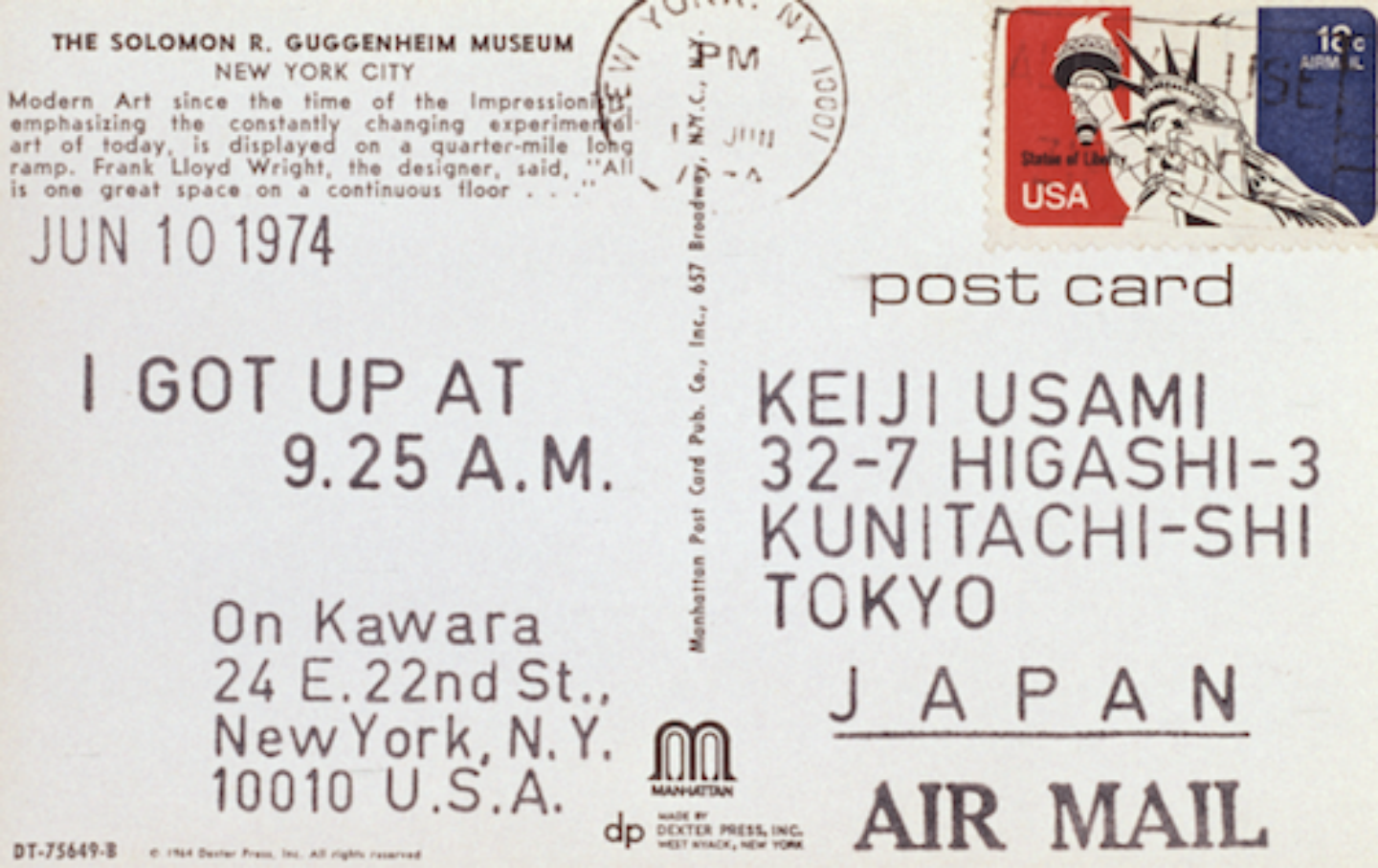
The art of On Kawara.
Mar 20, 2015 / Books & the Arts / Barry Schwabsky