
Behind Closed Doors, Ukraine Anxiously Watched the US Election Unfold
Ukrainian officials maintain an optimistic, bipartisan approach to the US, but in private, many Ukrainians are pessimistic about an increasingly bleak war and the US role in it.
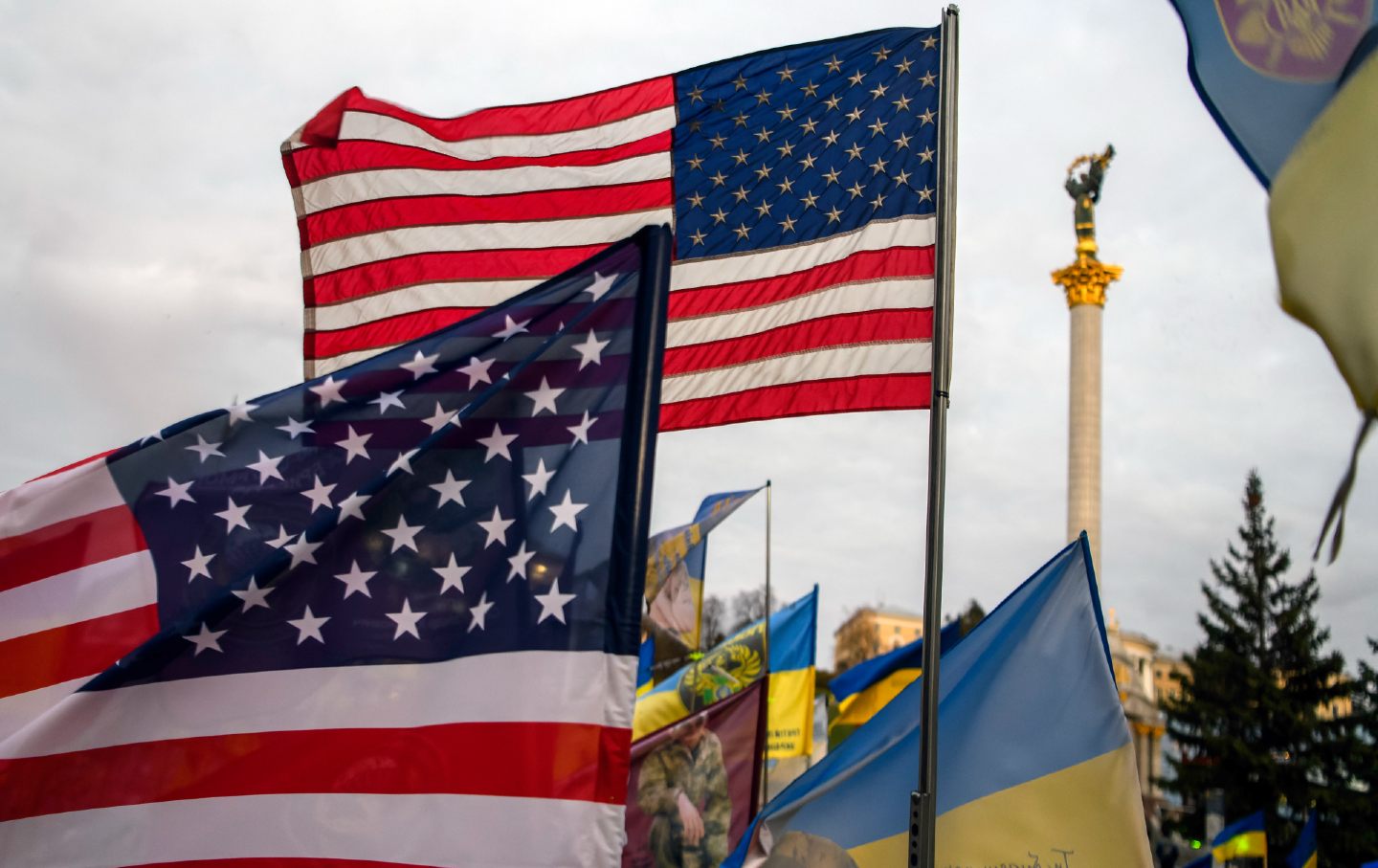
(Maxym Marusenko / NurPhoto via Getty Images)
In Lviv and Kyiv, the US election came with little fanfare. The bars didn’t show election coverage, and news outlets focused on the daily grind of war. But despite limited public celebration, behind closed doors, everyone was watching.
There are many reasons for Ukrainians to be nervous about how a Trump presidency might affect their war against Russia. There’s Trump’s friendliness with Russian President Vladimir Putin, his withholding military aid to Ukrainian President Volodymyr Zelensky in exchange for political favors, and his general isolationist agenda and criticism of defense alliances like NATO. There’s also Trump’s vice-presidential pick, JD Vance, who has been vocal and active against sending aid to Ukraine. Vance led the Republican coalition in Congress to block aid packages to Ukraine in April and has said on numerous occasions that a peace plan would involve Ukraine’s ceding its lost territory and giving up on its intention to join NATO, which is the plan that Putin also has suggested. Harris, meanwhile, promised to continue giving substantial aid to Ukraine.
Trump has repeatedly sidestepped questions regarding his response to the war in Ukraine, other than to say that he would “end the war in a day”—which would likely mean pressuring Ukraine into accepting the loss of its territory and abandoning its desire to join NATO. Still, many in Ukraine have been disappointed that the $106 billion the US has spent on aid to Ukraine has not been enough to fundamentally change the war. Many Ukrainians feel that the Democrats are hindering the overall war effort. This sentiment is fueled by President Joe Biden’s discouragement of air strikes deep into Russian territory and his refusal to close Ukrainian airspace with NATO’s assistance, due to concerns about escalation.
In the morning before the election, an editorial from The Kyiv Independent implored American voters to consider Ukrainians as they went to the polls, but did not say which of the two candidates would most benefit Ukrainians. One Ukrainian friend explained that election-night watching, even for Ukrainian politicians, is not part of the culture, because politics has been corrupt or under a single-party system for decades.
The media centers that at the beginning of the war were gathering spots for foreign and Ukrainian journalists have withered or disappeared as foreign journalists have stopped coming to Ukraine. But there are still cultural outposts for American cultural interests, like America House in central Lviv. On the second floor of a historic building, there were no events directly related to the election, but it was hosting an English-speaking club that evening.
At around 6 pm—or 11 am EST—still many hours before polls would close, Glenn Anderson arrived wearing a Harris-Walz 2024 shirt. A former high school history teacher in Orlando, Florida, Anderson moved to Ukraine some eight years ago when he joined the Peace Corps and then was offered a job at Lviv Polytechnic University.
His students began to file in to the “oval office,” a curved room with windows overlooking Lviv’s streets, as the election talk began. When discussion turned to Harris’s being the only hopeful option for Ukraine’s future, Inesa Horaschak, from nearby Ivano Frankivsk, who commuted to the class via a ride-sharing service, said, “I read that if Trump wins, he will end the war quickly, and maybe that is good.”
“No, we can’t think that way,” Anderson said. “Ending the war will only mean capitulation.”
Olgha Ivaschuk, a journalist living in Lviv but originally from the currently Russian-occupied Donbass, interjected, “So many soldiers have been lost. I do not believe Ukraine will win. Not the way we want.”
Much of the official messaging since the war began has been that Ukraine must—no, will—regain its territory, including Crimea. On my last reporting trip to Kyiv, almost exactly a year ago, government radio programs were discussing the imminent seizure of Crimea, claiming that Crimea would be taken within the next few weeks. That never happened and, by any reasonable measure, was never close to happening, but it nevertheless dominated official programming. Now. close to three years on, reports of war fatigue have plagued the Ukrainian government. The military is struggling to find new conscripts, and a counteroffensive fizzled out earlier this year.
As the pessimism grew in the room, Anderson asked, “Am I the only one at this table that believes in Ukrainian victory?”
Anastasiia Kuchma, from Lviv, said that Ukrainians are interested in the US election for how it will determine aid to Ukraine. She hoped that Harris would win, but explained that Ukrainians are frustrated by the Democratic Party. Under Barack Obama, Crimea was annexed; under Biden, the invasion began and has not ceased. “But we also know that Trump is not dependable,” she said. “He can say one thing and do another or do one thing and say another.”
A young man who gave his name as Ivan explained that people have been talking about the election, though they weren’t expecting to care this much when the war began. “In this country, we have no politics because of the war,” he said. “At the beginning of the war, we had the thought that the US election was in three years, so we were pretty confident that the war would end by now, and I feel quite sad that we are still in this difficult situation.”
Some think the way to Trump’s heart is a classic pro-American pitch that pits Ukraine as a defense against the United States’ classic enemies. The morning the results came in, officials were already eager to display admiration for Trump—who is known to be easily persuaded by flattery. On the popular Ukrainian morning show Snidanok, former foreign affairs minister Dmytro Kuleba listed five positive lessons from Trump’s win, which included a message that Europe will now need to be more responsible for its own defense, and that this will open new pathways of cooperation for Ukraine across the EU.
This bipartisan approach has meant that some Ukrainian officials have been courting the Republicans since long before the 2024 election. From his offices near the parliament, Maryan Zablotskyy sent messages to US colleagues to push forward with a plan to build a Ronald Reagan statue. He says he wants it to be made from the melted metal of a destroyed Russian tank that attacked Kyiv. Zablotskyy, a member of the US-Ukraine working parliamentary group, has in his office a framed photograph of Reagan, and next to it a photo depicting Félix Rodriguez holding a withered Che Guevara captive, just an hour before Rodriguez assassinated him. The photograph was gifted to Zablotskyy by Rodriguez himself.
Popular
“swipe left below to view more authors”Swipe →Zabloskyy talks about the conflict in the language of the Cold War. “It is a fact that we are not just fighting against Russia but also North Korea and Iran, and they are enemies of the United States” he said. “If you’re just being pro-American and you want to establish a balance of powers, you cannot allow this axis of evil to win in Ukraine.” He saw no difference between Harris and Trump “in terms of Ukraine policy” in the lead-up to the election.
“There may have been more pro-Ukrainian comments from Democrats, but less pro-Ukrainian actions,” Zabloskyy said. “And there have been maybe not so loving comments from Republicans, but much more affirmative actions.” He cited Trump’s sanctions against the Nord Stream 2 pipeline, without mentioning that the said pipeline was ushered into existence by Trump’s own first secretary of state, Rex Tillerson, in 2017, despite warnings from the previous Obama administration. He also cited that President Biden repealed the sanctions, also without mentioning that Trump had placed sanctions only after the project reached 90 percent completion during his presidency, which angered US allies in Europe and which sanctions Biden rolled back to rebuild the European relations that Trump had damaged.
But when it came to the idea of Trump pressuring Ukraine to meet Russia’s demands in a hypothetical peace deal, Zablotskyy was adamant. “When Russians say peace, they mean capitulation,” he said. “We are not going to accept that under any circumstances.”
Overall, Ukrainians are mostly eager to communicate that they are reluctant to give in to despair. They are deeply invested in the US election, but not for one candidate over another—at least not publicly.
For Mariia Didkovska, a student at the National University in Kyiv and the project coordinator for the Institute of American Studies, an NGO and think tank founded in April 2023, the message is that Ukraine must be ready to explore all avenues possible to continue this increasingly bleak war. There is little room for hopelessness.
“We need a two-party approach, that things are not black and white,” she said. To explain this relentless optimism, she explained that on Sunday a rocket launched by Russia blew out the windows of her department, the Institute of International Relations and Journalism. She and other students came to help clean the glass. “Our faculty has told us to be positive, and that we will continue our studies. Because they know that we will need educated people, no matter what happens here,” she said.
“To be optimistic is our only way to survive.”
Support independent journalism that does not fall in line
Even before February 28, the reasons for Donald Trump’s imploding approval rating were abundantly clear: untrammeled corruption and personal enrichment to the tune of billions of dollars during an affordability crisis, a foreign policy guided only by his own derelict sense of morality, and the deployment of a murderous campaign of occupation, detention, and deportation on American streets.
Now an undeclared, unauthorized, unpopular, and unconstitutional war of aggression against Iran has spread like wildfire through the region and into Europe. A new “forever war”—with an ever-increasing likelihood of American troops on the ground—may very well be upon us.
As we’ve seen over and over, this administration uses lies, misdirection, and attempts to flood the zone to justify its abuses of power at home and abroad. Just as Trump, Marco Rubio, and Pete Hegseth offer erratic and contradictory rationales for the attacks on Iran, the administration is also spreading the lie that the upcoming midterm elections are under threat from noncitizens on voter rolls. When these lies go unchecked, they become the basis for further authoritarian encroachment and war.
In these dark times, independent journalism is uniquely able to uncover the falsehoods that threaten our republic—and civilians around the world—and shine a bright light on the truth.
The Nation’s experienced team of writers, editors, and fact-checkers understands the scale of what we’re up against and the urgency with which we have to act. That’s why we’re publishing critical reporting and analysis of the war on Iran, ICE violence at home, new forms of voter suppression emerging in the courts, and much more.
But this journalism is possible only with your support.
This March, The Nation needs to raise $50,000 to ensure that we have the resources for reporting and analysis that sets the record straight and empowers people of conscience to organize. Will you donate today?
More from The Nation
Trump and His Soulless Cronies Have Managed to Suck the Joy Out of the World Cup Trump and His Soulless Cronies Have Managed to Suck the Joy Out of the World Cup
Not even soccer is immune from Trump’s reverse Midas touch.
Garbage In, Carnage Out Garbage In, Carnage Out
The harrowing lessons of the Pentagon’s recently dissolved partnership with Anthropic.
The Iran War Could Be Catastrophic for the US-Israel Alliance. Good. The Iran War Could Be Catastrophic for the US-Israel Alliance. Good.
As Israel’s role in pushing the war with Iran comes into ever sharper focus, it’s up to us to turn outrage into change.
An Unlawful War An Unlawful War
The precedent being set by the US in launching this war of aggression against Iran will long live in infamy.
Trump and Netanyahu Want to Turn Iran Into a Failed State Trump and Netanyahu Want to Turn Iran Into a Failed State
This war looks designed to cause maximum chaos and instability. The world will pay a high price.

The War on Terror Paved the Way for Trump’s Rise—Now He’s Making It His Own The War on Terror Paved the Way for Trump’s Rise—Now He’s Making It His Own
Only the total abolition of the DHS can restore freedom.

