The Claim That Russia Doesn’t Possess Any Solid Red Lines—or Won’t Enforce Them—Isn’t Supported by Evidence
Any policy debate on war must reckon with escalatory dynamics.
From the moment the war in Ukraine began, the Biden administration has attempted to accomplish what would seem to be two contradictory objectives: support Kyiv’s defenses against Russia’s unjustified invasion and minimize the prospects of a direct NATO-Russia conflict that could conceivably rise to the nuclear level.
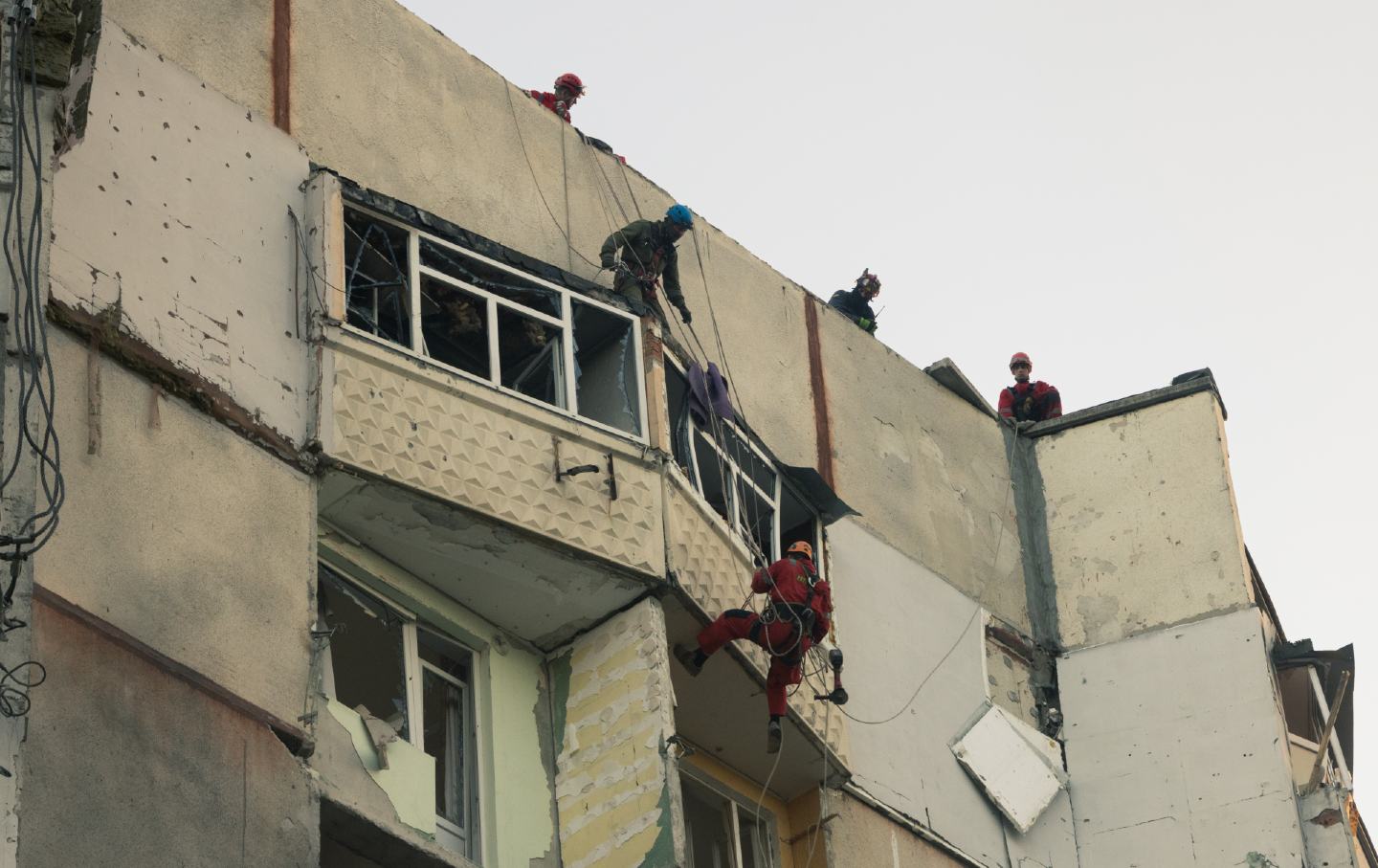
Washington has accomplished the feat—so far. Although the Russians continue their advance in the Donbas, at a high cost to their own personnel—UK Defense Minister John Healey claimed this month that around 1,100 Russian troops were being killed every day—the Ukrainians haven’t folded and are using Western-supplied equipment, from tanks and F-16 aircraft to the Army Tactical Missile System, to strike Russian positions in occupied Ukraine and within Russia’s own borders. Russian President Vladimir Putin’s nuclear saber-rattling, which he started at the very beginning of the conflict, has been just that: saber-rattling. While so many perceived Russian red lines have been crossed the last two and half years, some Western foreign policy commentators, as well as Ukrainian President Volodymyr Zelensky, have concluded that Washington and its allies can do pretty much anything without having to worry about escalation.
Yet, as President Biden deliberates on allowing Ukraine to use Western missiles to strike military targets deep in Russian territory, US officials must weigh the first-, second-, and third-order consequences of any decisions they make. Assuming that escalation risks don’t exist is irresponsible and potentially dangerous.
To be clear: The notion propagated by some that Russia is merely taking it on the chin and not escalating is inaccurate. Although nobody can ascertain Putin’s decision-making calculus with total accuracy, it’s certainly safe to say that when the Russian army’s back is against the wall, Putin responds by redoubling his commitment to the war effort—not by cowering from his maximalist position and suing for peace.
In September 2022, when the Ukrainian counteroffensive in the Kharkiv region was routing the Russian army, Putin ordered a partial mobilization of 300,000 men to buttress the ranks, stabilize the front lines in the east, and prepare defenses for what would turn out to be a larger-scale Ukrainian counteroffensive nine months later. In October 2022, a month after Kyiv’s triumph in Kharkiv, the Russians began relentlessly targeting Ukraine’s energy infrastructure, using ballistic and cruise missiles, loitering munitions and drones to spread terror within the Ukrainian population and freeze the country into submission as winter approached. That Russia would escalate to the nuclear level was even a possibility, albeit a low one, with CIA Director William Burns telling a conference this month that ”there was a genuine risk of…the potential use of tactical nuclear weapons” in the fall of 2022. Those discussions weren’t random; they took place at a time when the Russian army’s defenses were crumbling and Moscow’s entire war effort was at considerable risk of defeat.
The same trend holds true today. For instance, it’s no coincidence that, weeks after the Ukrainian army launched an incursion across the border into Russia’s Kursk region—catching Russian intelligence by surprise and embarrassing the Russian military yet again—Moscow redoubled its aerial campaign against Ukrainian cities and towns to an extent that hadn’t been seen in the months prior. While Putin played down the Kursk incursion as a minor nuisance and even cut off one of his advisers who started to discuss it during a cabinet meeting, Russia’s actions illustrate just how alarmed the Russian strongman was about the situation. As the Ukrainians sought to expand their control in Kursk, Russian missiles targeted at least 15 regions in Ukraine on August 26, including Kyiv, in what Ukraine’s air force commander, Mykola Oleshchuk, called the “most massive air attack” to date. The next day, Russia sent another large barrage of drones and missiles, killing five people in the process. August 29 was no different, and Russia is no closer to settling on Kyiv’s terms today as it was when the war first began.
Russia has also escalated beyond the immediate battlefield to register disapproval of US policy. Horizontal escalation, in which a combatant expands the geographical scope of the conflict, is now part of the Russian playbook.
On the surface, this assertion may seem odd. The Russians, after all, aren’t bombing US positions in Iraq and Syria or assassinating Western leaders. But Moscow is making US diplomatic initiatives more difficult and undermining US priorities in other parts of the world. Russia, for example, is leveraging its veto power at the UN Security Council—often in conjunction with China, another great power whose opposition to US policy is well-known—to stymie the body and render it largely ineffectual on some of the world’s pressing security issues. In July 2023, Russia vetoed a resolution that would have extended humanitarian operations in northwest Syria by nine months. A month later, Russia vetoed another resolution that would have maintained the UN sanctions regime in Mali. In March, Moscow killed off the Panel of Experts monitoring sanctions on North Korea, which Washington hoped to preserve. While Russia’s obstructionism on the North Korea file can’t be explained entirely through the lens of the war in Ukraine, Washington’s policy on the war certainly hasn’t persuaded Moscow to be helpful on the matter.
Russia has gone beyond diplomatic measures, as well. The US intelligence community has noticed a significant uptick in Russian-backed sabotage operations in Europe, partly to penalize NATO member states for shipping weapons to Kyiv. This month, US Secretary of State Antony Blinken asserted that Moscow was supporting Iran’s nuclear program in exchange for Tehran’s shipment of short-range ballistic missiles to the Russian army—a notable change in Russian policy given its past support for constraining Iran’s nuclear activities. In addition, Russia debated sending weapons to the Houthis in Yemen in what US officials assessed was retaliation for Washington’s decision in the spring to allow Ukraine to use US-supplied HIMARS missiles to hit Russian territory along the border.
For the Kremlin, these moves have clear motives: to demonstrate to Washington and its allies that their policy decisions on Ukraine will have consequences and to seek to deter Ukraine’s primary external backers, the United States and Europe, from authorizing Kyiv’s use of Western-supplied weapons inside Russia.
Whether or not Russia is successful, the central point shouldn’t get overlooked: The conventional claim that Moscow doesn’t possess any solid red lines or won’t enforce them isn’t supported by the evidence. Any policy debate on the war must account for escalatory dynamics, however constraining that may be. Pundits on the sidelines can hope for the best and fancifully assume that Russia is powerless to respond to counterattacks; policymakers with actual responsibility on their shoulders don’t have that luxury.
Support independent journalism that does not fall in line
Even before February 28, the reasons for Donald Trump’s imploding approval rating were abundantly clear: untrammeled corruption and personal enrichment to the tune of billions of dollars during an affordability crisis, a foreign policy guided only by his own derelict sense of morality, and the deployment of a murderous campaign of occupation, detention, and deportation on American streets.
Now an undeclared, unauthorized, unpopular, and unconstitutional war of aggression against Iran has spread like wildfire through the region and into Europe. A new “forever war”—with an ever-increasing likelihood of American troops on the ground—may very well be upon us.
As we’ve seen over and over, this administration uses lies, misdirection, and attempts to flood the zone to justify its abuses of power at home and abroad. Just as Trump, Marco Rubio, and Pete Hegseth offer erratic and contradictory rationales for the attacks on Iran, the administration is also spreading the lie that the upcoming midterm elections are under threat from noncitizens on voter rolls. When these lies go unchecked, they become the basis for further authoritarian encroachment and war.
In these dark times, independent journalism is uniquely able to uncover the falsehoods that threaten our republic—and civilians around the world—and shine a bright light on the truth.
The Nation’s experienced team of writers, editors, and fact-checkers understands the scale of what we’re up against and the urgency with which we have to act. That’s why we’re publishing critical reporting and analysis of the war on Iran, ICE violence at home, new forms of voter suppression emerging in the courts, and much more.
But this journalism is possible only with your support.
This March, The Nation needs to raise $50,000 to ensure that we have the resources for reporting and analysis that sets the record straight and empowers people of conscience to organize. Will you donate today?