
A Peace Prize for Trump the Militarist?
While he has been more reluctant than some presidents to put US troops in harm’s way, Trump has dismissed checks on his use of military force, saying, “We’re just gonna kill people.”
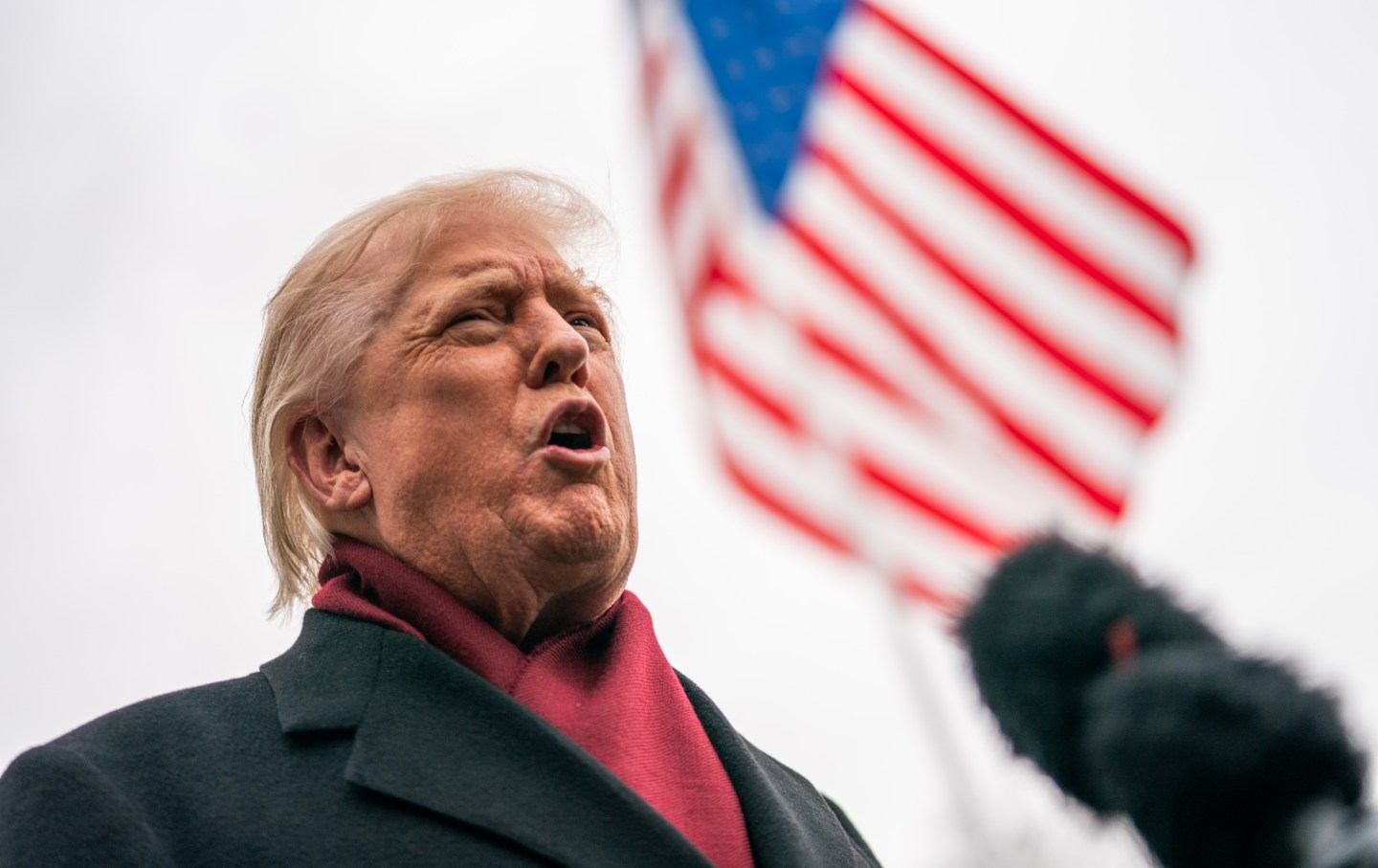
As US forces continue to engage in illegal attacks on boats in the Caribbean and with the growing threat of direct US military intervention in Venezuela, you might be wondering, “What happened to Trump’s promises to avoid foreign military entanglements?”
In reality, Trump was never the anti-interventionist he claimed to be.
When running for president in 2016, Trump gained support from swing voters, possibly in sufficient numbers to win the Electoral College, by claiming he had opposed the disastrous 2003 invasion of Iraq and 2011 intervention in Libya backed by his opponent, portraying Hillary Clinton as a reckless militarist who would pursue “forever wars.”
Trump actually supported both military operations.
While Trump has been more reluctant than some politicians to place American troops in harm’s way, he has been very much a militarist president. He has supported dramatic increases in the already bloated Pentagon budget. He has shown little interest in real diplomacy of any kind, instead using threats and bluster and dismissing human rights and international law in favor of a purely transactional approach to foreign relations.
He has appointed Marco Rubio, one of the most hawkish members of the US Senate, as both secretary of state and national security adviser, the only person other than Henry Kissinger to hold both roles simultaneously.
In the first 10 months of his second term, Trump has ordered hundreds of air strikes on countries in the greater Middle East, surpassing the number during Biden’s entire presidency or during his entire first term. The majority of these have taken place in Houthi-controlled areas of Yemen, resulting in over 200 civilian deaths. In Somalia, where a small number of US combat forces remain, he has doubled the rate of air strikes against Al-Shabaab, also resulting in increasing civilian casualties.
Trump’s preference for war over diplomacy is most clearly illustrated in regard to Iran. The Fordo, Natanz, and Isfahan nuclear facilities had had their operations severely restricted and under close surveillance because of the 2015 Joint Comprehensive Plan of Action, commonly known as the Iran Nuclear Deal, eliminating any means to produce a nuclear weapon. However, Trump broke off the agreement and reimposed draconian sanctions, thereby leading Iran to resume its full-scale operation. In June, citing the supposed threat from these three facilities, he ordered them bombed, the first direct strikes by the United States against that country since the Tanker War of the 1980s.
In Iraq and Syria, Trump has continued to deploy several thousand combat troops and has repeatedly bombed suspected ISIS positions as well as Iranian-allied Shia militia, both of which emerged as a direct result of the US invasion, occupation, and counterinsurgency war in Iraq.
Given the failure of the Democratic leadership to act more decisively in challenging Trump’s abuses of power domestically, it may be too much to expect that they would do so regarding foreign policy, particularly in light of the long-standing deferential treatments presidents of both parties have received regarding military intervention. Indeed, Trump during his first term—as well as Bush, Obama, and Biden—all got away with bombing multiple countries without congressional approval. This has empowered Trump to dismiss any checks on his use of military force, saying, “We’re just gonna kill people.”
These presidents defended their war making in the Middle East on the grounds that Congress had authorized the use of force in 2001 and 2002. However, the resolution in the immediate aftermath of 9/11 was regarding against those who “planned, authorized, committed, or aided the terrorist attacks that occurred on September 11, 2001, or harbored such organizations or persons,” and the authorization the following year specifically targeted the Iraqi regime of Saddam Hussein. Subsequent military interventions have therefore been in violation of the 1973 War Powers Resolution and indeed the Constitution itself, but—with some notable exceptions—congressional leaders of both parties have done little to hold the executive branch accountable.
By far the biggest outcry from Congress regarding Trump’s war making was over a missile attack in March in the Yemeni capital of Sanaa targeting an alleged Houthi official in charge of the country’s missile program. However, the outcry was because a reporter was accidentally included in a Signal chat group between US security officials about the attack, not because it involved destruction of an entire apartment building with civilians inside, or that the air strike, like the others on that country, were not authorized by Congress.
Since these US air strikes for the most part do not endanger US forces and have been limited in scope, they have rarely made much news outside the targeted countries. Such war making should be subjected to vigorous debate, however, since the United States has been bombing countries in the greater Middle East for most of the past 35 years and has done little to bring security to the region—if anything, it has created a backlash that has encouraged extremist elements.
Perhaps more seriously, it has gravely undermined the separation of powers enshrined in the Constitution, thereby reinforcing an imperial presidency. If Trump can get away with running roughshod over constitutional limitations and US law overseas, it will only embolden him to do the same here in the United States.
Popular
“swipe left below to view more authors”Swipe →Become a Sustaining Donor This September
Between the reemergence of right-wing red-baiting and Donald Trump’s use of the chilling National Security Presidential Memorandum–7 to criminalize left political organizing, we’re seeing McCarthyism reborn before our eyes.
This assault on democracy cannot be ignored or wished away. Resisting it requires bravery in the face of threats and repression, a steadfast commitment to the truth, and the unwavering belief that we can—and will—overcome this darkness.
We must have an independent media that sets the record straight, unearths corruption and abuses of power, and advances a politics of justice and dignity for all if we’re to win this fight.
That’s why I’m writing to you today. This September, The Nation needs to add 100 monthly donors to sustain our progressive journalism. Your contribution makes the next investigative report, the next truth-speaking column, and the next pathbreaking essay all possible.
I hope you’ll support our work with a recurring donation today. If you donate $10 or more a month, we’ll send you a brand new “Hands Off the Free Press!” sticker to recognise your commitment to our cause. Please, donate today.
Onward,
Katrina vanden Heuvel
Editor and Publisher, The Nation
More from The Nation
Israel’s Election Can’t Fix What Netanyahu Broke Israel’s Election Can’t Fix What Netanyahu Broke
The fundamental problem is not the name of the prime minister, but rather the actions of the Israeli government and the urgent issues that need to be addressed.

The AfD’s Rise Isn’t Just About East Germany The AfD’s Rise Isn’t Just About East Germany
The Alternative für Deutschland has a stable national poll lead, including in the former West Germany. Its rise owes to much more than Eastern grievances.
Chinese Development Is the Betrayal Washington Cannot Forgive Chinese Development Is the Betrayal Washington Cannot Forgive
The prospects for Xi Jinping’s visit are dim because American leaders are blaming China for the failures of globalization.

Pinochet: The Verdict of History in the Letelier-Moffitt Case Pinochet: The Verdict of History in the Letelier-Moffitt Case
An act of international terrorism on the streets of Washington, DC, still reverberates 50 years later.
How to Arrest Benjamin Netanyahu How to Arrest Benjamin Netanyahu
Make no mistake: The United States can seize Netanyahu for crimes under US law and prosecute him in US courts when he is in New York City this week.
In the Age of AI, Nuclear Weapons Abolition Is a Renewed Imperative In the Age of AI, Nuclear Weapons Abolition Is a Renewed Imperative
As long as we have nuclear weapons, the job of ending humanity will continue to be as easy as the push of a button—or an AI agent hacking into a nuclear command-and-control system...

