
Trump’s 51st-State Plan Would Be a Literal Death Sentence for Canadians
Canadians have a universal healthcare system and significantly longer life expectancy than Americans.
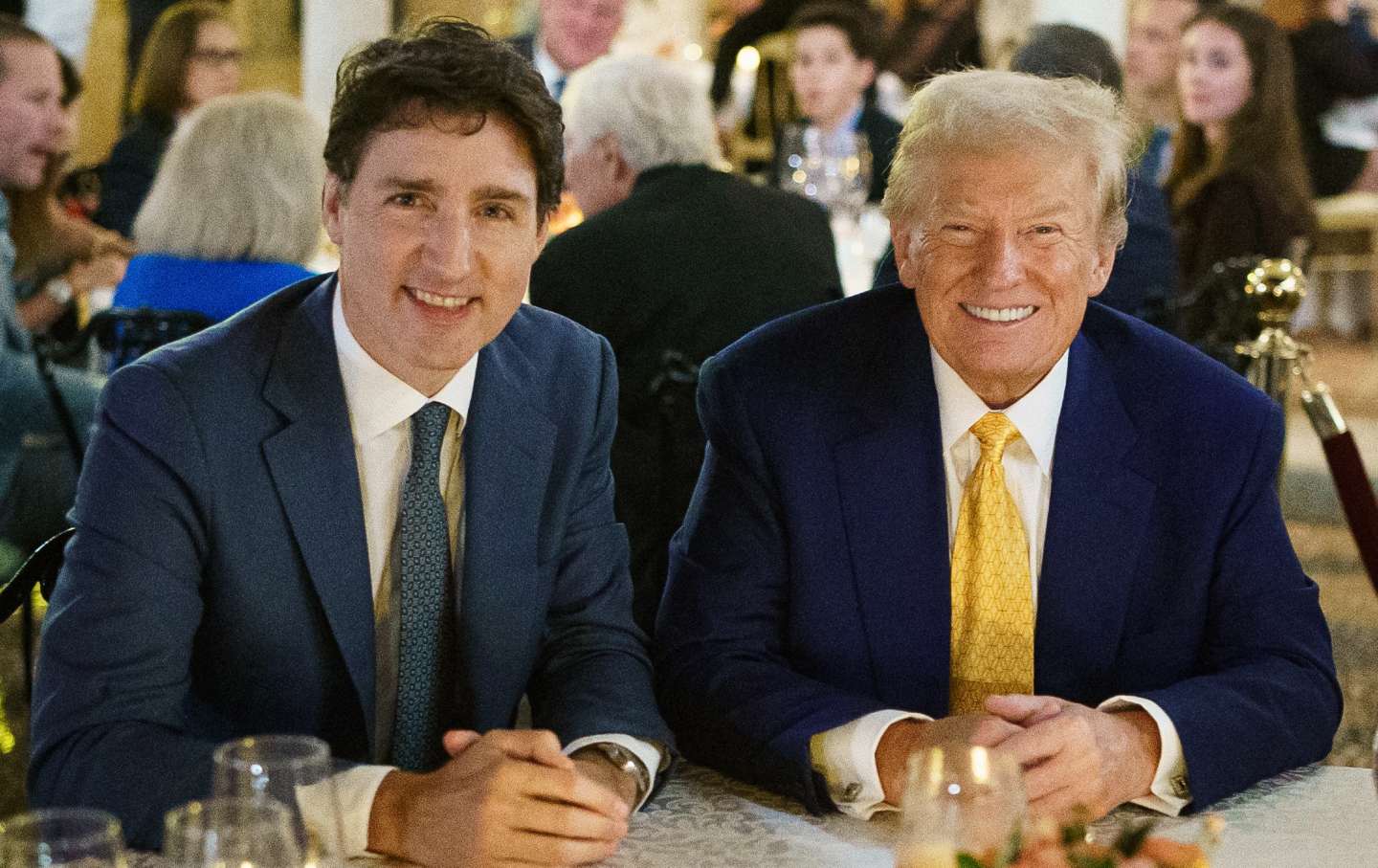
Justin Trudeau and Donald Trump at Mar-a-Lago on November 29, 2024.
(Justin Trudeau / X)Donald Trump thinks Canadians should become Americans. For weeks, he has called for Canada to become the 51st American state—one that would stretch from the Atlantic to the Pacific and as far north as the Arctic.
Trump seems serious about this idea. But Canadians are equally serious about rejecting it.
“The Angus Reid poll conducted a survey of both Canadians and Americans. For one question, Canadians were asked how they would vote in a referendum on whether Canada should become part of the U.S.,” the Canadian Broadcasting Corporation explained after Trump proposed the idea in January. “That survey found just a small minority, one out of 10 Canadians surveyed, would support the idea of Canada joining the U.S., but that the vast majority, 90 per cent, were opposed.”
“Canada Hates Trump!” social media spaces are also proliferating at a dramatic rate.
But Trump does not take “no” for an answer. In his Super Bowl Sunday interview with Fox News’s Bret Baier, the president was asked if his assertion that Canada should become the 51st state was “a real thing”— as Canadian Prime Minister Justin Trudeau warned after talking with the president. Trump said, “Yeah, it is.” And he did not stop there, saying, “I think Canada would be much better off being the 51st state.”
Then, Trump took his fantasy to even more ludicrous heights. He claimed that, as citizens of the US, “Canadian citizens would…have much better medical [care].”
Seriously?
Unlike the United States, where our for-profit healthcare system regularly fails to provide quality care for all Americans, Canada has a publicly funded healthcare system that provides “universal coverage for medically necessary healthcare services provided on the basis of need, rather than the ability to pay.”
According to an assessment of scholarly research on the healthcare systems in the US and Canada, which was produced by the group Physicians for a National Health Care Program, “The Canadian single payer healthcare system produces better health outcomes, with substantially lower administrative costs than the United States.”
At the heart of the Canadian system is its guarantee of universal coverage. That contrasts dramatically with the United States where, according to a 2024 study of “The State of Health Insurance Coverage in the U.S.” by the Commonwealth Fund, “Nine percent of adults were uninsured, 12 percent had a gap in coverage over the past year, and 23 percent were underinsured, meaning they had coverage for a full year that didn’t provide them with affordable access to health care.” And that’s even with the expansion of coverage under the Affordable Care Act.
The lack of affordable access to care in the United States has profound consequences that would undoubtedly shock Canadians.
For instance, according to the Commonwealth Fund, in the United States:
Nearly three of five (57%) underinsured adults said they avoided getting needed health care because of its cost; 44 percent said they had medical or dental debt they were paying off over time.
Delaying care has health consequences: two of five (41%) working-age adults who reported a cost-related delay in their care said a health problem had worsened because of it.
Nearly half of adults (48%) with medical debt are paying off $2,000 or more; half of those with debt said it stemmed from a hospital stay.
Popular
“swipe left below to view more authors”Swipe →But the starkest distinction between Canada and the United States involves the ultimate health outcome: life expectancy.
There are many groups that compare life-expectancy rates by country. All of them conclude that Canadians live longer than Americans—in some cases, a lot longer. The World Bank Group’s comprehensive survey found in 2022 that Canadian life expectancy was 81.3 years versus 77.4 for Americans. Other surveys, such as the CIA World Factbook (2024 estimate: 84.2 years for Canada versus 80.9 years for the Americans) describe slightly different gaps. But the bottom line is consistent: Canadians outlive Americans—and this pattern was especially evident during and after the period when the Covid-19 pandemic highlighted the life-and-death consequences of universal access to quality care.
There are, of course, many factors that can influence life expectancy—including wealth disparity, the relative development of broader social safety nets, and health and diseases patterns. But access to quality healthcare is widely accepted as a vital factor and, as Senator Bernie Sanders says, that has benefited Canadians—tremendously. “A single payer system does not mean having a lower quality system,” says the Vermont independent. “Canada has longer life expectancy than in the U.S. and better health outcomes.”
Indeed, when Trump spoke in January about making Canada a part of the United States—with a claim that “they’d have much better health coverage”—Sanders dismissed the scheme with a question and answer:
Better health coverage? If Canadians became US citizens they would lose their free health care, pay nearly three times more for their prescription drugs, and many of them wouldn’t be able to get coverage at all. Something tells me they won’t be interested.
Factor in the life-expectancy differential and, for Canadians, the whole 51st-state plan seems less like a promise and more like a threat.
Support independent journalism that does not fall in line
Even before February 28, the reasons for Donald Trump’s imploding approval rating were abundantly clear: untrammeled corruption and personal enrichment to the tune of billions of dollars during an affordability crisis, a foreign policy guided only by his own derelict sense of morality, and the deployment of a murderous campaign of occupation, detention, and deportation on American streets.
Now an undeclared, unauthorized, unpopular, and unconstitutional war of aggression against Iran has spread like wildfire through the region and into Europe. A new “forever war”—with an ever-increasing likelihood of American troops on the ground—may very well be upon us.
As we’ve seen over and over, this administration uses lies, misdirection, and attempts to flood the zone to justify its abuses of power at home and abroad. Just as Trump, Marco Rubio, and Pete Hegseth offer erratic and contradictory rationales for the attacks on Iran, the administration is also spreading the lie that the upcoming midterm elections are under threat from noncitizens on voter rolls. When these lies go unchecked, they become the basis for further authoritarian encroachment and war.
In these dark times, independent journalism is uniquely able to uncover the falsehoods that threaten our republic—and civilians around the world—and shine a bright light on the truth.
The Nation’s experienced team of writers, editors, and fact-checkers understands the scale of what we’re up against and the urgency with which we have to act. That’s why we’re publishing critical reporting and analysis of the war on Iran, ICE violence at home, new forms of voter suppression emerging in the courts, and much more.
But this journalism is possible only with your support.
This March, The Nation needs to raise $50,000 to ensure that we have the resources for reporting and analysis that sets the record straight and empowers people of conscience to organize. Will you donate today?
More from The Nation

Trump and His Soulless Cronies Have Managed to Suck the Joy Out of the World Cup Trump and His Soulless Cronies Have Managed to Suck the Joy Out of the World Cup
Not even soccer is immune from Trump’s reverse Midas touch.
Garbage In, Carnage Out Garbage In, Carnage Out
The harrowing lessons of the Pentagon’s recently dissolved partnership with Anthropic.

The Iran War Could Be Catastrophic for the US-Israel Alliance. Good. The Iran War Could Be Catastrophic for the US-Israel Alliance. Good.
As Israel’s role in pushing the war with Iran comes into ever sharper focus, it’s up to us to turn outrage into change.

An Unlawful War An Unlawful War
The precedent being set by the US in launching this war of aggression against Iran will long live in infamy.

Trump and Netanyahu Want to Turn Iran Into a Failed State Trump and Netanyahu Want to Turn Iran Into a Failed State
This war looks designed to cause maximum chaos and instability. The world will pay a high price.

The War on Terror Paved the Way for Trump’s Rise—Now He’s Making It His Own The War on Terror Paved the Way for Trump’s Rise—Now He’s Making It His Own
Only the total abolition of the DHS can restore freedom.

