
The Time to Stop Donald Trump’s Iran War Is Now!
America’s TACO president needs to fear popular backlash as much as he does hawks.
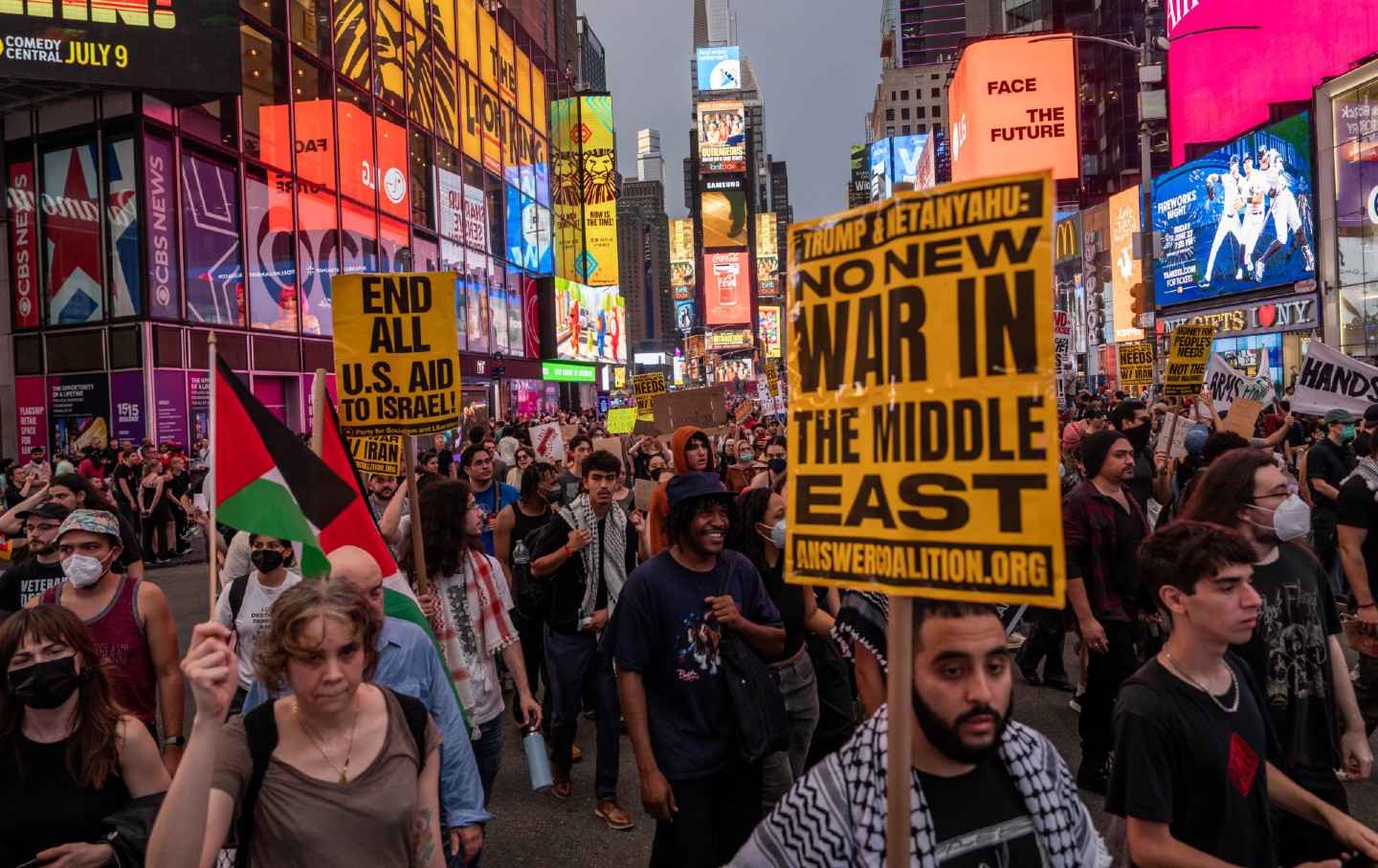
Last Saturday as many as 6 million Americans, in what might be the largest single-day mass protest in the nation’s history, rallied against President Donald Trump under the banner, “No Kings!” The urgency of that slogan has only increased as Trump now threatens to do the most monarchical misdeed possible: launch his country into a disastrous war by pure fiat, without even debate in Congress, let alone a vote. Betraying his frequent campaign promise to govern as a peacemaker, Trump has adopted the long-held policy of anti-Iran hard-liners such as Senator Lindsey Graham and the Foundation for the Defense of Democracy. Trump greenlighted Israel’s attack on Iran and is on the cusp of deciding to join the war directly (rather than the current policy of just using Israel as America’s attack dog). Such a war would be a catastrophe fully on par with George W. Bush’s 2003 invasion of Iraq—a generational disaster with an immeasurable cost in treasure and blood, both American and in the Middle East.
Right now, Washington is obsessed with the question of if and when Trump will bomb Iran, possibly using bunker-busting bombs. The legendary investigative journalist Seymour Hersh reports that his sources tell him the decision could come as early as this weekend. The White House itself says that the decision could be two weeks away. It’s risky to trust the White House on this, but if the decision is two weeks away, opponents of the war have a small but crucial window of opportunity to stop Trump from unleashing this world-historical disaster.
It takes only a brief study of Donald Trump to learn an important lesson: It is impossible to read the mind of someone who has no mind. When Trump was asked about his plans on Wednesday, the president replied, “You don’t know that I’m going to even do it. I may do it. I may not do it. Nobody knows what I’m going to do.”
From any other leader, this statement might be taken as strategic ambiguity—a desire to leave the foe uncertain of his intent. In Trump’s case, a more literal interpretation is possible. It could be “nobody knows” what Trump thinks because Trump himself doesn’t know what he thinks.
As his career shows, Trump has few if any thoughts. Rather, he is a creature of scattershot impulses and conflicting goals, easily swayed by the last person who whispers in his ear. The satiric acronym TACO (Trump Always Chickens Out) was coined to describe his flightiness on the issue of trade, where he oscillates from starting global tariff wars to backing down when the stock and bond markets express displeasure. But the principle of TACO applies to foreign policy as well: Notably, in his first term he went from threatening nuclear war (“fire and fury,” as he called it in a tweet) against North Korea in 2017 to praising dictator Kim Jong Un for having a ”great and beautiful vision for his country” in 2019. Trump did this without actually achieving his stated goal of ending North Korea’s nuclear program.
Benjamin Netanyahu and his allies in Washington have taken advantage of the TACO principle to stampede Trump into supporting their rush to war. But there is no reason that opponents of the war can’t apply the TACO principle for their own advantage. If Trump sees that the war carries with it a significant political cost, that might just give him the necessary pause. As with his North Korea policy in his first term—or his month-long bombing of Yemen earlier this year—he could decide to simply claim victory without achieving any significant goals and retreat.
The key political fact is that a war with Iran is extremely unpopular—it divides Republicans against each other. Conversely, opposing the war could unite the Democrats—if only they can shake off the death grip of pro-war establishment figures. An anti-war Democratic party would gain in popularity.
According to a YouGov poll (commissioned by The Economist), 60 percent of Americans oppose US military involvement in the war between Israel and Iran, as opposed to 16 percent who support such involvement. An almost equally strong breakdown occurs among those who voted for Trump in 2024 (53 percent opposing war, 19 percent supporting). Those numbers among Republicans might change if Trump does launch an attack, owing to a rally-around-the-leader effect. One shouldn’t underestimate Trump’s personality cult among his MAGA followers.
But Trump’s popularity on the right will be mitigated by the fact that a significant portion of his coalition is deeply uneasy about another Middle Eastern war. Tucker Carlson, a leading pro-Trump media personality, recently conducted a lengthy interview with Senator Ted Cruz that largely consisted of Carlson mocking the ignorance and bluster behind the pro-war push. Aside from Carlson, other leading MAGA voices—notably Representative Marjorie Taylor Greene, onetime Trump adviser Steve Bannon, conspiracy theorist Alex Jones, and Senator Josh Hawley—have spoken against the escalating war. They have been joined by more libertarian-oriented Republicans, notably Senator Rand Paul and Representative Thomas Massie.
This fracturing of the MAGA coalition is an opportunity for Democrats. As I repeatedly argued in the run-up to the last election, Kamala Harris made a political mistake in ceding the anti-war argument to Donald Trump (which was exacerbated by her embrace of pro-war Never Trump Republicans such as Liz Cheney).
While the hawks are trying to do a reprise of Bush’s Iraq War, the fundamental fact is that 2024 is very different from 2003. George W. Bush was able to exploit the fresh wound of the 9/11 attack. In leading the nation to war, he had a united party and a compliant media, whipped into line with a long propaganda campaign. America in 2024 is far more divided on the issue of war, and Trump is meeting with a much stronger opposition, including from within his own party.
Writing in Foreign Policy, Matt Duss, vice president of the Center for International Policy, notes that anti-war politics have benefitted Democrats in the past and need to be reclaimed by the party:
In fact, there is a large constituency for a stronger anti-war stance. It is worth noting that in every election since the end of the Cold War (with the post-9/11 exception of 2004), Americans have voted for the less militarist, less interventionist candidate. Barack Obama was elected in 2008 in large part because he had the courage to speak out against the Iraq War six years earlier. We need leaders with the courage to do that now….
In 2024, Democrats made a mistake by leaving the anti-war lane wide open for Trump. A Democrat who has the courage to offer a different choice, to offer Americans a new vision of U.S. foreign policy that boldly embraces global peacemaking, is a Democrat who can win. Trump has just opened the door to them.
Popular
“swipe left below to view more authors”Swipe →Right now, the battle over the war is in Congress. The War Powers Act allows Democrats to force a vote on the war, putting Republican lawmakers in the uncomfortable position of voting for a war that is immensely unpopular, and which could easily go very badly. Resolutions against the war are gathering steam in both the House and Senate.
While AIPAC has been working overtime trying to rally lawmakers of both parties to take a maximalist pro-war position, a strong opposition is shaping up. Gratifyingly, on the Democratic side, skepticism towards the war can be found not just on the left but includes centrist lawmakers like Rhode Island Senator Jack Reed, who is ranking member of the Senate Armed Forces committee and a stalwart supporter of the national security state. In a statement on Friday, Reed warned that “Israel’s alarming decision to launch airstrikes on Iran is a reckless escalation that risks igniting regional violence. These strikes threaten not only the lives of innocent civilians but the stability of the entire Middle East and the safety of American citizens and forces.”
Reed’s statement is a good sign that a mainstream anti-war position can be hammered out by Democrats. To be sure, Democrats could lose some support among their more hawkish members, notably the Never Trump neoconservatives who have joined the party in recent years. William Kristol, who had been a major cheerleader of George W. Bush’s Iraq War, is equally enthusiastic about Trump’s new adventure. But the electoral calculus is clear: The Democrats can well afford to lose a few William Kristols and Liz Cheneys if they are on the right side of the supermajority of Americans who oppose this war.
The time to organize against this impending catastrophe is now. If the same energy that went into the No Kings rally were applied to anti-war politics, particularly to lobbying Congress, Trump could be put on the defensive.
Trump stole anti-war populism away from Barack Obama. It is time for Democrats to steal back a winning issue that is both smart politics and smart policy.
More from
Jeet Heer 
Obama Delivers a Scorching Rebuke to Trump—and Centrist Dems Obama Delivers a Scorching Rebuke to Trump—and Centrist Dems
Unlike other establishment figures, the former president isn’t scared to associate with the party’s left flank.
Why Trump Is Embracing Vivek Ramaswamy’s Vile Ad Why Trump Is Embracing Vivek Ramaswamy’s Vile Ad
The president is leaning into the politics of toxic parenting.
Even Republicans Are Waking Up to Trump’s Corruption Even Republicans Are Waking Up to Trump’s Corruption
And, somewhat shockingly, so are Democratic elites.
Where Is the Outrage Over Trump’s Racist Targeting of Ilhan Omar? Where Is the Outrage Over Trump’s Racist Targeting of Ilhan Omar?
The establishment press and some Democrats are strangely mute over the president’s flagrant abuse of the legal system.

The Real AI Threat Is Already Here The Real AI Threat Is Already Here
Never mind some future apocalypse—AI is being used right now to cause enormous suffering.
Elon Musk’s James Talarico Smear Blew Up In His Face Elon Musk’s James Talarico Smear Blew Up In His Face
But that doesn’t mean the danger from Musk’s lies is over.

