A New Age for US-Russia Arctic Cooperation?
Ceasefire talks could be a catalyst for advancing cooperation in the Arctic, but the climate crisis should not be forgotten.
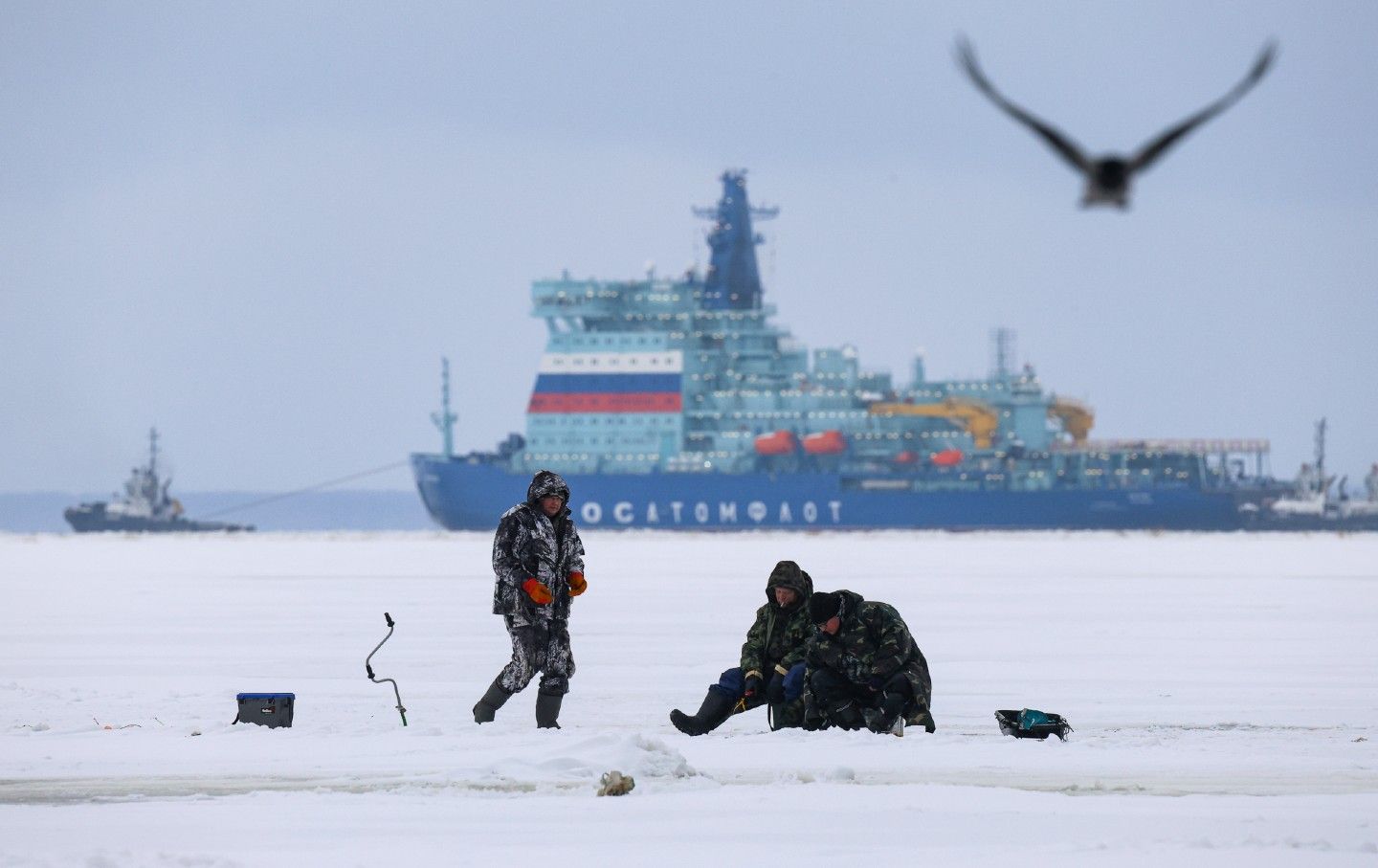
Fishermen work on the ice of the Gulf of Finland against the backdrop of the nuclear icebreaker Yakutia, a key tool in Russia’s Arctic program, while US President Donald Trump has ordered the development and approval of a program to acquire a US icebreaker fleet. (Artem Priakhin / Sipa via AP Images)
US-Russia talks in Saudi Arabia and the Trump-Putin phone call signal a possible negotiation for peace in Ukraine and new opportunities for the countries’ relations, including in the Arctic region.
The Arctic, warming four times faster than the rest of the world, may be the key region for the US and Russia to advance cooperation. US-Russia rapprochement may broadly benefit the world by bringing an end to the disastrous war in Ukraine and reducing the risk of nuclear war, but existential environmental issues still demand attention.
The Trump administration has started purging government websites of climate data. It is now the task of civil society to elevate climate change as a concern and pressure the two countries to include climate change in the Arctic cooperation agenda. The Arctic climate crisis is the “canary in the coal mine” for what awaits other regions.
At the February 18, 2025, Rubio-Lavrov meeting in Riyadh, Kirill Dmitriev, CEO of the Russian Direct Investment Fund, named the region as a potential setting for US-Russia cooperation: “We need to pursue joint projects, including, for example, in the Arctic.” The Arctic region makes sense as a setting for cooperation as the two sides have explicitly expressed interest in exploring cooperation in energy, investment, and geopolitical issues. Western sanctions on Russia have led Moscow to step up its cooperation in the Arctic with China in joint energy ventures and grand plans for Arctic shipping. US officials now see Arctic cooperation as a potential means to “drive a wedge” between Moscow and Beijing.
In my meetings in Moscow with American and Russian diplomats and businessmen over the past few weeks, it is clear that many are interested in diverse forms of Arctic cooperation, from cultural diplomacy that celebrates the commonalities of Indigenous peoples on both sides of the Bering Strait, to scientific diplomacy to understand and adapt to climate hazards faced by both nations. Business interests, however, are at the top of the agenda.
Trump’s suggestion to acquire Greenland, not ruling out military or economic coercion, has reignited global concerns over Arctic stability. Trump’s threats against Denmark, a NATO ally, have caused alarm in the Euro-Atlantic community. While some Russian state media pundits celebrated Trump’s statements, Russian diplomats criticized the destabilizing effect of the proposal and said that Trump’s plan “can only bring uncertainty and tension to the region.”
Together with Trump’s desire to acquire Ukraine’s resources and reduce the US’ dependence on Chinese rare earth, it is clear that rare earth minerals are a key focus of Trump’s political worldview. Greenland has large deposits of rare earth elements and is strategically positioned alongside Arctic shipping lanes and offshore oil deposits. Putin’s offer to open Russian rare earth minerals to joint exploration with the US may also have implications for Arctic cooperation.
Trump has grumbled about Russian and Chinese ships “all over the place” near Greenland, indicating an element of great power competition in Trump’s Greenland fixation. This is a misunderstanding of Arctic security, as Russian and Chinese military activity is far from Greenland, occasionally operating together in the Bering Strait near Alaska. Greenland may, however, play a role in North American defense as a radar outpost to detect threats coming from across the North Pole.
The announced plan to revamp diplomatic relations and restore the staff of the countries’ diplomatic missions will significantly reduce the current obstacles to US-Russia scientific cooperation in the Arctic. By making it easier to issue visas and travel between the two countries, Americans and Russians will again be able to conduct joint research, expeditions, and scientific conferences and build models to better understand the unfolding climate emergency. Scientific cooperation to understand the changes affecting sea ice, permafrost, ecosystems, and local communities has been blunted by the political fallout of the war in Ukraine.
Cooperation in the Arctic can help build regional stability. More importantly, Arctic cooperation will build trust between the US and Russia that could complement or spill over into other crucial fields of cooperation such as arms control, Middle East peace, and global health.
Support independent journalism that does not fall in line
Even before February 28, the reasons for Donald Trump’s imploding approval rating were abundantly clear: untrammeled corruption and personal enrichment to the tune of billions of dollars during an affordability crisis, a foreign policy guided only by his own derelict sense of morality, and the deployment of a murderous campaign of occupation, detention, and deportation on American streets.
Now an undeclared, unauthorized, unpopular, and unconstitutional war of aggression against Iran has spread like wildfire through the region and into Europe. A new “forever war”—with an ever-increasing likelihood of American troops on the ground—may very well be upon us.
As we’ve seen over and over, this administration uses lies, misdirection, and attempts to flood the zone to justify its abuses of power at home and abroad. Just as Trump, Marco Rubio, and Pete Hegseth offer erratic and contradictory rationales for the attacks on Iran, the administration is also spreading the lie that the upcoming midterm elections are under threat from noncitizens on voter rolls. When these lies go unchecked, they become the basis for further authoritarian encroachment and war.
In these dark times, independent journalism is uniquely able to uncover the falsehoods that threaten our republic—and civilians around the world—and shine a bright light on the truth.
The Nation’s experienced team of writers, editors, and fact-checkers understands the scale of what we’re up against and the urgency with which we have to act. That’s why we’re publishing critical reporting and analysis of the war on Iran, ICE violence at home, new forms of voter suppression emerging in the courts, and much more.
But this journalism is possible only with your support.
This March, The Nation needs to raise $50,000 to ensure that we have the resources for reporting and analysis that sets the record straight and empowers people of conscience to organize. Will you donate today?