
We Tried to Bring Food Into Gaza—but Israel Blocked and Arrested Us
As Israel continues to starve the people of Gaza, a delegation of rabbis marched toward the Erez Crossing during Passover carrying sacks of flour and demanding a cease-fire.

In 2017, I spent several days in Gaza as a staff person for the American Friends Service Committee. Although I took away many powerful and vivid memories from that trip, some of the most indelible involved the delicious food that was continuously served to us by our Gazan hosts. Gazans are famously proud of their cuisine, and rightfully so, as it provides them with a palpable connection to Palestinian history and life outside that small 140 square-mile strip—to communities in Palestine where their ancestors used to live. As journalist Laila El-Haddad has observed, Gazan food is “a sort of treasure map to a largely invisible, or invisibilized, world of Palestinian history going back well before the 1948 Nakba.”
During the course of our visit, Ali, a member of the AFSC Gaza staff, mentioned more than once that Gazan knafeh (a traditional Arabic dessert) was by far the best in Palestine. When our staff group gathered at a restaurant in Gaza City for our final meal, Ali was chagrined to learn that there was no more knafeh left in the kitchen. Determined, he got up, ran down the street to another restaurant, and returned with a huge round plate of the sticky, golden pastry for our table. It was indeed more delicious than any knafeh I have eaten before or since.
I’ve recalled that sweet memory often over the past seven years. When I think of it now, however, I find its sweetness has curdled into horror. As far back as December, human rights agencies determined that Israel “was using starvation as a weapon of war.” According to the World Food Program, Gaza’s food system was on the brink of collapse and the population was facing a “high risk of famine.”
This past March, the mainstream media published shocking, heartbreaking pictures of Yazan Kafarneh, a 10-year-old Gazan boy reduced to skin and bones from starvation. To date, it has been estimated that 28 children have died of malnutrition and starvation in northern Gaza. By all accounts, starvation in the besieged Strip has now reached “catastrophic” proportions. Palestinians in Gaza are now forced to eat grass just to survive.
As a congregational rabbi, I spoke with many people who told me that they were not sure how—or even if—they would celebrate Passover this year. With the genocide and forced starvation of the people of Gaza deepening with no end in sight, they said it felt beyond challenging to celebrate a festival of Jewish liberation. To make the moral dissonance even more dissonant, many in the Jewish communal establishment framed the meaning of this year’s Passover exclusively around the plight of the Israeli hostages in Gaza and the call for their liberation from Hamas, with nary a mention of the 35,000 Gazans who have been killed by Israel’s genocidal vengeance.
More than once I was asked, “How can I partake of this festive meal while Israel has been starving Palestinians in the name of the Jewish people? How can I read about Pharaoh’s oppression of Israelite children when I’ve just read the latest death count of Palestinian children dying increasingly things from forced starvation?”
As a political-spiritual response to this unprecedented Passover moment, Rabbis for Ceasefire—a group of rabbis and rabbinical students who came together last October to demand an end to the violence—began to organize an action at the Gaza border. Motivated by Passover’s central imperative—“All who are hungry come and eat!”—our mission was to bring food supplies to the Erez Crossing and demand that Israel allow us to pass through. Our action included 10 American rabbis, writer Ayelet Waldman, and 30 Israeli activists—including Israeli rabbis—who have been tirelessly protesting both at the Gaza border and organizing protect presence for West Bank communities targeted by settler violence.
On April 26, we gathered at a preplanned meetup location, with a truck filled with half a ton of flour. We each shouldered bags of rice and, carrying banners and flags, marched in the direction of the Erez Crossing. The Israeli police quickly drove up to intercept us. During that initial stand-off, several of us offered statements.
I began with an opening prayer, an adaptation of the “Magid” section of the Passover Haggadah, when Jews retell the story of the Exodus: “This is the bread of affliction, the bread and food systemically, cruelly denied the people of Gaza. Let all who are hungry come and eat. Let all who are oppressed be liberated this Pesach. Now, we are here—tomorrow, let there be bread for Gaza. Now, we are here—next year, may there be liberation from the river to the sea!”
Other speakers included Israeli Rabbi Avi Dabush of Rabbis for Human Rights, a resident and survivor of a kibbutz that was attacked on October 7, and Noam Shuster-Eliassi, a well-known Israeli activist, writer, and comedian. When our program was over, we pushed forward toward the border. When the soldiers violently attempted to break us up, several of us sat down in the road. During the course of the protest seven of our group—four Americans and three Israelis—were arrested.
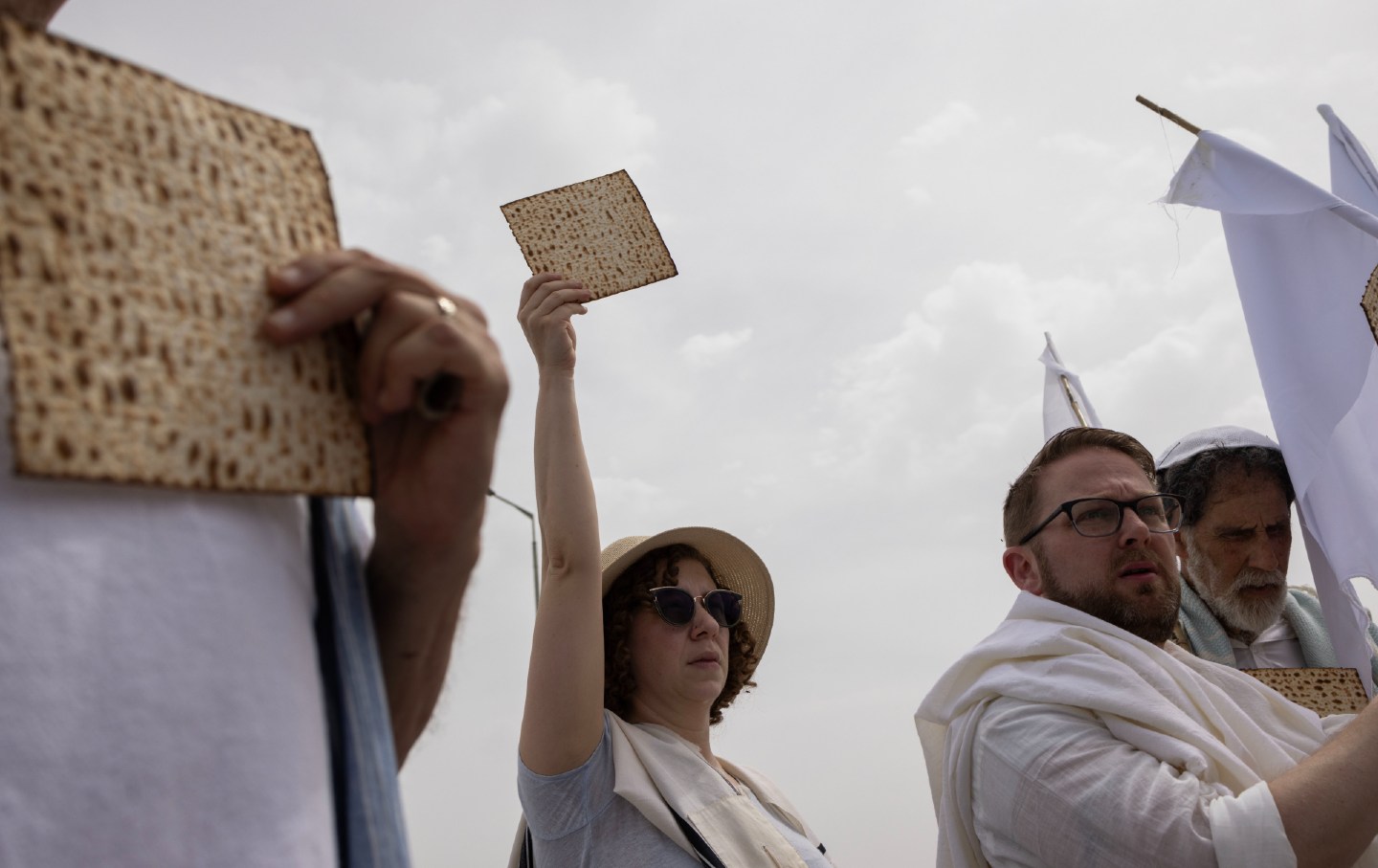
All of the arrested were fully prepared for this eventuality (the Israelis were veterans at protest arrests and had briefed us on protocol). They were taken to two detention centers and interrogated for eight to nine hours. The Americans were told, bluntly, that they were being held for “attempting to bring food into Gaza.” All the arrested were released that evening. Thankfully, the food we attempted to bring into Gaza was not confiscated, so we were able to donate it to Masafer Yatta—a community in the South Hebron Hills where almost 3,000 residents are resisting the daily threat of demolitions, evictions, and dispossession.
Now that many of us are back in the United States, we are not ready to stop sounding the alarm about the atrocities Israeli is committing in Gaza, not ready to stop pressing for a cease-fire and the flow of food once again into Gaza. As it is, nearly 2.2 million Palestinians in Gaza currently face mass starvation and encroaching famine. Hundreds of trucks filled with humanitarian goods have been sitting idle on roads leading into the Rafah crossing on the border with Egypt, blocked from entering Gaza by a draconian inspection process that severely limits the number of trucks that can pass through. Inside Gaza, the Israeli military has attacked efforts to distribute aid with tragic results. According to the United Nations, the Israeli military has killed 196 relief workers, while soldiers have shot and killed hundreds of Gazans venturing out to seek food.
Amid all this horror, the one agency that has the capacity and infrastructure to effectively distribute relief to the people of Gaza, the United Nations Relief and Works Agency (UNRWA), has been defunded by the Biden administration. This past January, the Israeli government leveled the still-unsubstantiated claim that 12 UNRWA employees were involved in Hamas’s October 7 attacks in Israel. Though UNRWA immediately fired the employees in question and launched an investigation, the US withdrew its financial support of the agency, which was founded in 1949 to provide support to the hundreds of thousands of refugees created by the establishment of the state of Israel.
In its spending bill this past March, the US government extended its ban on UNRWA funding for a year. Though the agency reports it has sufficient funds to operate until the end of May, its ability to provide services in Gaza has been dangerously hampered. Last month, Israel announced that it would no longer approve UNRWA food convoys to the north of Gaza, where famine is the most imminent. According to a recent report, the agency noted that “a total of 420 food trucks were denied or impeded by Israeli authorities [inMarch].” It warned: “Gaza is on the brink of famine, with 1.1 million people—half of its population—experiencing catastrophic food insecurity due to the intense conflict and severe restrictions on humanitarian access.”
Most ominously, Israel continues to amplify its threats to invade Rafah, where some 1.4 million people are currently living, many of them refugees from elsewhere in Gaza. An invasion would almost certainly result in massive human suffering and tragedy.
Popular
“swipe left below to view more authors”Swipe →
And yet, in the wake our action on the border, I continue to hold out hope. It is clear to me that our border protest was part of something much larger: the dramatic rise in Palestine solidarity increasing around the world, including the growing student protest movement on campuses across the United States. And I am more convinced than ever that Israel cannot, try as it might, starve or bomb the Palestinian people from existence, nor can it destroy the love for their culture that is so deeply rooted in their homeland: In the words of El-Haddad: “Lately, I’ve been thinking about what I would go back to, and what I would find, if I returned to Gaza. Most of the landmarks have been destroyed. Gone too are many of the people I cherished. But…it feels like I am the torchbearer now, the family’s keeper of treasured recipes. Like Um Hani [Leila’s aunt, who was killed in an Israeli air strike], I will cook and I will teach, connecting the next generation of Palestinians to our homeland.”
Support independent journalism that does not fall in line
Even before February 28, the reasons for Donald Trump’s imploding approval rating were abundantly clear: untrammeled corruption and personal enrichment to the tune of billions of dollars during an affordability crisis, a foreign policy guided only by his own derelict sense of morality, and the deployment of a murderous campaign of occupation, detention, and deportation on American streets.
Now an undeclared, unauthorized, unpopular, and unconstitutional war of aggression against Iran has spread like wildfire through the region and into Europe. A new “forever war”—with an ever-increasing likelihood of American troops on the ground—may very well be upon us.
As we’ve seen over and over, this administration uses lies, misdirection, and attempts to flood the zone to justify its abuses of power at home and abroad. Just as Trump, Marco Rubio, and Pete Hegseth offer erratic and contradictory rationales for the attacks on Iran, the administration is also spreading the lie that the upcoming midterm elections are under threat from noncitizens on voter rolls. When these lies go unchecked, they become the basis for further authoritarian encroachment and war.
In these dark times, independent journalism is uniquely able to uncover the falsehoods that threaten our republic—and civilians around the world—and shine a bright light on the truth.
The Nation’s experienced team of writers, editors, and fact-checkers understands the scale of what we’re up against and the urgency with which we have to act. That’s why we’re publishing critical reporting and analysis of the war on Iran, ICE violence at home, new forms of voter suppression emerging in the courts, and much more.
But this journalism is possible only with your support.
This March, The Nation needs to raise $50,000 to ensure that we have the resources for reporting and analysis that sets the record straight and empowers people of conscience to organize. Will you donate today?
More from The Nation

Trump and His Soulless Cronies Have Managed to Suck the Joy Out of the World Cup Trump and His Soulless Cronies Have Managed to Suck the Joy Out of the World Cup
Not even soccer is immune from Trump’s reverse Midas touch.

Garbage In, Carnage Out Garbage In, Carnage Out
The harrowing lessons of the Pentagon’s recently dissolved partnership with Anthropic.

The Iran War Could Be Catastrophic for the US-Israel Alliance. Good. The Iran War Could Be Catastrophic for the US-Israel Alliance. Good.
As Israel’s role in pushing the war with Iran comes into ever sharper focus, it’s up to us to turn outrage into change.

An Unlawful War An Unlawful War
The precedent being set by the US in launching this war of aggression against Iran will long live in infamy.

Trump and Netanyahu Want to Turn Iran Into a Failed State Trump and Netanyahu Want to Turn Iran Into a Failed State
This war looks designed to cause maximum chaos and instability. The world will pay a high price.

The War on Terror Paved the Way for Trump’s Rise—Now He’s Making It His Own The War on Terror Paved the Way for Trump’s Rise—Now He’s Making It His Own
Only the total abolition of the DHS can restore freedom.

