
The Paris Olympics Has Launched a War on the Poor
Paris will almost certainly be remembered as a successful Olympic site. Such recollections, however, will leave out those who suffered under its weight.
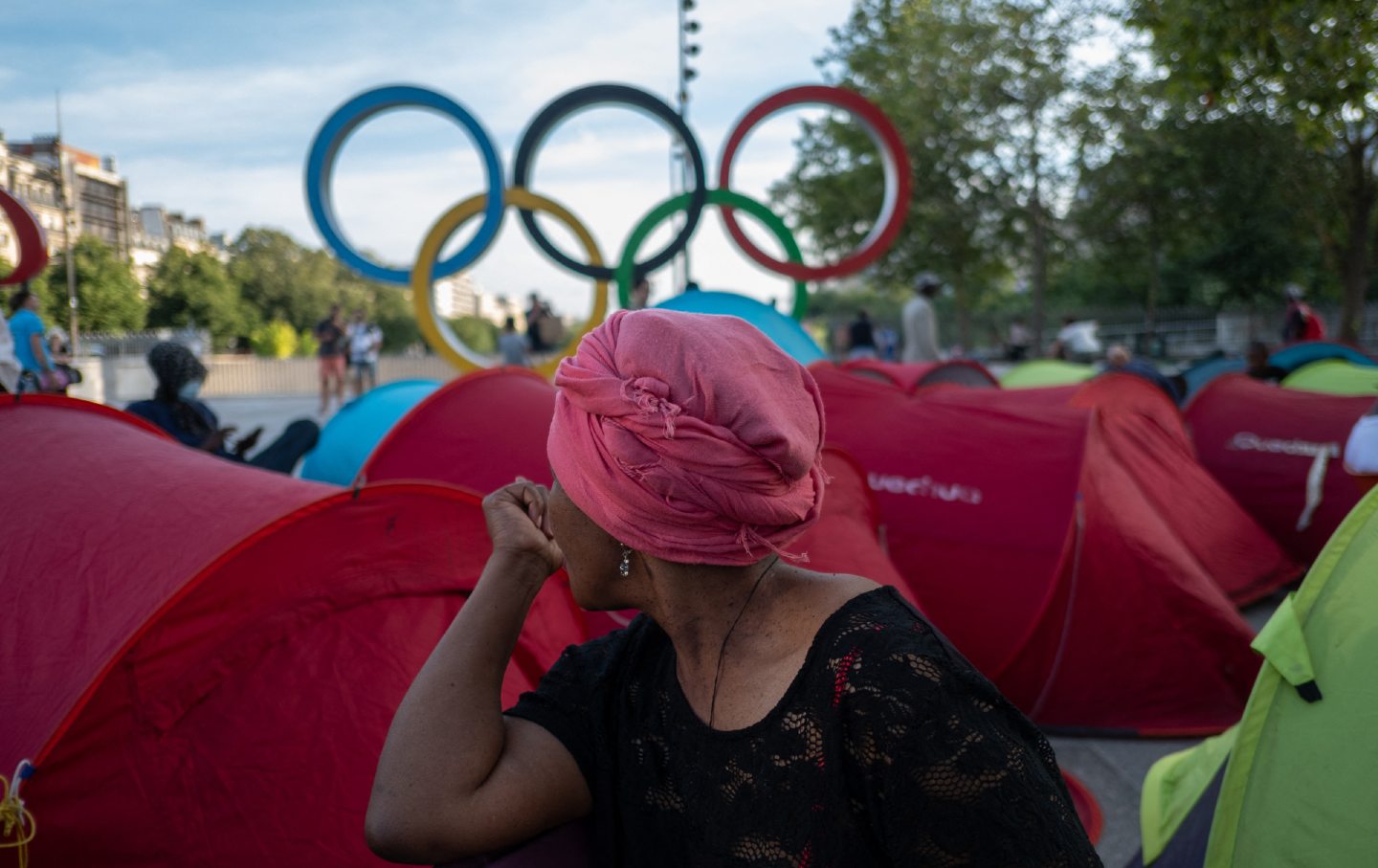
A women seated during the installation of an encampment at the Bastille to demand accommodation for homeless people in Paris on August 6, 2024.
(Victoria Valdivia / Hans Lucas / AFP via Getty Images)
As the Paris 2024 sporting spectacle crescendos this week, a less conspicuous struggle continues outside the Olympic zone: a war on the poor. Inside the Olympic bubble, high-stakes medal events are scheduled every day, while outside the five-ring fever dream the stakes are brutal and the contrast is stark. “The Olympic city is hell for the poor,” said Paul Alauzy, of Médecins du Monde (Doctors of the World). “At the middle of it you have an Eden [the Olympics]. Everyone wants to participate. They’re watching it, but they can’t get in.”
What we’ve witnessed here in Paris is part of a larger, ignominious Olympic tradition: the brass-knuckled displacement of working-class and poor people to clear space for the Games, whether in Seoul in 1988, Atlanta in 1996, Beijing in 2008, or Rio de Janeiro in 2016.
Melora Koepke, a geographer who splits her time between Paris and Vancouver, Canada, and whose research operates at the nexus of displacement, poverty, and drug use, told us that “people who are deemed undesirable in public space” have borne the brunt of state repression and that “this has accelerated because of the Olympics.”
The contrast between the glitzy Paris Olympics, where a ticket to the closing ceremony at the Stade de France can cost €1,600, and those pushed to the margins of French society couldn’t be more stark. We got a glimpse of this reality while out on a night of outreach—or a maraude—with a team from Médecins du Monde, consisting of a doctor, two translators, and two outreach specialists.
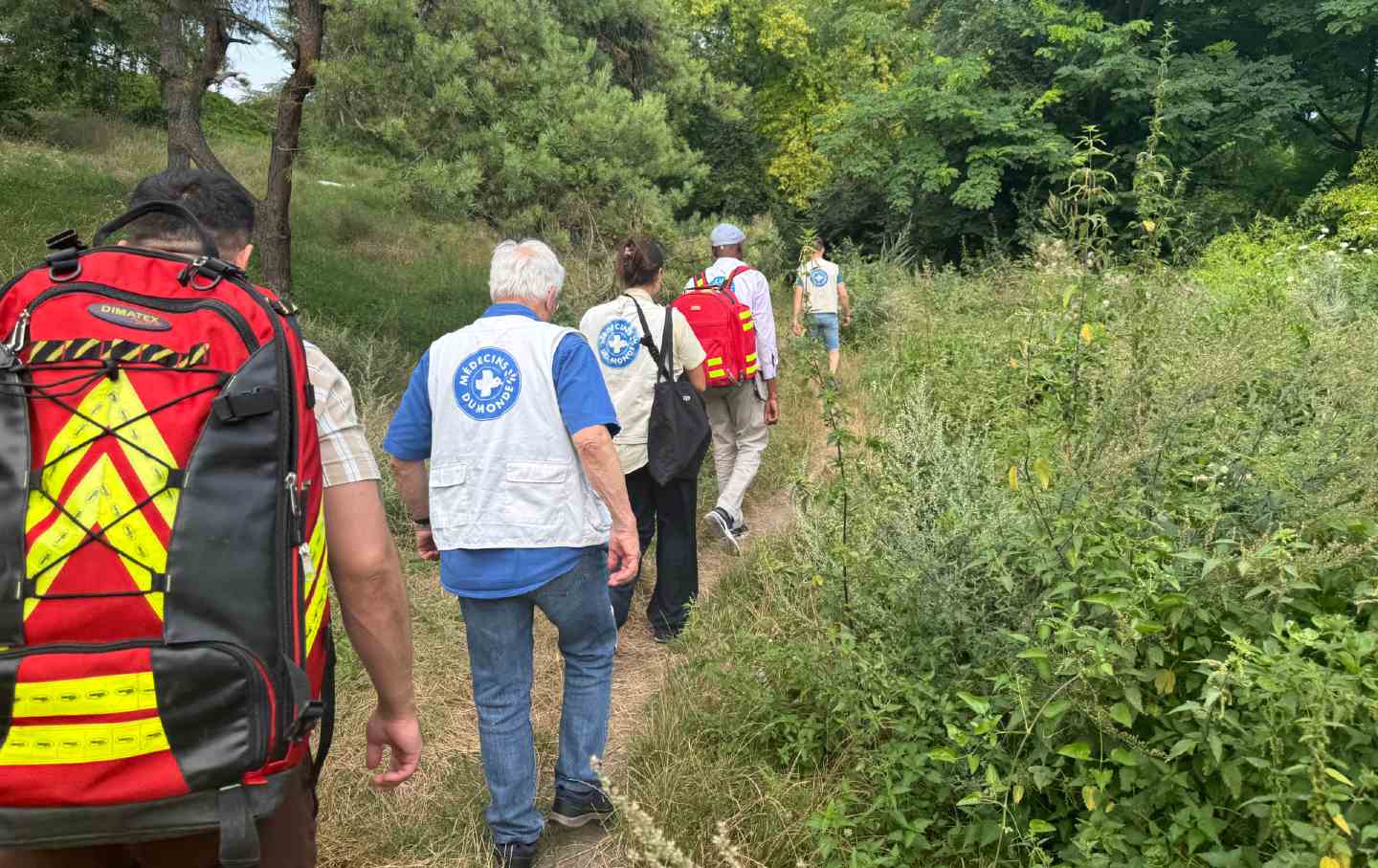
Our first stop was Bobigny in Saint Denis, an area in the north of Paris that Olympic organizers vowed would benefit from hosting the Games. When we pushed through the brush and into the forest, we found numerous migrant encampments, but none of the promised benefits. The outreach workers told us that the Olympics were actually making their job more difficult—the people they assist have been pushed deeper into the shadows, making even finding them a challenge. In fact, in our first three stops, we didn’t come across a single person wanting a doctor’s consultation. This, said Alauzy, was the first time this had happened in six years of doing outreach four nights a week. Sometimes the absence of evidence is the evidence itself.
But then, as darkness settled over the City of Light, we came upon Abdishakur, a 17-year-old migrant from the Ivory Coast who was setting up his tent in a covered area near the Pompidou Center. He told us that the Olympics had made it much more difficult for him to secure food. He described how, during the Games, police wake him up every day at 5 am, screaming at him and his fellow migrants to scatter out of view. Many shuffle around the corner and into an underpass where tents sit wedged between a fence and a busy road. Cars whooshed by at high speeds. Several of them told us that, for them, the Paris Olympics are more a bane than a boon.
When Abdishakur realized we had a doctor among us, he pulled out a crinkled X-ray of his shoulder and a crumpled manila envelope containing medical papers that he had kept carefully wrapped in plastic, a layer of fabric, and then another layer of plastic to protect them from the elements. Dr. Bertrand Chatelain listened patiently as he held the X-ray against a street light, eventually giving him some medication and a referral to a local clinic.
Meanwhile, dozens of migrants encircled us, lining up for medical assistance. For the next two and a half hours, Chatelain treated person after person, all of them unaccompanied minors from Africa, mostly the Ivory Coast and Guinea. Abakar Moussa, an Arabic translator who has worked with Médecins du Monde since 2018 because, as he told us, he “feels close to the values” of the group, stood by taking notes and plucking the correct medications from the three large bags of supplies that we toted around. Alauzy darted about, engaging in friendly banter with the young migrants and assisting Moussa as needed.
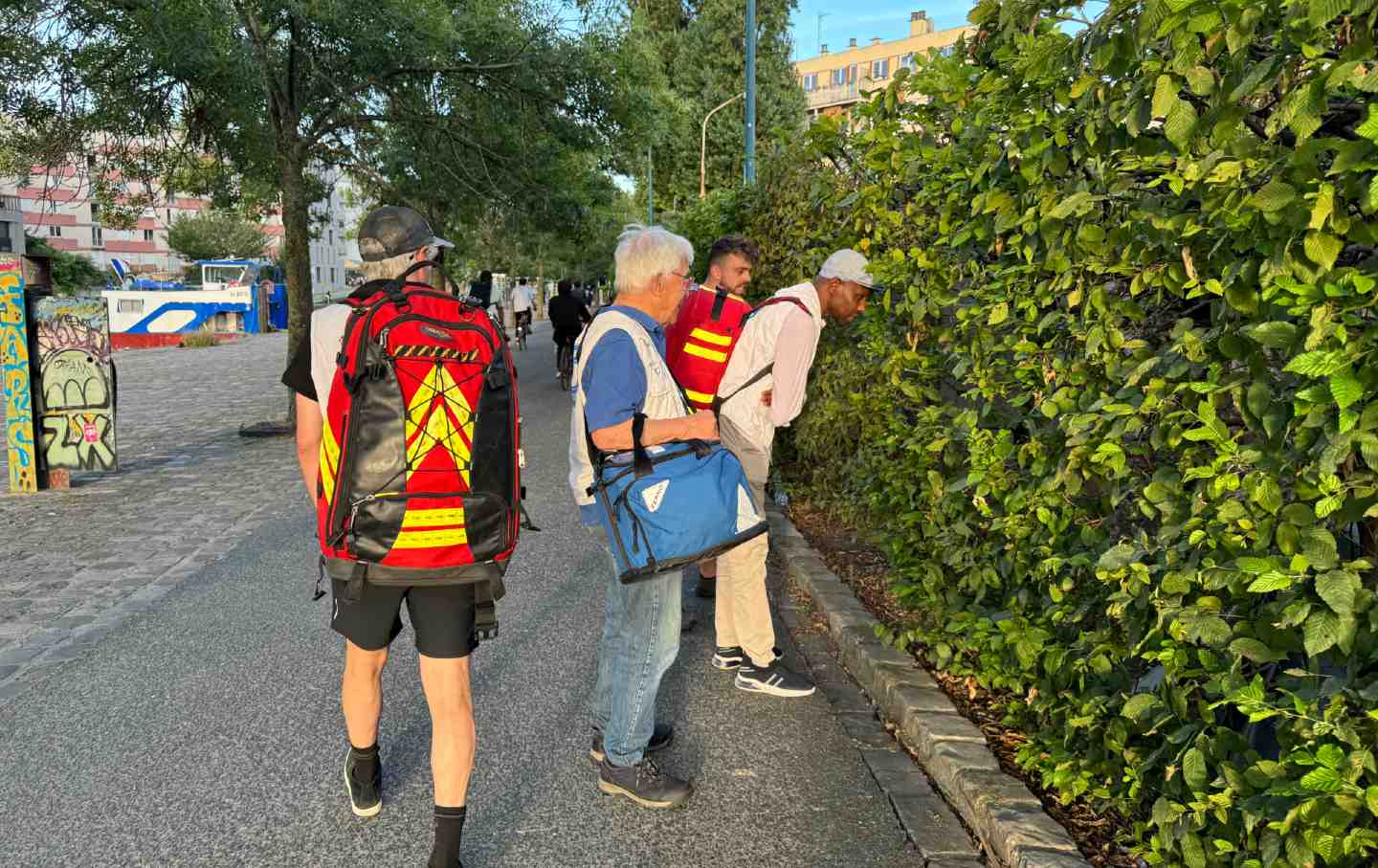
The Olympic Charter extols “the educational value of good example, social responsibility and respect for internationally recognised human rights and universal fundamental ethical principles.” This team from Médecins du Monde was quietly putting those values into action, far from the hot glare of the Olympic media hype machine.
Human-rights activists in Paris are calling the displacement process that preceded the Olympics—and that has continued apace during the Games—“nettoyage social,” or social cleansing. Before the Olympics began here in Paris, Alauzy, who doubles as a spokesperson for the activist collective Le Revers de la Médaille (The Other Side of the Medal), explained to us: “In Paris, the social cleansing can be understood with a double logic of dispersion: a dispersion within the Olympic’s city public space, to avoid tent cities, slums, squats, and disperse the marginalized people, and a dispersion within the whole country, so that to delocalize the unwanted and push the misery away from the Olympic city.”
Alauzy is referring to so-called “SAS reception centers,” 10 temporary housing programs located far from Olympic Paris in cities like Strasbourg, Lyon, and Marseille. Unhoused people in Paris are loaded onto buses by police and sent to these makeshift locations, where they receive shelter and food for a few weeks. While the French government says these centers are supposed to help process asylum claims and to speed up the paperwork process, one Paris-area lawyer called the system “an antechamber to deportation.”
The pace at which unhoused people–including numerous migrants who have fled violence back home–have been scooped off the streets of Paris is bracing. A research study carried out by Le Revers de La Médaille revealed that over the past year more than 12,500 vulnerable people were forcibly removed from the streets of Paris. This amounted to a nearly 39 percent uptick over the previous year. French officials have denied that these displacements are linked to the Paris 2024 Games. However, an e-mail from a government official specializing in housing stated that the goal of these mass expulsions from squats and encampments was to “identify people on the street in sites near Olympic venues” and remove them before the Olympics began.
One striking example of displacement occurred at the Maison des Métallos, a building owned by the City of Paris. There, around 150 homeless and unaccompanied minor migrants were squatting to keep out of the elements. Among them was 16-year-old Fousseni Kanté, who had fled violence in his home country of Chad. As Phineus James reported in The Dial, Kanté followed the rules and “applied for asylum as an unaccompanied minor.” But “when his claim was rejected because the state did not recognize his birth certificate, he ended up on the streets.” When the City of Paris moved to expel squatters at the Maison des Métallos, the community fought back. A placard outside read: “These are grave times. No housing, no Olympics. We’re staying in Paris.” By early July, the city finally agreed to house the migrants in numerous gymnasiums spanning the city.
Last week, we visited the Maison des Métallos. The building’s makeover was unmistakable. The space where scores of migrant youth spread their sleeping pads had been replaced by a fancy exhibition designed to spotlight Tokyo as a tourist destination. Free samples of sake flowed. Exquisite glass cups were being sold for nearly €400. Glossy exhibits celebrated Japanese manga and Godzilla. We asked one of the Japanese hosts whether she was aware that before their arrival, this was a last-ditch safe space for young African migrants. “I’ve heard,” she said. “But I didn’t see them.”
Activists in Paris have fought valiantly against the injustices that are built into the Olympics. Their efforts have been complicated by members of the Paris 2024 Organizing Committee, who have either failed to be good-faith partners or who have outright withheld information. French National Assembly member Aurélie Trouvé, who represents a district in Seine-Saint-Denis, an area of the city deeply affected by the Games, told us, “The whole Olympic system is opaque and unaccountable,” adding, “Unfortunately, as members of Parliament, we have very few levers or resources to track the impacts of the Olympics on the people, on our cities, on our ecosystems.”
This lack of accountability was very much on the mind of Médecins du Monde outreach worker Brunnhilde Chellian. During a brief break from our maraude, she told us that while Paris Olympic organizers plowed loads of money and rhetoric into security and sustainability, they failed to do the same for the social component of the Games: Paris authorities, she said, “didn’t try at all.” Chellian lamented this “missed opportunity,” adding that “the people in the streets” have been left behind.
“The hypergentrified city keeps the most marginalized out of its territory,” France-based writer Cole Stangler notes in his book Paris Is Not Dead: Surviving Hypergentrification in the City of Light. This dynamic has been turbocharged in Olympic Paris. It breaks up families. It uproots people’s lives. And it is cruel. One reporter was overheard saying that there weren’t any compelling off-the-field stories at this year’s Olympics.
Popular
“swipe left below to view more authors”Swipe →Actually, there are 12,500. But you have to want to look.
Around midnight, as we packed our bags and prepared to walk back to the Médecins du Monde van, Abdishakur had wedged himself between two tents where, amid the hustle and sirens of Olympic Paris, he performed his Islamic prayers. Behind him was a wall bearing the ubiquitous purple signage for the Paris 2024 Olympics. The wall might as well have been surrounded by barbed wire.
Paris will almost certainly be remembered as a successful Olympic site. Such recollections, however, will leave out those who suffered under its weight. They will ignore that one measure of “success” for politicians and Olympic organizers will have required the cruel disappearance of people like Abdishakur.
As Los Angeles readies for the 2028 Olympics, California’s unhoused people are already being subjected to an appalling agenda of displacement. We need to shine light on the social crimes of Olympic Paris now, or they will be replicated on our own shores.
Support independent journalism that does not fall in line
Even before February 28, the reasons for Donald Trump’s imploding approval rating were abundantly clear: untrammeled corruption and personal enrichment to the tune of billions of dollars during an affordability crisis, a foreign policy guided only by his own derelict sense of morality, and the deployment of a murderous campaign of occupation, detention, and deportation on American streets.
Now an undeclared, unauthorized, unpopular, and unconstitutional war of aggression against Iran has spread like wildfire through the region and into Europe. A new “forever war”—with an ever-increasing likelihood of American troops on the ground—may very well be upon us.
As we’ve seen over and over, this administration uses lies, misdirection, and attempts to flood the zone to justify its abuses of power at home and abroad. Just as Trump, Marco Rubio, and Pete Hegseth offer erratic and contradictory rationales for the attacks on Iran, the administration is also spreading the lie that the upcoming midterm elections are under threat from noncitizens on voter rolls. When these lies go unchecked, they become the basis for further authoritarian encroachment and war.
In these dark times, independent journalism is uniquely able to uncover the falsehoods that threaten our republic—and civilians around the world—and shine a bright light on the truth.
The Nation’s experienced team of writers, editors, and fact-checkers understands the scale of what we’re up against and the urgency with which we have to act. That’s why we’re publishing critical reporting and analysis of the war on Iran, ICE violence at home, new forms of voter suppression emerging in the courts, and much more.
But this journalism is possible only with your support.
This March, The Nation needs to raise $50,000 to ensure that we have the resources for reporting and analysis that sets the record straight and empowers people of conscience to organize. Will you donate today?
More from The Nation

Trump and His Soulless Cronies Have Managed to Suck the Joy Out of the World Cup Trump and His Soulless Cronies Have Managed to Suck the Joy Out of the World Cup
Not even soccer is immune from Trump’s reverse Midas touch.
Garbage In, Carnage Out Garbage In, Carnage Out
The harrowing lessons of the Pentagon’s recently dissolved partnership with Anthropic.

The Iran War Could Be Catastrophic for the US-Israel Alliance. Good. The Iran War Could Be Catastrophic for the US-Israel Alliance. Good.
As Israel’s role in pushing the war with Iran comes into ever sharper focus, it’s up to us to turn outrage into change.

An Unlawful War An Unlawful War
The precedent being set by the US in launching this war of aggression against Iran will long live in infamy.

Trump and Netanyahu Want to Turn Iran Into a Failed State Trump and Netanyahu Want to Turn Iran Into a Failed State
This war looks designed to cause maximum chaos and instability. The world will pay a high price.

The War on Terror Paved the Way for Trump’s Rise—Now He’s Making It His Own The War on Terror Paved the Way for Trump’s Rise—Now He’s Making It His Own
Only the total abolition of the DHS can restore freedom.

