
The NSA Wants Carte Blanche for Warrantless Surveillance
If the Senate passes an expansion of the Foreign Intelligence Surveillance Act, any American’s international communications could become an open book.
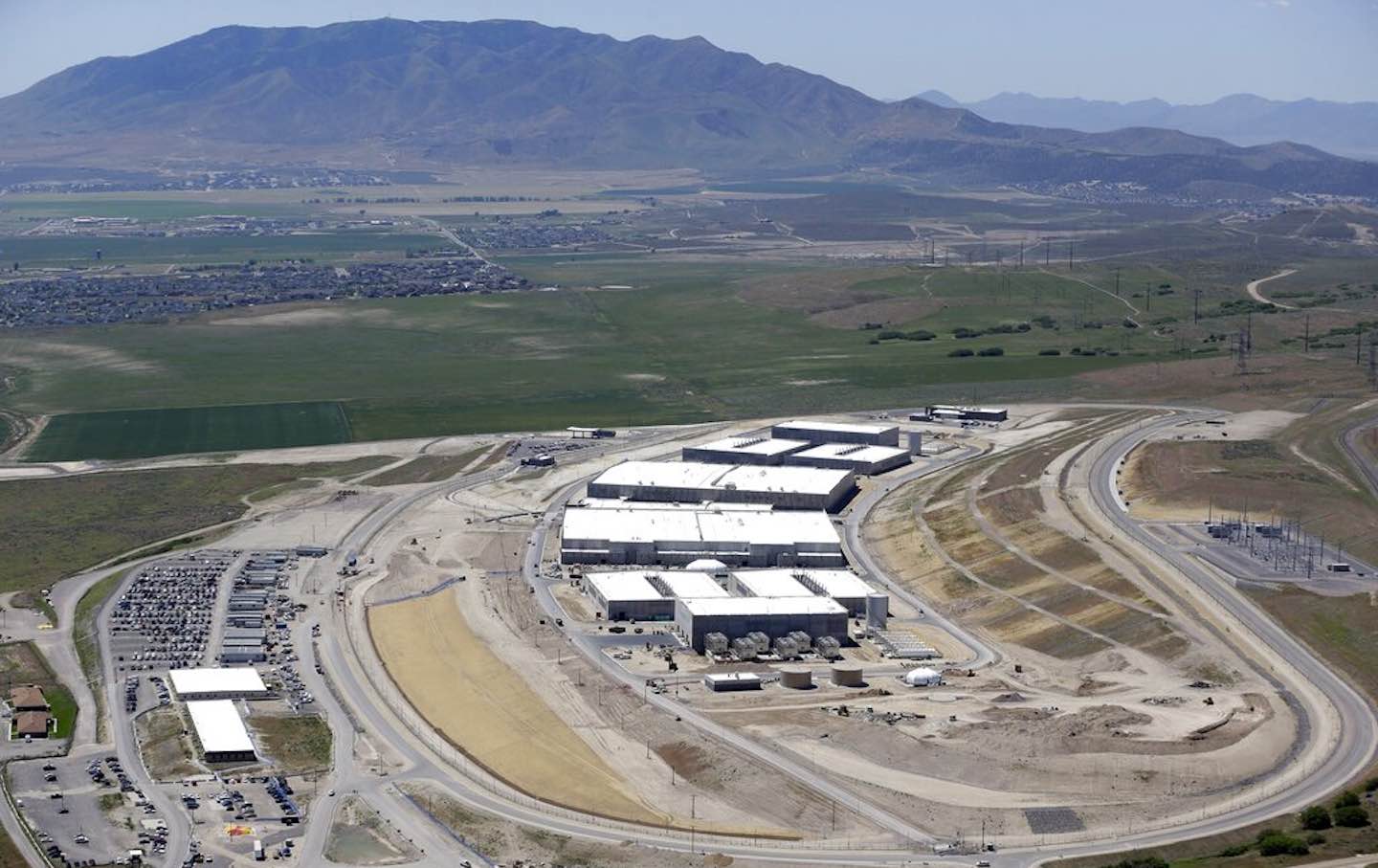
The National Security Agency’s Utah Data Center in Bluffdale, Utah.
(Rick Bowmer / AP Photo)Standing at the thick, eavesdropper-proof windows of his office suite on the eighth floor of OPS 2B, newly appointed NSA director Timothy Haugh, an Air Force general, has a commanding view of his hidden empire. The size of a small city, it is the largest, most secret, most powerful, and most intrusive spy organization ever created. And last Friday, General Haugh was likely smiling very broadly as he looked out on his secret world. The House of Representatives had just passed Section 702 of the Foreign Intelligence Surveillance Act. This legislation would permit the agency, without a warrant, to collect from Google and other US Big Tech companies the communications of Americans talking, e-mailing, or texting with non-Americans outside the country—in theory to gather foreign intelligence, but in practice amassing an enormous amount of data on American citizens.
To understand the vast quantity of private data the NSA clandestinely intercepts, one only has to take a look at its massive Utah data center, more than five times the size of the US Capitol. Functioning partly as a sort of remote external hard drive, it has a storage capacity in the zettabytes—the equivalent of more than 100 million 1-terabyte personal computers. According to the data storage company Seagate Technology, “three zettabytes is enough space to hold 30 billion 4K movies—that’s so much cinema it’d take 5.4 million years to watch it! Or 60 billion video games—enough to let you enjoy nonstop gameplay for 86,700 lifetimes!” And by now the data center may have moved from zettabytes to yottabytes, beyond which names have not yet been created. But NSA is not interested in video games or Hollywood flicks; its zettabytes are for storing communications people believe—mistakenly—are private.
The law—first passed in 1978 in the wake of the Watergate revelations of governmental misconduct—was due to expire on April 19, this Friday, and the issue of whether a warrant would be required for surveillance was hotly debated up to the last minute. At that point, House Speaker Mike Johnson, a Louisiana Republican, broke a tie vote in favor of excluding a warrant requirement.
The issue of NSA’s warrantless surveillance is one I have been following for a very long time. While in law school in 1974, I was also serving in the US Navy reserves and was sent for two weeks of active duty to an NSA listening post in Puerto Rico. Soon after arriving, I discovered that the agency was illegally eavesdropping on Americans. As a result, I turned whistleblower and reported the operation to the Church Committee, a congressional investigation into the US intelligence community led by Senator Frank Church, an Idaho Democrat. It sent a team on a surprise visit and discovered that the agency had lied about halting the practice years earlier. Since then, I have authored three books, produced several PBS documentaries, and written scores of articles on the NSA. Twice the Justice Department threatened me with prosecution under the espionage act for my writing. But it failed to justify the charges and never followed through on the threats.
Then, in December 2005, The New York Times revealed that the NSA was operating a highly secret warrantless eavesdropping program that was begun after the attacks of 9/11. The next month, I agreed to become a plaintiff—along with the writer Christopher Hitchens and several others—in the first lawsuit to challenge the NSA’s warrantless wiretapping program. Brought by the ACLU, it charged that the program was both illegal and unconstitutional and asked the court to order an end to it. Months later, the district court granted us summary judgment and ordered that the program be halted immediately. There are “no hereditary kings in America and no power not created by the Constitution,” ruled Judge Anna Diggs Taylor. But the ruling was later reversed following an appeal by the government—and the Supreme Court declined to review the case. In the meantime, Congress created Section 702 of the Foreign Intelligence Surveillance Act, which, in effect, legalized the Bush administration’s warrantless wiretapping program.
One of the key arguments in our lawsuit is as valid today as it was back then: namely, that without the requirement to obtain a warrant, the NSA will be able to freely monitor the communications of Americans with others outside the country, as long as there is the possibility of gathering “intelligence” of some sort. And certain groups of people—such as journalists communicating with foreign sources and attorneys discussing cases with clients and potential witnesses overseas—are worried that knowing the government might be listening in could cause both sources and witnesses to keep silent. “There’s a real chilling effect in the fear that they can no longer have confidential discussions with clients or sources without the possibility that the NSA is listening,” said Ann Beason, associate legal director of the ACLU at the time.
As someone who has spent decades as a journalist working on national security stories, I argued in the suit that it is very concerning that the NSA may be recording a conversation with a source to whom I have given a pledge of confidentiality. Getting such sources to cooperate in the first place becomes far more difficult knowing the NSA may be listening. Hitchens spoke of similar concerns, since he “regularly exchange[d] emails and telephone calls with individuals in Iraq, Iran, Afghanistan, Pakistan, India, Indonesia, Qatar and Kuwait.” The topics of conversations have included “discussions of Islamic fundamentalism, terrorism, jihad,” and other sensitive areas. But because of the fear of being monitored, he said in 2006, “individuals are less forthcoming…and may cut off communications completely,” leaving the public far less informed of world events, including during time of crisis.
Also greatly affected would be the relationship between attorneys in the US and witnesses and clients overseas—especially in cases that touch on national security. As attorney Nancy Hollander testified in the ACLU case:
My practice requires that I speak with lawyers living abroad, with witnesses and experts around the world. I no longer use the telephone, fax or email to communicate with clients, lawyers, witnesses, experts in any of my cases that involve terrorist related charges. I must travel the world to represent my clients as they have the right to be represented zealously within the bounds of the law and with their confidences and my work-product protected.
Criminal defense attorney Joshua Dratel had similar concerns, especially when speaking with witnesses and clients overseas:
The genuine fear that lawyers’ conversations with their clients, with their experts, with other lawyers, and with witnesses are not confidential, but in fact are intercepted by the government without any judicial or other independent oversight, casts a pall over the investigation and preparation of any defense. As a result of this NSA program (and the disclosure of its existence), lawyers will no longer be able to communicate candidly and completely by means that were previously thought immune from government intrusion.”
A requirement could easily be added to Section 702 that compels the need for a warrant as soon as an NSA employee or FBI agent recognizes that the communication involves a journalist conducting an interview, or an attorney engaged in a conversation with a client or source. In the end, insight gained from the American journalist’s interaction with a foreign source may be far more valuable and provide considerably more insight than inhibiting sources to interact with journalists.
Such restrictions are necessary considering that “the program sweeps in massive amounts of Americans’ communications, which may be searched without a warrant,” according to Senator Dick Durbin (D-IL). That’s because, once captured by the NSA, the communications are then stored in the agency’s bottomless zettabyte hard drive, the Utah data center—possibly forever. This allows the FBI to go on a warrantless hunt through that ocean of data using an American citizen’s e-mail address or other identifiers. “Even after implementing compliance measures, the FBI still conducted more than 200,000 warrantless searches of Americans’ communications in just one year—more than 500 warrantless searches per day,” added Durbin.
Nor is there any protection for journalist/source or attorney/client/witness eavesdropping and storage, Utah Republican Senator Mike Lee warned recently. “The documented abuses under FISA should provoke outrage from anyone who values the Fourth Amendment Rights of American citizens,” he said. “From warrantless searches targeting journalists, political commentators, and campaign donors to monitoring sitting members of Congress, these actions reveal a blatant disregard for individual liberties. Upholding the Fourth Amendment isn’t optional—it’s a duty.” Both Durbin and Lee were among a bipartisan group of senators who sponsored the SAFE Act—a modified warrant requirement for US person queries conducted under Section 702.
Popular
“swipe left below to view more authors”Swipe →On Monday, the House settled a number of procedural issues clearing the way for the controversial bill to be sent to the Senate for a vote—minus a warrant requirement. “This bill represents one of the most dramatic and terrifying expansions of government surveillance authority in history,” warned Senator Ron Wyden (D-OR), a member of the Senate Intelligence Committee. “I will do everything in my power to stop it from passing in the Senate.”
Twenty twenty-four seems an appropriate year for the passage of the most oppressive piece of surveillance legislation in US history. It’s the 40th anniversary of the surveillance state that George Orwell wrote about in his prescient novel 1984. “Any sound that Winston made, above the level of a very low whisper, would be picked up by it,” he wrote. “There was of course no way of knowing whether you were being watched at any given moment…. You had to live—did live, from habit that became instinct—in the assumption that every sound you made would be overheard and, except in darkness, every movement scrutinized.”
More from The Nation


Writing About War as Bombs Fall Writing About War as Bombs Fall
While the Israeli government launched a well-orchestrated offensive of disinformation and hyperbole that would make the illegal permissible in the war on Gaza.
Turkey Is Brutally Oppressing Queer People. Here’s What You Need to Know. Turkey Is Brutally Oppressing Queer People. Here’s What You Need to Know.
The government’s sweeping crackdown on the LGBTQ community is an escalation of a decades-long pattern.

The Anatomy of a Literary Scandal The Anatomy of a Literary Scandal
The pillorying of Canadian-Haitian novelist Thélyson Orélien, accused of using AI to write his new novel, is the latest in a chaotic year for French publishing.
Has France’s Government Overplayed Its Hand? Has France’s Government Overplayed Its Hand?
The speed and scale of the police response mark a dangerous new normal.

This Is Not an Anniversary This Is Not an Anniversary
Does remembering the date of October 7 make it easier to name?

