How The New York Times Enabled the Worst Assault on Indian Press Freedom in Decades
How “The New York Times” Enabled the Worst Assault on Indian Press Freedom in Decades
By publishing a flimsy, red-baiting scare story, the paper allowed the Modi government to crack down on some of the country’s most important independent voices.
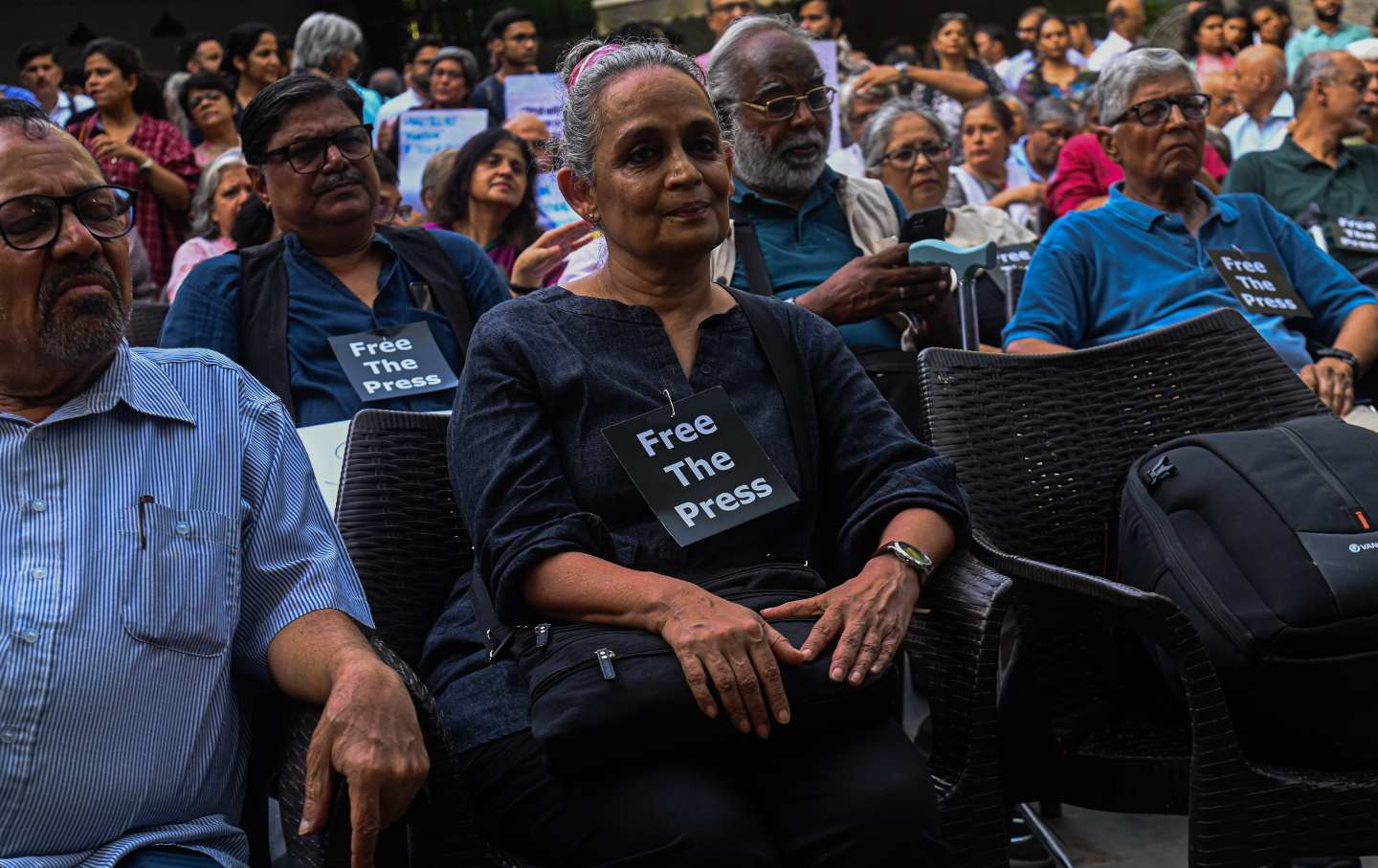
Arundhati Roy attends a protest against the raids of homes of journalists and writers belonging a news portal in New Delhi, India, on October 04, 2023.
(Kabir Jhangiani / NurPhoto via Getty Images)The Indian government has an elephant’s memory and a newt’s skin. Arundhati Roy, the Booker Prize–winning author, has once again been charged with sedition in a revival of a 2010 case against her and former professor Sheikh Showkat Hussain. She joins nearly 50 people associated with the independent journalism site Newsclick who have been subject to the Indian government’s crackdown on freedom of speech. Whether because of Roy’s long-standing opposition to successive administrations’ treatment of the poor, or for Newsclick’s recent, internationally circulated coverage of farmers’ protests, the Indian government is acutely sensitive to changes in its operating environment. Words cut Prime Minister Narendra Modi deep, and now the administration is fighting back. These are the worst attacks on India’s fourth estate since Indira Gandhi’s 1975–77 Emergency Period—and they have been made possible by The New York Times.
The Indian government has justified its NewsClick crackdown on the grounds that “funds have been fraudulently infused by one Neville Roy Singham, active member of propaganda department of Communist Party of China.” And how did the government come to learn of these supposed connections? Through an August New York Times article titled “A Global Web of Chinese Propaganda Leads to a U.S. Tech Mogul.”
Singham lives in China, but he’s neither a party member nor an employee of the Chinese government. The Times’ evidence that he might be a puppet of the Chinese government included his being retweeted by Chinese state media and sitting near a Communist Party official while “jotting in a notebook adorned with a red hammer and sickle.” Also, his home is apparently equipped with an “always follow the party” banner and a Xi Jinping plate. It’s a classic case of innuendo posing as journalism.
Times reporters were told categorically that the charitable organization funding Newsclick had never received funding from “from any foreign individual, organisation, political party, or government (or from any of their members or representatives.” Roy can’t be a member of the Chinese Communist Party because he’s not Chinese. The paper didn’t include these facts. Absent any evidence to the contrary, the Times simply ignored them. The reporting contained no specific charges. The paper merely encouraged readers to look at some factoids—and then squint to conjure their own fantasies of malfeasance. The Indian government obliged.
Journalism in India has never been an occupation for the faint-hearted. British colonial-era laws give the government sweeping powers over freedom of speech. The Modi administration has, however, been more brazen in the targeting of its perceived enemies. Under a 2019 amendment to the Unlawful Activities (Prevention) Act, the Indian government can designate individuals as terrorists, without evidence. Delhi police cited this law in its charges against Prabir Purkayastha and Amit Chakravarty, Newsclick’s founding editor in chief and head of human resources, respectively. Purkayastha has been a stalwart of the Indian left, and is particularly concerned with democratizing science; he founded the Free Software Movement of India in 2010.
Roy in turn is accused of “provoking enmity between groups,” “imputations prejudicial to national integration,” and “public mischief.” All this for observing in a 2010 seminar that the Indian government itself didn’t think that the disputed territory of Kashmir was “an integral part of India.” Roy and Newsclick are far from alone. In February this year, the offices of the BBC in Delhi and Mumbai were raided, phones and computers confiscated, and journalists encouraged to complete a survey following the release of a BBC documentary critical of Modi and his Bharatiya Janata Party (BJP). Before them, several other Indian journalists were charged and imprisoned for their reporting.
Modi’s anxieties mirror those of his administration: neuroses about the South Asian diaspora, inferiority to China, domestic dissent, and the possibilities of criticism on the international stage. Newsclick led the reporting about the single biggest embarrassment that Modi has faced: the world’s largest protest over laws to deregulate agriculture. The Times piece was catnip to the BJP mandarins.
Under other circumstances, the Times might reasonably claim not to have been able to anticipate the Indian government’s weaponizing of its reporting against Indian journalists. But the Times was told what the consequences of their reporting would be for the Indian press in no uncertain terms by one of Newsclick’s contributors, Kavita Krishnan, during the course of their research. (Yes, she’s also a member of the Indian Communist Party—a completely legal organization.)
We have no quarrel with good journalism. Philanthropy itself is profoundly antidemocratic and deserves the full scrutiny of the fourth estate. The Gates Foundation, for instance, funded the Alliance for a Green Revolution in Africa (AGRA) in a billion-dollar effort to combat hunger in 13 countries. Eight years later, hunger was up by 30 percent and AGRA has changed its name, so that it is no longer an acronym; it now stands for nothing at all. This is a topic that richly deserves Times coverage, but it chooses to focus instead on a nonexistent Chinese-funded conspiracy.
We offer the Gates Foundation example not because we’re practicing a generalized whataboutism but because we struggle for good reasons why the Times might publish a piece that is based on such flimsy material knowing that fellow journalists would suffer. Perhaps it is to show the right that it is being “evenhanded” and is capable of also roasting the left as it skewers Donald Trump and his allies. But this false equivalence vastly underestimates the threat from the right to American liberal democracy.
To us, it makes more sense to understand the Times as supine. It has followed the contours of liberal dominion, reporting on a millionaire but ignoring a billionaire, even if that reporting comes at the cost of those risking their lives to speak truth. If India is a thin-skinned behemoth, perhaps the Times is a wrasse, picking clean the teeth of sharks, hoping that its service to the powerful will save it from becoming a meal itself.
Support independent journalism that does not fall in line
Even before February 28, the reasons for Donald Trump’s imploding approval rating were abundantly clear: untrammeled corruption and personal enrichment to the tune of billions of dollars during an affordability crisis, a foreign policy guided only by his own derelict sense of morality, and the deployment of a murderous campaign of occupation, detention, and deportation on American streets.
Now an undeclared, unauthorized, unpopular, and unconstitutional war of aggression against Iran has spread like wildfire through the region and into Europe. A new “forever war”—with an ever-increasing likelihood of American troops on the ground—may very well be upon us.
As we’ve seen over and over, this administration uses lies, misdirection, and attempts to flood the zone to justify its abuses of power at home and abroad. Just as Trump, Marco Rubio, and Pete Hegseth offer erratic and contradictory rationales for the attacks on Iran, the administration is also spreading the lie that the upcoming midterm elections are under threat from noncitizens on voter rolls. When these lies go unchecked, they become the basis for further authoritarian encroachment and war.
In these dark times, independent journalism is uniquely able to uncover the falsehoods that threaten our republic—and civilians around the world—and shine a bright light on the truth.
The Nation’s experienced team of writers, editors, and fact-checkers understands the scale of what we’re up against and the urgency with which we have to act. That’s why we’re publishing critical reporting and analysis of the war on Iran, ICE violence at home, new forms of voter suppression emerging in the courts, and much more.
But this journalism is possible only with your support.
This March, The Nation needs to raise $50,000 to ensure that we have the resources for reporting and analysis that sets the record straight and empowers people of conscience to organize. Will you donate today?