
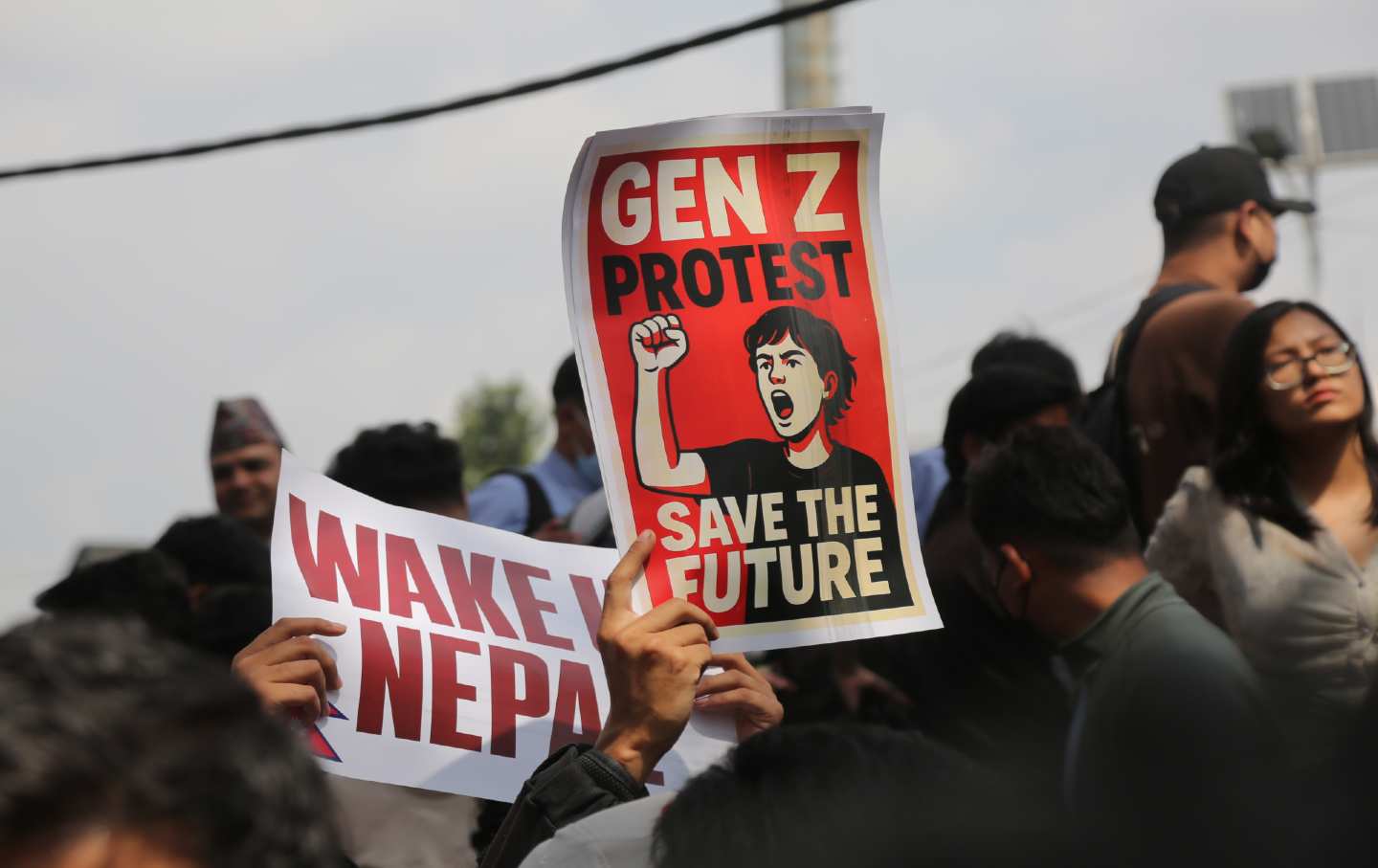
Anti-government protestors in Kathmandu, Nepal, on September 8
(Sunil Pradhan / Anadolu via Getty Images)Something big is happening in remote Nepal—the first revolution not only powered by network technology but also in many respects about it. In a weeklong blaze of fury, young protesters belonging to a movement dubbed simply “Gen Z” burned the parliament, the Supreme Court building, international business headquarters, and the homes of disfavored politicians, some of whom were chased down and beaten by mobs. The Brahmin Communist prime minister, KP Sharma Oli, resigned, and protest leaders entered into discussions with the army, which historically answered to the monarchy, to form a new government. On September 15, one week after the start of riots that claimed at least 72 lives, mostly protesters killed by police, the dead were honored as “Gen Z martyrs.” The new regime is headed, for now, by the country’s first woman prime minister, Sushila Karki, a septuagenarian former Supreme Court justice and anticorruption crusader not affiliated with any party.
“The Parliament of Nepal right now is Discord,” the chat app popular with young gamers, a 23-year-old online content creator from Kathmandu, Sid Ghimiri, told The New York Times. The comment was typical of the enthusiastic international press coverage. You may be forgiven if it triggers your Silicon Valley BS detector. Yet, amazingly, this wasn’t hyperbole—Karki defeated four other short-listed candidates in a vote held in a Discord chat room with 160,000 members, organized by a Nepali nongovernmental organization (NGO) involved in the negotiations with army leaders. Although Internet tech has played a key role in recent revolutions—memorably during the Arab Spring as well as the so-called color revolutions—the facsimile of direct democracy held in an online chat room is something rather new.
Initial reports framed the Gen Z uprising as a response to a draconian ban on social media and online messaging platforms. But beneath that spark lay the tinder of more traditional grievances about wealth inequality, corruption, and representation. “What this group is demanding is an end to corruption, with good governance, and economic equality,” Karki said after being sworn in. “We must work with the Gen Z mindset.” Exactly what that means, especially in the Nepali context, remains nebulous. Obviously, no generation has uniform politics. What the press has declined to ask is who this vague new mindset leaves behind.
Nepal’s latest, and rather remarkable, revolution underscores just how profoundly the Internet has become foundational to the structures of governance, not only in wealthy countries but also in some of the poorest. It’s also an instructive example of how wielding control of the internet can be a double-edged sword for the ruling class. In dominant economies such as the United States and China, public- and private-sector investors are pouring hundreds of billions of dollars into the promulgation of artificial intelligence, even outsourcing military targeting decisions to networked computers that are accountable to no one. AI represents the pinnacle of computerized managerialism in wealthy countries, serving not only as a tool to disempower labor and the intelligentsia but also as a mechanism for automated social control. Nepal’s Discord parliament provides, perhaps, a counterexample, showing that technology still allows for change from below.
The pseudo-parliamentary Discord chat is currently closed to new members. It was organized by an NGO called Hami Nepal, or We Are Nepal, founded after the devastating 2015 earthquake by Sudan Gurung, a 38-year-old former DJ and nightclub owner who lost his child in that disaster. Hami Nepal used social media, including Instagram and YouTube, to disseminate demonstration routes and advice on safety and strategy to the protesters, such as wearing school uniforms to appear more sympathetic. Despite a pledge of transparency, the NGO’s website doesn’t list its funders. In 2021, Gurung honored donors from the business establishment, including Infinity Holdings and the Shankar Group, both of which have denied involvement in the Gen Z protests. In a joint statement, they distanced themselves from Gurung’s politics, said their contribution to Hami Nepal was limited to pandemic relief, and lamented the burning of the Hilton as a “barbaric act of arson” that discouraged tourism. Hami Nepal says it is not accepting donations for its political activities.
Apart from the critical role played by American tech companies, there is no suggestion of a foreign hand in this revolution, which seems to lack a long-term strategy. Indeed, almost immediately after Karki’s appointment, a faction of the Gen Z movement led by Gurung called for her replacement with another new prime minister, registering dissatisfaction with her cabinet picks. “If we come back to the streets, no one can stop us. We will rip them out from where we put them,” Gurung boasted. Before Karki’s appointment, other factions in his Discord network reportedly accused Gurung of acting as a gatekeeper to discussions with military leaders.
Mechanically, the Discord parliament works like any other online chat, which is to say, with relentless argument among virtual strangers overseen by moderators who may be anonymous. “People were learning as they went,” Regina Basnet, a 25-year-old law graduate who joined the protests as well as the Discord chat, told Al Jazeera. “Many of us didn’t know what it meant to dissolve parliament or form an interim government. But we were asking questions, getting answers from experts, and trying to figure it out together.” Some in the chat advocated for the elevation of Kathmandu Mayor Balen Shah, a former rapper, but, per Al Jazeera, “Hami Nepal moderators informed the participants they could not reach Shah, who later posted his endorsement of Karki on social media.” Others, branded “infiltrators,” advocated for the restoration of the monarchy. Still others cast suspicion on the moderators, which is perhaps justifiable.
Who drew up the short list of candidates and set the terms of the vote? Who selected the moderators? Who ensured that the same people didn’t use separate accounts to vote multiple times? Who had the authority to ban accounts, and on what basis? What exactly happened here?
The relative silence on such fundamental questions demonstrates that elections held in a proprietary online chatroom are not “more effective” than a traditional democratic process, as some participants claimed. It’s also hard to believe that rural Nepalis, many of whom are impoverished and speak local languages, were as well represented online as urban students and relatively well-off dissidents living abroad. “I’m proud of the kids. They’ve got guts,” my favorite Hong Kong neighborhood Nepali chef, a soft-spoken middle-aged man who shared protest videos from his restaurant’s Instagram account, told me when I stopped by for lunch. “Somebody had to do it.”
The general secretary of Nepal’s liberal Congress party, Gagan Thapa, has complained that the process by which the new government was formed was unconstitutional. The Communist Party of Nepal (Unified Marxist-Leninist)—the ousted prime minister’s party—has expressed the same sentiment, calling for the protection of the republic and the achievements of the Maoist movement that won a decade-long civil war in 2006. How could it be otherwise? Mere thousands of participants in a Discord chat cannot speak for a population of 31 million.
Which is not to say Gen Z lacks legitimate grievances. The former government’s clumsy Social Media Bill of 2025 would have put the digital platforms people rely on under authoritarian government control and complicated life for those who rely on Nepal’s vast informal economy, which increasingly runs on platforms like WhatsApp. In a better world, unaccountable megacorporations like Meta wouldn’t be in the middle of every online conversation and transaction. But neither, necessarily, would the government.
The ousted Communist government claimed that the Social Media Bill was about regulation, not censorship, but nobody was buying it—especially since memes tagged #nepobabies and #nepokids were circulating ahead of the protests, contrasting the lavish lifestyles of elite youth with the grueling conditions of everyday life for many Nepalis. If the outpouring of rage on the streets demonstrated anything, it’s that Communist leaders have, like their predecessors, failed to satisfy the public’s demand for material improvements.
Popular
“swipe left below to view more authors”Swipe →As journalist Aditya Adhikari writes in his 2014 book, The Bullet and the Ballot Box: The Story of Nepal’s Maoist Revolution, the enduring shame of successive Nepalese governments has been the failure to provide employment sufficient to negate the need for people to seek work abroad. When I visited Kathmandu this summer, the most enduring image came not from any tourist site but at the end of my trip, outside the airport, where a crush of humanity spilled from the boarding gates out into the parking lot. In that crowd, families bade tearful goodbyes to their young breadwinners destined for long periods of second-class servitude in the Gulf states—or worse, in some cases, as mercenaries in Russia’s war on Ukraine.
The influence of tech was visible to me as well. I was charmed by inDrive, a popular taxi-hailing app that, in contrast to Uber’s algorithmic predatory pricing model, allows riders to negotiate directly with drivers, reaching a price acceptable to both. But upon reflection, we were still haggling over what was, to my Western wallet, small change. Even an app designed with the best of intentions lacks the power to address the structural problems of inequality, disenfranchisement, and corruption. Parliament by Discord is no solution to any of that. But Gen Z’s achievement has nevertheless left many Nepalis more optimistic. “This is a moment of political reckoning for the Nepali youth, and also a moment for Nepali political parties to change their ways,” Kathmandu journalist and author Amish Raj Mulmi tells me. “If this process ends with the end of impunity, not just in corruption cases but also in other aspects of society, and leads to a more responsive and inclusive political class, I’d call this movement a success.”
Become a Sustaining Donor This September
Between the reemergence of right-wing red-baiting and Donald Trump’s use of the chilling National Security Presidential Memorandum–7 to criminalize left political organizing, we’re seeing McCarthyism reborn before our eyes.
This assault on democracy cannot be ignored or wished away. Resisting it requires bravery in the face of threats and repression, a steadfast commitment to the truth, and the unwavering belief that we can—and will—overcome this darkness.
We must have an independent media that sets the record straight, unearths corruption and abuses of power, and advances a politics of justice and dignity for all if we’re to win this fight.
That’s why I’m writing to you today. This September, The Nation needs to add 100 monthly donors to sustain our progressive journalism. Your contribution makes the next investigative report, the next truth-speaking column, and the next pathbreaking essay all possible.
I hope you’ll support our work with a recurring donation today. If you donate $10 or more a month, we’ll send you a brand new “Hands Off the Free Press!” sticker to recognise your commitment to our cause. Please, donate today.
Onward,
Katrina vanden Heuvel
Editor and Publisher, The Nation
More from The Nation

The AfD’s Rise Isn’t Just About East Germany The AfD’s Rise Isn’t Just About East Germany
The Alternative für Deutschland has a stable national poll lead, including in the former West Germany. Its rise owes to much more than Eastern grievances.
Chinese Development Is the Betrayal Washington Cannot Forgive Chinese Development Is the Betrayal Washington Cannot Forgive
The prospects for Xi Jinping’s visit are dim because American leaders are blaming China for the failures of globalization.

Pinochet: The Verdict of History in the Letelier-Moffitt Case Pinochet: The Verdict of History in the Letelier-Moffitt Case
An act of international terrorism on the streets of Washington, DC, still reverberates 50 years later.

How to Arrest Benjamin Netanyahu How to Arrest Benjamin Netanyahu
Make no mistake: The United States can seize Netanyahu for crimes under US law and prosecute him in US courts when he is in New York City this week.

In the Age of AI, Nuclear Weapons Abolition Is a Renewed Imperative In the Age of AI, Nuclear Weapons Abolition Is a Renewed Imperative
As long as we have nuclear weapons, the job of ending humanity will continue to be as easy as the push of a button—or an AI agent hacking into a nuclear command-and-control system...

These Students Are Shaping UN Human Rights Policy These Students Are Shaping UN Human Rights Policy
Princeton undergraduates are helping the organization develop standards for post-mortem digital privacy and death in custody.

