
Haitians Don’t Need More “Dumbasses” From the US State Department Weighing In on the Crisis
The solutions offered by current and former American officials rarely, if ever, consider what Haitians actually want.
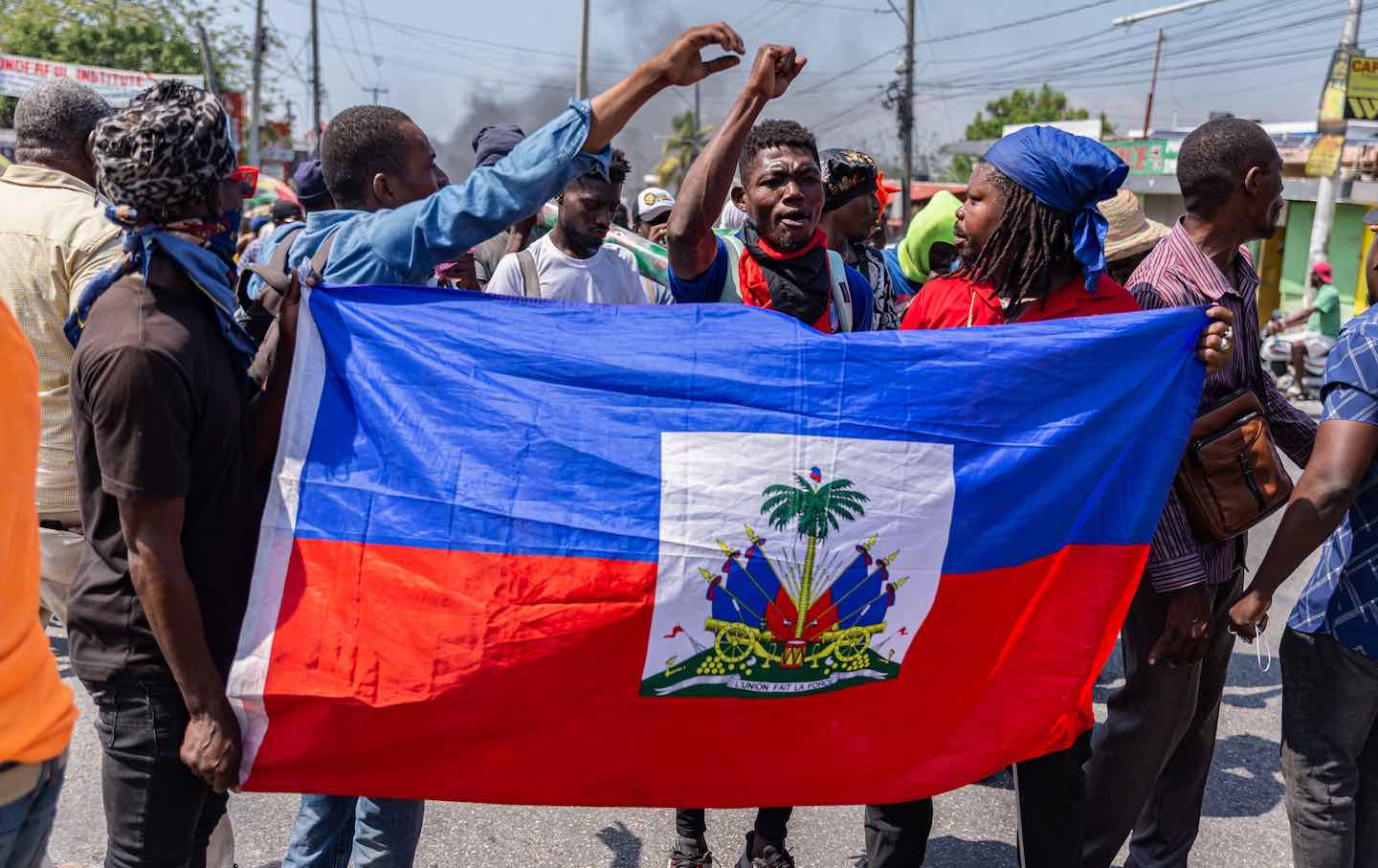
The Haitian flag is held up during a demonstration in Port-au-Prince, Haiti, on March 12, 2024.
(Photo by Guerinault Louis / Anadolu via Getty Images)Former US ambassador to Haiti Pamela White recently gave a shocking interview to Fox News that ignited a firestorm among Haitians. Her remarks highlighted the disastrous American policy toward the country that many Haitians and others believe contributed greatly to the surge in gang violence there. And yet, this point of view is nowhere to be found in the mainstream media’s lurid accounts of the armed rebels seeking to overthrow the Haitian government.
Haitians and Haitian-Americans exploded with anger over White’s suggestion that the US State Department should include two notoriously violent figures, Guy Philippe and Jimmy “Barbecue” Chérizier, in the ongoing American-sponsored negotiations for a transitional government. Even more jaw-dropping was that she revealed a distressing familiarity with both men; she said in the March 16 interview that she had spoken to Philippe on the phone “yesterday,” and she referred to Chérizier as “Jimmy C.”
These two are not ordinary politicians. Philippe was part of the illegal US-backed effort that overthrew elected president Jean-Bertrand Aristide in 2004; more recently, he added to his criminal résumé with six years in US federal prison for his involvement in drug trafficking. “Jimmy C” is the boss of one of the most dangerous gangs in Haiti, a vicious band that is guilty of multiple massacres in poor Port-au-Prince neighborhoods.
Haitians see White’s apparent coziness with these sinister figures as more proof that the State Department has long propped up a series of corrupt and violent men, while completely ignoring courageous Haitian mass movements to promote democracy and end impunity for the criminals. In fact, another former US envoy to Haiti, Dan Foote, was so disgusted by US policy that he resigned on principle in September 2021.
The mainstream media is jumping on the latest Haiti crisis—CNN even helicoptered a crew into Port-au-Prince—but reporters aren’t saying anything about the failed US policy. Instead, American coverage is relying on violence pornography: “gang members with machetes are on the march”; endless video loops of bonfires and street chaos. The US media is simply assuming that the State Department’s effort to broker a solution is neutral and benevolent.
In Haiti, the US ambassador is not an anonymous, obscure figure. Politically conscious Haitians—a big percentage of the population, especially in the capital—can name whoever occupies the post, and they include the envoy’s views and personal preferences in their analysis. During White’s tenure (2012–15), Haitians criticized her for being too close to then-President Michel Martelly, the singer turned politician who was already suspected (rightly) of massive corruption. Jake Johnston, a senior researcher at the Center for Economic and Policy Research in Washington, D.C., spent years investigating the catastrophic American policy in Haiti. His new book, Aid State, is an indispensable and sharply written indictment. He points out that Haitians dismissed White as “Pamela Pink”; Martelly’s political party used that color as its theme.
He includes a revealing portrait of White’s behavior during a key 2015 debate in Haiti’s Parliament. He watched on a video livestream as she personally walked around Parliament trying to persuade lawmakers to support one of Martelly’s political positions. He says, “It’s the equivalent of seeing, say, the Chinese ambassador on the floor of the US House of Representatives, lobbying members of Congress.”
US interference did not end when White left Port-au-Prince. American diplomats continued to prop up unpopular leaders, most recently the unelected prime minister, Ariel Henry, while ignoring Haitian efforts to form a broad-based transitional government to stabilize the country and move toward genuine elections. In 2021, envoy Foote started to work with this coalition, which was called the Montana Accord and eventually included some 650 organizations and individuals—labor unions, community organizations, Catholic and Protestant churches, women’s groups, chambers of commerce, and a range of political groups. The State Department ignored Foote’s efforts. His blistering resignation letter, made public in September that year, warned US policymakers: “I do not believe that Haiti can enjoy stability until her citizens have the dignity of truly choosing their own leaders fairly and acceptably.”
Today, Foote says his former colleagues are continuing their efforts to impose a solution on the Haitian people. Washington finally forced Ariel Henry to resign, and engineered negotiations in Jamaica where the State Department and other outside powers shaped the form of the provisional administration. Foote has little confidence that the maneuver will succeed. “It’s occurring in a vacuum, outside Haiti, and outsiders are dictating the composition of the body,” he told me in a phone interview. “No one in Haiti will trust this provisional government; no one will accept it. It’s another example of dumbasses weighing in on how to fix Haiti.”
The critique of US interference is part of an even larger indictment, one shared by just about every single Haitian; whatever happened to the huge amount of aid that the US and the rich world promised Haiti after the terrible 2010 earthquake? Jake Johnston has the facts. “Two months after the earthquake, the world pledged $10.7 billion,” he says. “Two years later, $2.4 billion had been spent, but less than 1 percent of it went to the Haitian government. Ten years after the disaster, the U.S. aid total had reached $2.5 billion—but 54 percent of that was spent on U.S. private companies that are headquartered inside the Washington Beltway, sometimes called ‘Beltway Bandits.’ Only 2.6 percent of that total went directly to Haitian companies and organizations.”
There are few visible signs of that aid in Port-au-Prince, aside from a couple of new luxury hotels and a few ugly government office buildings. Every Haitian I know rebuilt their homes using their own funds, often with help from their relatives in the Haitian diaspora—health workers in New York, taxi drivers in Montreal.
I’ve been in regular contact with the Pierre family in the capital for 25 years. They normally live in Carrefour Feuilles (Leafy Crossroads), a lower-middle/working-class neighborhood, but one of the gangs invaded the area seven months ago and chased the residents away. The Pierres are scattered elsewhere in the city, part of an estimated 362,000 internal refugees displaced by the gangs, whom Haitians call “bandits.” The family’s current head, Étienne Pierre, is an elementary school teacher, but he rarely works these days due to the disruption. His wife is in Canada, sending money home.
Popular
“swipe left below to view more authors”Swipe →Étienne Pierre is understandably angry. He tells me that he and his neighbors widely share the following view: “The Haitian people detest the bandits. We detest the traditional politicians. We detest the Haitian elite. And we detest the United States and the rest of the international community who are imposing an agreement on our country in Jamaica. We don’t believe a single word, a single sentence that they are saying.”
He goes on: “We don’t want foreign soldiers here. But we do have one request. We ask the US, and the others, to send the Haitian police the weapons, the matériel that the police need to be able to defeat the gangs. Our police need stronger weapons. They need armored vehicles.”
Meanwhile, though, the calls continue for a military invasion by outside forces. A proposed intervention by 1,000 Kenyan police is apparently still being considered. You will rarely, if ever, hear from opponents like Étienne Pierre in mainstream US reports, and Haitians have not been asked if they want foreign troops in their country.
What’s more, ex-envoy Foote offers two warnings. First, he points out that armed Kenyans, or others, who are not Haitian, who don’t speak the language or understand the reality, could make fatal mistakes and open fire on innocent people. Foote adds that a US-imposed provisional government would also doom such an intervention. He says, “If there is not a legitimate, trustworthy Haitian partner, the population will not put up with it. Haitians don’t want yet another government put there by white people.”
Support independent journalism that does not fall in line
Even before February 28, the reasons for Donald Trump’s imploding approval rating were abundantly clear: untrammeled corruption and personal enrichment to the tune of billions of dollars during an affordability crisis, a foreign policy guided only by his own derelict sense of morality, and the deployment of a murderous campaign of occupation, detention, and deportation on American streets.
Now an undeclared, unauthorized, unpopular, and unconstitutional war of aggression against Iran has spread like wildfire through the region and into Europe. A new “forever war”—with an ever-increasing likelihood of American troops on the ground—may very well be upon us.
As we’ve seen over and over, this administration uses lies, misdirection, and attempts to flood the zone to justify its abuses of power at home and abroad. Just as Trump, Marco Rubio, and Pete Hegseth offer erratic and contradictory rationales for the attacks on Iran, the administration is also spreading the lie that the upcoming midterm elections are under threat from noncitizens on voter rolls. When these lies go unchecked, they become the basis for further authoritarian encroachment and war.
In these dark times, independent journalism is uniquely able to uncover the falsehoods that threaten our republic—and civilians around the world—and shine a bright light on the truth.
The Nation’s experienced team of writers, editors, and fact-checkers understands the scale of what we’re up against and the urgency with which we have to act. That’s why we’re publishing critical reporting and analysis of the war on Iran, ICE violence at home, new forms of voter suppression emerging in the courts, and much more.
But this journalism is possible only with your support.
This March, The Nation needs to raise $50,000 to ensure that we have the resources for reporting and analysis that sets the record straight and empowers people of conscience to organize. Will you donate today?
More from The Nation
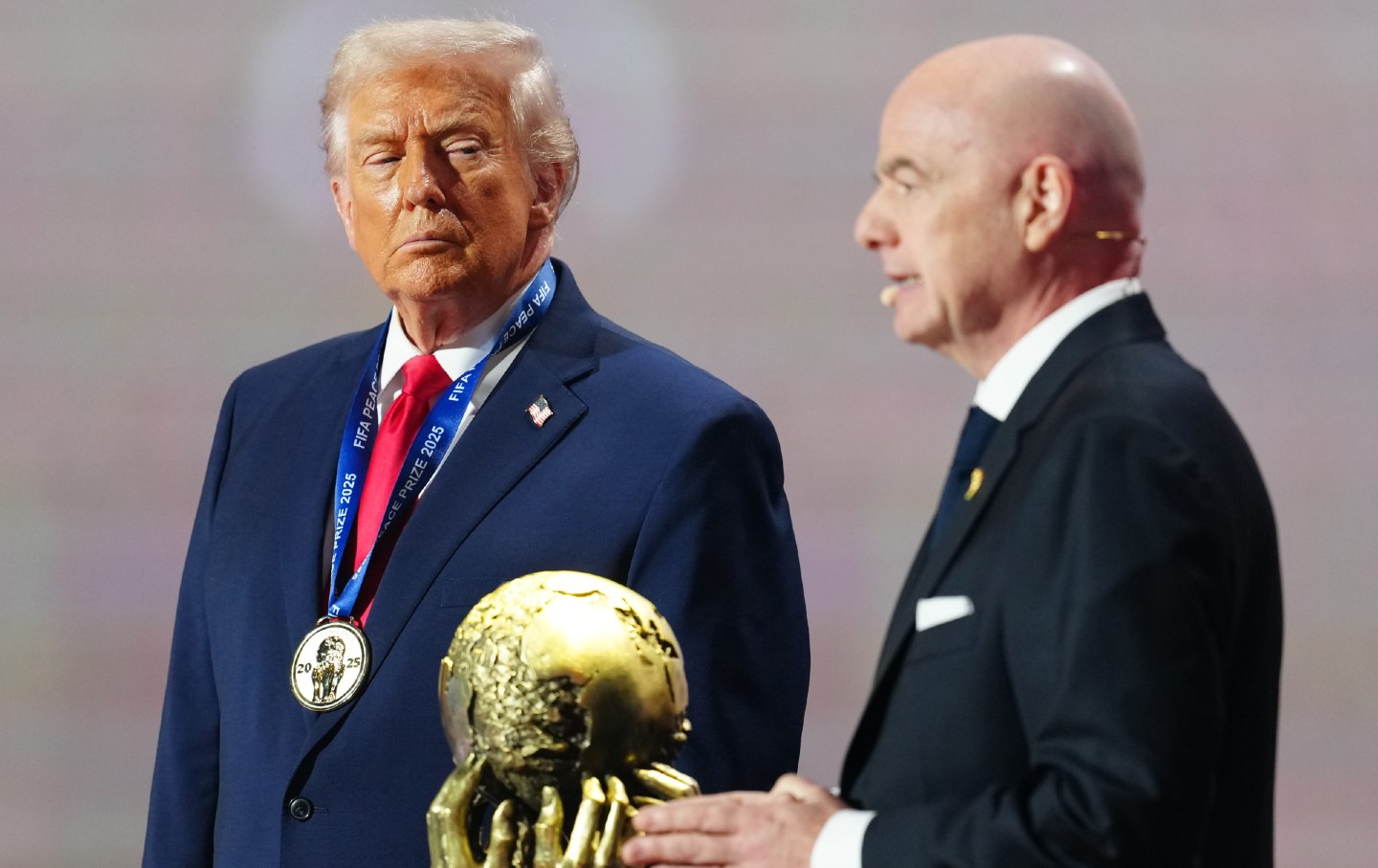
Trump and His Soulless Cronies Have Managed to Suck the Joy Out of the World Cup Trump and His Soulless Cronies Have Managed to Suck the Joy Out of the World Cup
Not even soccer is immune from Trump’s reverse Midas touch.
Garbage In, Carnage Out Garbage In, Carnage Out
The harrowing lessons of the Pentagon’s recently dissolved partnership with Anthropic.
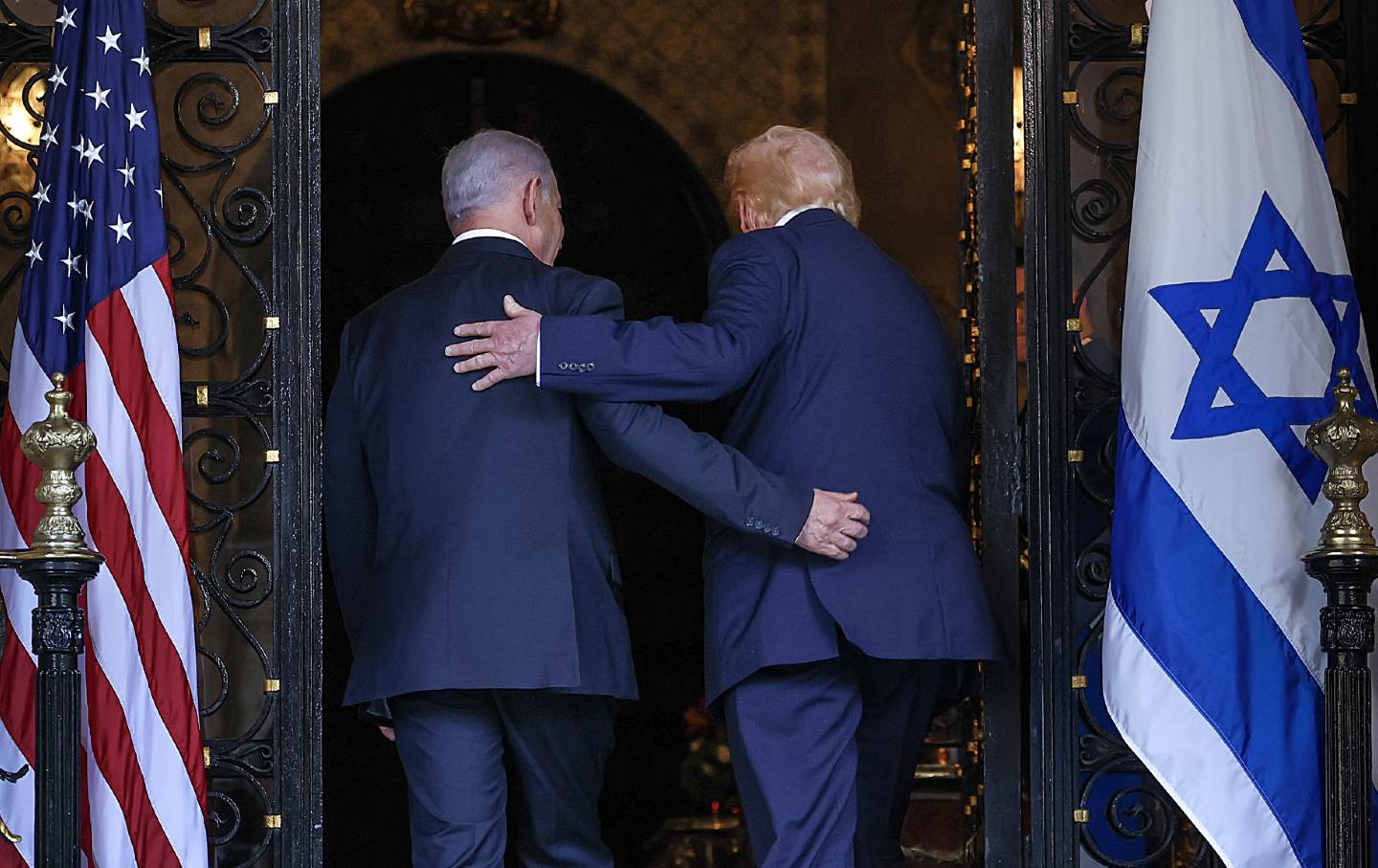
The Iran War Could Be Catastrophic for the US-Israel Alliance. Good. The Iran War Could Be Catastrophic for the US-Israel Alliance. Good.
As Israel’s role in pushing the war with Iran comes into ever sharper focus, it’s up to us to turn outrage into change.
An Unlawful War An Unlawful War
The precedent being set by the US in launching this war of aggression against Iran will long live in infamy.
Trump and Netanyahu Want to Turn Iran Into a Failed State Trump and Netanyahu Want to Turn Iran Into a Failed State
This war looks designed to cause maximum chaos and instability. The world will pay a high price.

The War on Terror Paved the Way for Trump’s Rise—Now He’s Making It His Own The War on Terror Paved the Way for Trump’s Rise—Now He’s Making It His Own
Only the total abolition of the DHS can restore freedom.

