
Gazans Have a Message for Trump: We’re Not Going Anywhere
The president wants to clear the territory and take it for the US. But people here are adamant: “I will never, ever leave my land.”

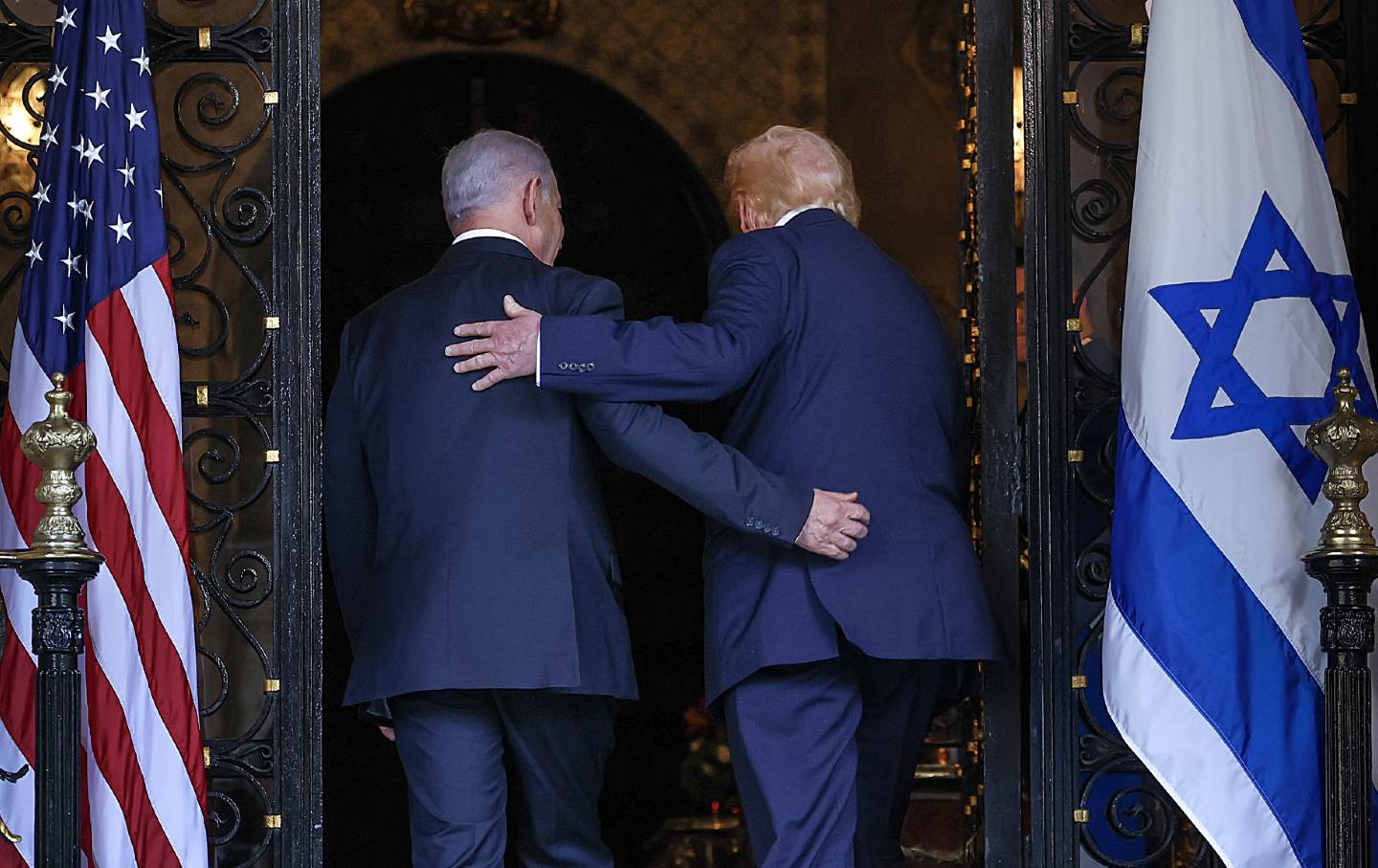
Donald Trump hosts Israeli Prime Minister Benjamin Netanyahu in the White House in Washington. DC, on February 4, 2025.
(Avi Ohayon / GPO /Handout / Anadolu via Getty Images)Gaza—After over a year of bloodshed, the Gaza ceasefire between Israel and Hamas has allowed hundreds of thousands of displaced people to return to their homes in northern Gaza—and hundreds of thousands of others to begin trying to rebuild their lives.
Yet, just as people began to take these first tentative steps back to normalcy, US President Donald Trump unveiled a seemingly serious plan to ethnically cleanse Gaza, pushing us to neighboring countries like Egypt and Jordan while the United States takes “ownership” of our land.
People around the world have condemned such solutions, viewing them as an attempt to erase the Palestinian national identity rather than provide a just resolution to their historical plight.
But how do Palestinians in Gaza feel? Judging from the people I spoke to here, the answer is simple: They’re not going anywhere.
Despite the immense hardships, the overwhelming majority of Gazans reject the idea of emigration—no matter what compensation or privileges may be offered, and even if the reconstruction of Gaza may take years.
One such person is 24-year-old Asma Abdu, who endured fear, displacement, and starvation in northern Gaza throughout the 15 months of the war.
“I will never, ever leave my land. And those who left during the war to the south—they regret it deeply,” she said firmly. “Their love for their city and attachment to their homes made them return immediately when the Netzarim corridor opened. They returned home, even though they had no homes or shelters. Their only concern was going back. They didn’t think of the consequences. So how could you imagine they would accept permanent displacement?”
Asma believes that what Biden failed to achieve, Trump won’t make happen either. “Our stability—our very souls—are tied to this land. Believe me.”
Even people who already left Gaza reject Trump’s plan. Manar went to Egypt with her family after the start of the genocide. She wants to come back. “Our departure from Gaza was only for our safety,” she said. “[We] need to come back to Gaza once the borders are open and everything is settled.”
Mohammed Omar, a father of two who fled to Egypt, has the same perspective. “Our departure from Gaza was a mistake. Even if a million dollars was paid for me to immigrate, I will refuse. There is no peace or calm but in Gaza, even during wars, Gaza feels warmer and more compassionate than any place in the world.”
Some said that Trump had betrayed the promises he’d made to them before his election. “I felt deeply disappointed hearing such statements,” said Nada Nabil, a human rights activist. “For a while, I thought that the new American administration would genuinely aim to stabilize the Middle East and put an end to wars and conflicts, based on Trump’s pre-declared policies.”
“But apparently, US policies never turn kind toward the Palestinians,” she added.
Nabil acknowledged that if this scheme were backed by job opportunities and proper accommodations, some might begin to consider emigration. On a personal level, however, she does not see herself leaving Gaza. “After the war, I feel completely disillusioned with the world. I hate how the world stood by in silence. I can only see myself happy inside my land, surrounded by my family and my people—not anywhere else.”
Trump’s plan has several obvious hurdles. It would take considerable military might to expel so many people, and there would have to be other countries that wanted to take them.
“The Arab countries’ stance during the Israeli war on Gaza will never be forgotten. No country provided substantial help or exerted meaningful pressure on Israel to stop its genocidal crimes against Gazans,” Asma pointed out. “So why would they open their doors for us now?”
The citizens of those countries will also resist Trump’s plans. Last week, a massive crowd of Egyptians protested against Trump’s schemes near the Rafah crossing border, in solidarity with Palestinians and their right to their lands.
Mohammed, a 32-year-old citizen from Gaza, had a better idea of where Palestinians might go. “We’d better be sent to our homeland—Palestine—which our ancestors were expelled from by force since 1948,” he said. “Why push us into other Arab countries and aggravate our suffering?”
As displaced Gazans struggle to rebuild their lives in the wake of destruction, many fear that Trump’s rhetoric could only further hinder their task.
Popular
“swipe left below to view more authors”Swipe →“The issue of rebuilding Gaza is going to be the most brutal battle, involving all forms of political bargaining,” said political activist Aziz Al-Masri in a Facebook post. “Every day that passes without reconstruction is like a year of delay.”
“The main target behind the massive destruction in Gaza is to make rebuilding so complicated that the Strip becomes unliveable,” he added. “Eventually, the Gazan citizen who has no place to live will find no solution but to leave.”
Though the notion of Gazans’ displacement from Gaza is unacceptable for everyone here, Trump apparently takes it more seriously than we may perceive. Asked in an interview about Egypt and Jordan’s rejection of his proposals, he said, “We do a lot for them, and they are going to accept.”
So the question remains: Will the international community uphold Palestinians’ rights to return and rebuild, or will they allow another chapter of forced displacement to unfold?
Support independent journalism that does not fall in line
Even before February 28, the reasons for Donald Trump’s imploding approval rating were abundantly clear: untrammeled corruption and personal enrichment to the tune of billions of dollars during an affordability crisis, a foreign policy guided only by his own derelict sense of morality, and the deployment of a murderous campaign of occupation, detention, and deportation on American streets.
Now an undeclared, unauthorized, unpopular, and unconstitutional war of aggression against Iran has spread like wildfire through the region and into Europe. A new “forever war”—with an ever-increasing likelihood of American troops on the ground—may very well be upon us.
As we’ve seen over and over, this administration uses lies, misdirection, and attempts to flood the zone to justify its abuses of power at home and abroad. Just as Trump, Marco Rubio, and Pete Hegseth offer erratic and contradictory rationales for the attacks on Iran, the administration is also spreading the lie that the upcoming midterm elections are under threat from noncitizens on voter rolls. When these lies go unchecked, they become the basis for further authoritarian encroachment and war.
In these dark times, independent journalism is uniquely able to uncover the falsehoods that threaten our republic—and civilians around the world—and shine a bright light on the truth.
The Nation’s experienced team of writers, editors, and fact-checkers understands the scale of what we’re up against and the urgency with which we have to act. That’s why we’re publishing critical reporting and analysis of the war on Iran, ICE violence at home, new forms of voter suppression emerging in the courts, and much more.
But this journalism is possible only with your support.
This March, The Nation needs to raise $50,000 to ensure that we have the resources for reporting and analysis that sets the record straight and empowers people of conscience to organize. Will you donate today?
More from The Nation

Trump and His Soulless Cronies Have Managed to Suck the Joy Out of the World Cup Trump and His Soulless Cronies Have Managed to Suck the Joy Out of the World Cup
Not even soccer is immune from Trump’s reverse Midas touch.

Garbage In, Carnage Out Garbage In, Carnage Out
The harrowing lessons of the Pentagon’s recently dissolved partnership with Anthropic.
The Iran War Could Be Catastrophic for the US-Israel Alliance. Good. The Iran War Could Be Catastrophic for the US-Israel Alliance. Good.
As Israel’s role in pushing the war with Iran comes into ever sharper focus, it’s up to us to turn outrage into change.

An Unlawful War An Unlawful War
The precedent being set by the US in launching this war of aggression against Iran will long live in infamy.

Trump and Netanyahu Want to Turn Iran Into a Failed State Trump and Netanyahu Want to Turn Iran Into a Failed State
This war looks designed to cause maximum chaos and instability. The world will pay a high price.

The War on Terror Paved the Way for Trump’s Rise—Now He’s Making It His Own The War on Terror Paved the Way for Trump’s Rise—Now He’s Making It His Own
Only the total abolition of the DHS can restore freedom.

