
How I Get Through Just One Day in Gaza
Every day that we don’t give up is an act of defiance, holding on to the threads of hope.
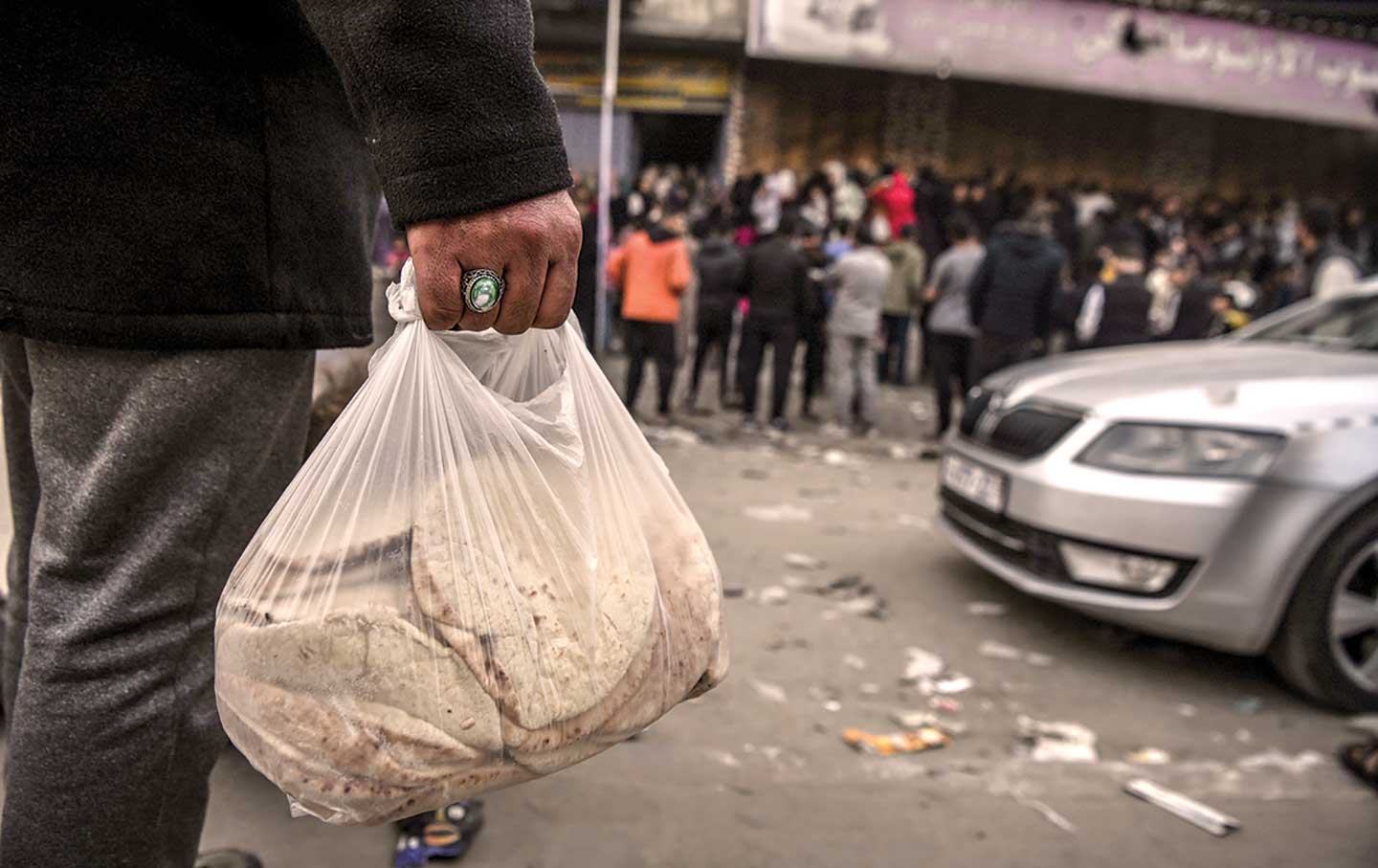
Making it through: In Gaza, simply getting ahold of some bread counts as a win these days.
(Abed Zagout / Anadolu via Getty Images)With its unceasing bombardment of our homes and neighborhoods—which has killed over 23,000 people, reduced our cities to nothing, and made millions of us internally displaced refugees—Israel has transformed Gaza into a slaughterhouse. And with its continuous targeting of hospitals, bakeries, water wells, solar panels, and markets, Israel is depriving us of all the necessities of life. It is a gruesome attempt to break our spirit and destroy our hope, and it has turned every second of every day into a gamble with death.
This is what it takes to get through just one day in Gaza.
Each day, my family, along with three other families, goes on a mission to get what we need to make it to the next morning. When someone leaves the house, my mother and my aunts say a prayer.
Usually, two of my cousins are the first to go. From 4 am to 4 pm, they are trying to get bread at the bakery. The lines are endless, and Israel has no problem bombing bakeries, so this is not a simple task. Sometimes they will return victorious with one bag of bread. Or they return filled with disappointment: Either there was no bread, or people started fighting in the line and my cousins were afraid to stay there any longer.
My aunts, my mother, and I are usually responsible for going to the market twice a week. Our markets were once filled with delicious treats and lively colors. Now they look like they’re part of a ghost town, and so do we. We move like phantoms, eyes scanning desperately. A good day is when we get some potatoes, onions, salt, a small bag of rice, and two cans of beans or tuna.
Meanwhile, my brother and another cousin collect our phones and batteries and try to find a place to charge them. This could be a shop, a neighbor’s house (if the neighbor has solar panels that haven’t been bombed), a school, or a hospital.
We remain terrified until everyone returns. Every sound we hear is alarming; every time a bomb goes off, our hearts sink. Once we hear a knock at the door, we can finally catch our breath.
When the sun sets, the darkness seems to swallow even the faintest glimmer of hope. The bombs are like a thunderstorm that never ends.
How do we keep doing this? The simple answer is that we love each other too much not to.
The other thing that carries us forward is an all-consuming desire to know what is happening to our friends and our world here in Gaza. I spend every day looking for news about all the places and names I have ever known. Just as I breathe a little easier when someone returns from an errand, a loved one’s reply to my messages brings me a brief inkling of peace.
But Israel’s war is targeting even these fleeting connections. Telecommunications in Gaza have been repeatedly cut off. When this happens, I find myself on the edge of going insane. Questions race through my mind: Do people realize we are disconnected from the outside world, and each other, again? If we cannot transmit our messages, will people forget about Gaza? Are my friends OK? Are my other family members alive? What did that bomb hit? What will I do if they bomb us and no one knows about it? What will I do if I am stuck under the rubble? When the connection comes back, a part of me wants to do anything but open my phone or check the news. Those actions inevitably bring heartbreak and grief. But I need to know. Far too often, I find something I don’t want to find. My cousin, gone. My friends, gone. My colleagues, gone. As I lie down to try and sleep, my constant prayer to God is that I wake up without having lost anyone, and without anyone having lost me.
All of this barely feels like living. But here’s the thing: Israel has made getting through even 24 hours a challenge beyond description. Yet in doing so, it has ensured that, each morning, when the sun rises and the birds sing and the loving wind of my homeland blows, the people of Gaza have another victory to savor. Israel wants to wipe us out. It wants us to give up. Every day that we don’t is an act of defiance, a proclamation that we are still here, still holding on to threads of hope. We survive. We endure. We love each other. We live. And the next day, we do it all over again.
More from The Nation

Trump and Netanyahu Want to Turn Iran Into a Failed State Trump and Netanyahu Want to Turn Iran Into a Failed State
This war looks designed to cause maximum chaos and instability. The world will pay a high price.

The War on Terror Paved the Way for Trump’s Rise—Now He’s Making It His Own The War on Terror Paved the Way for Trump’s Rise—Now He’s Making It His Own
Only the total abolition of the DHS can restore freedom.
The Iranian Voices America Isn’t Hearing The Iranian Voices America Isn’t Hearing
We need to listen to those who oppose both the Islamic Republic’s authoritarianism and foreign military escalation.
The US Attacks Iran in a War of Aggression The US Attacks Iran in a War of Aggression
The US has waged many wars—but this is one of the most senseless we've ever seen.

Opposing Trump’s Cruel Assault on the Cuban People Opposing Trump’s Cruel Assault on the Cuban People
An interview with Representative Jim McGovern.

A New Report on Alexey Navalny’s Death A New Report on Alexey Navalny’s Death
Boris Kagarlitsky and hundreds of unknown political prisoners remain in Russia’s prisons.

