
The Bitter Pill for Emmanuel Macron’s Survival
Amid a spiraling political crisis, France’s president is being forced to retreat on his signature reform.

France’s political crisis has seen many dramatic twists and turns in the last 12 months, but the instability reached new heights this past week with the sudden resignation and reinstatement of Prime Minister Sébastien Lecornu. It all began on the morning of October 6, when the premier announced his departure a mere hours after presenting the makeup of his government. Ostensibly in office for 14 hours, Lecornu’s first cabinet can be counted among the shortest-lived governments in European history. Tapped by President Emmanuel Macron in early September, he was already the country’s third prime minister since the autumn of 2024.
Macron reappointed his close ally on Friday, however, after several days of turbulence that had the country careening toward a new dissolution of the National Assembly. “I have proposed a government based on a simple mission and objections,” the reinstated Lecornu said in his inaugural address to parliament this Tuesday, after presenting a draft 2026 budget calling for some €30 billion in savings. Facing a spate of no-confidence votes scheduled for this Thursday, Lecornu urged the fractured lower house to “go beyond the divergences in our thinking and priorities and to focus on what it’s possible to do together.”
But the prospect of another government collapse has receded, with Lecornu offering an important concession to the center left: a suspension of the 2023 pension reform that increased the retirement age from 62 to 64 years. “I’ll propose to parliament that we suspend the 2023 retirement reform until the presidential election,” Lecornu told representatives on Tuesday, throwing his weight behind a freeze on the signature reform of Macron’s second term.
The law was enacted in the face of stiff public opposition thanks to a special power that allows the adoption of legislation without a direct vote in parliament—the so-called “49.3,” referring to its article in the French Constitution. That brash show of force came after a wave of protests and strikes and has remained one of the main rallying cries against the president.
Suspending the retirement law was the main demand from the Parti Socialiste, the swing bloc that Lecornu needs to woo in order to survive a no-confidence vote. “I’m still in the opposition but I want there to be a debate,” PS leader Olivier Faure said in a prime-time interview on Tuesday night, confirming that the center-left party would not support Thursday’s no-confidence motions. Assuming that all representatives in Lecornu’s fractious minority coalition support him, more than a third of the MPs in the PS caucus would need to defect from the party line in order to topple the government.
Hopes for a suspension of the retirement reform surged over the past week, as discipline broke down even among many of Macron’s most ardent loyalists. In an interview last Tuesday with Le Parisien, Elisabeth Borne, prime minster during the 2023 legislative drive, suggested that the president’s allies should agree to a suspension of the law. “We need to know when to listen and get moving,” Borne said, arguing that such a concession may prove to be the price for “the stability of the country.”
Resisting attacks on the pension reform has been a priority for the president’s camp since the election of the current hung parliament in July 2024; so Lecornu’s retreat risks alienating some members of the minority centrist-conservative coalition. His promise for parliament to take up the matter means that it could still fall victim to obstruction. (For now, Lecornu has also pledged that his government will disavow use of the 49.3— the same power used to enact the 2023 law, though it is traditionally reserved for budgeting.) Already this past spring, a round of negotiations between trade unions and business lobbies tasked with proposing pension reform amendments ended with no agreement.
But for all the reform’s symbolic importance to Macron and his allies, the actual cost of a suspension is itself marginal compared with the broader imbalances driving France’s budgetary crisis. By Lecornu’s own estimation, a suspension would cost a few hundred million euros in 2026 and some €1.8 billion by 2027. That’s still well below the €13 billion hit estimated to have resulted just from the collapse of Prime Minister Michel Barnier’s government last December.
What is also pushing the PS and the Macronist bloc together is a shared dread at the thought of snap elections—the likely next step if parliament votes down Lecornu’s government. All polls suggest that a return to the voting booths would most serve to strengthen the grip of the far-right Rassemblement National. The RN is already the largest single party in a parliament divided between 11 official caucuses.
Since the collapse of the first Lecornu government on October 6, the far right’s line is that it will accept nothing short of new elections. “We want new elections and we therefore want the dissolution of the National Assembly,” Le Pen told reporters at the Assemblée nationale before Lecornu’s address. “We’ll censure any government proposed by Emmanuel Macron.”
If he survives Thursday’s no-confidence votes, Lecornu’s next fight will be securing approval for a austerity budget, as the premier indicates that the cost of the retirement will need to be offset with savings elsewhere down the line. For the 2026 fiscal package, Lecornu is aiming to reduce France’s public deficit to below 5 percent of GDP—down from the 5.4 percent of GDP expected for 2025. In the budget outline presented Tuesday, he called for small revenue increases on the ultra-wealthy, though they fall considerably short of the comprehensive fiscal reforms urged by the left.
The PS is still calling “victory,” however. “Tonight, I’m happy for the 3.5 million French people who will be able to start their retirement early,” Faure, the PS leader, said on Tuesday night.
The party’s hope is that wresting a suspension of the retirement reform will justify its decision to break from the Nouveau Front populaire, the left-wing alliance formed during the 2024 snap elections. The other three parties of the NFP—the Écologistes, the Parti Communiste, and La France insoumise (LFI)—have all come out in support of ousting the government.
The PS will also be pointing to Lecornu’s retreat to defuse accusations of betrayal, most notably from LFI. “Macron only knows how to do things Macron’s way,” party leader Jean-Luc Mélenchon shot back after Lecornu’s reappointment on Friday.
Yet it’s hard to not savor the latest turnaround. On Monday, Macron tried to pin the blame on the opposition, whom he deemed “alone responsible” for the political turbulence. But the first significant de-escalation in France’s crisis came with a retreat by the president, whose approval ratings have hit record lows. Some two-thirds of the public are in favor of a new dissolution of parliament, according to a poll conducted last week. An even clearer majority—70 percent, according to one study—want Macron’s resignation, with even close allies like former prime minister Édouard Philippe joining those calls.
Popular
“swipe left below to view more authors”Swipe →The Macronists’ short-term arrangement with the PS is a bid to buy time—with an implicit recognition that new elections are ultimately the only solution.
Become a Sustaining Donor This September
Between the reemergence of right-wing red-baiting and Donald Trump’s use of the chilling National Security Presidential Memorandum–7 to criminalize left political organizing, we’re seeing McCarthyism reborn before our eyes.
This assault on democracy cannot be ignored or wished away. Resisting it requires bravery in the face of threats and repression, a steadfast commitment to the truth, and the unwavering belief that we can—and will—overcome this darkness.
We must have an independent media that sets the record straight, unearths corruption and abuses of power, and advances a politics of justice and dignity for all if we’re to win this fight.
That’s why I’m writing to you today. This September, The Nation needs to add 100 monthly donors to sustain our progressive journalism. Your contribution makes the next investigative report, the next truth-speaking column, and the next pathbreaking essay all possible.
I hope you’ll support our work with a recurring donation today. If you donate $10 or more a month, we’ll send you a brand new “Hands Off the Free Press!” sticker to recognise your commitment to our cause. Please, donate today.
Onward,
Katrina vanden Heuvel
Editor and Publisher, The Nation
More from The Nation

Pinochet: The Verdict of History in the Letelier-Moffitt Case Pinochet: The Verdict of History in the Letelier-Moffitt Case
An act of international terrorism on the streets of Washington, DC, still reverberates 50 years later.
How to Arrest Benjamin Netanyahu How to Arrest Benjamin Netanyahu
Make no mistake: The United States can seize Netanyahu for crimes under US law and prosecute him in US courts when he is in New York City this week.
In the Age of AI, Nuclear Weapons Abolition Is a Renewed Imperative In the Age of AI, Nuclear Weapons Abolition Is a Renewed Imperative
As long as we have nuclear weapons, the job of ending humanity will continue to be as easy as the push of a button—or an AI agent hacking into a nuclear command-and-control system...

These Students Are Shaping UN Human Rights Policy These Students Are Shaping UN Human Rights Policy
Princeton undergraduates are helping the organization develop standards for post-mortem digital privacy and death in custody.

The Peril of Trump’s Final Act: Would He Use a Tactical Nuclear Weapon in Iran? The Peril of Trump’s Final Act: Would He Use a Tactical Nuclear Weapon in Iran?
Trump is trapped in a war that has already been lost, a reality that he will never allow himself to admit.
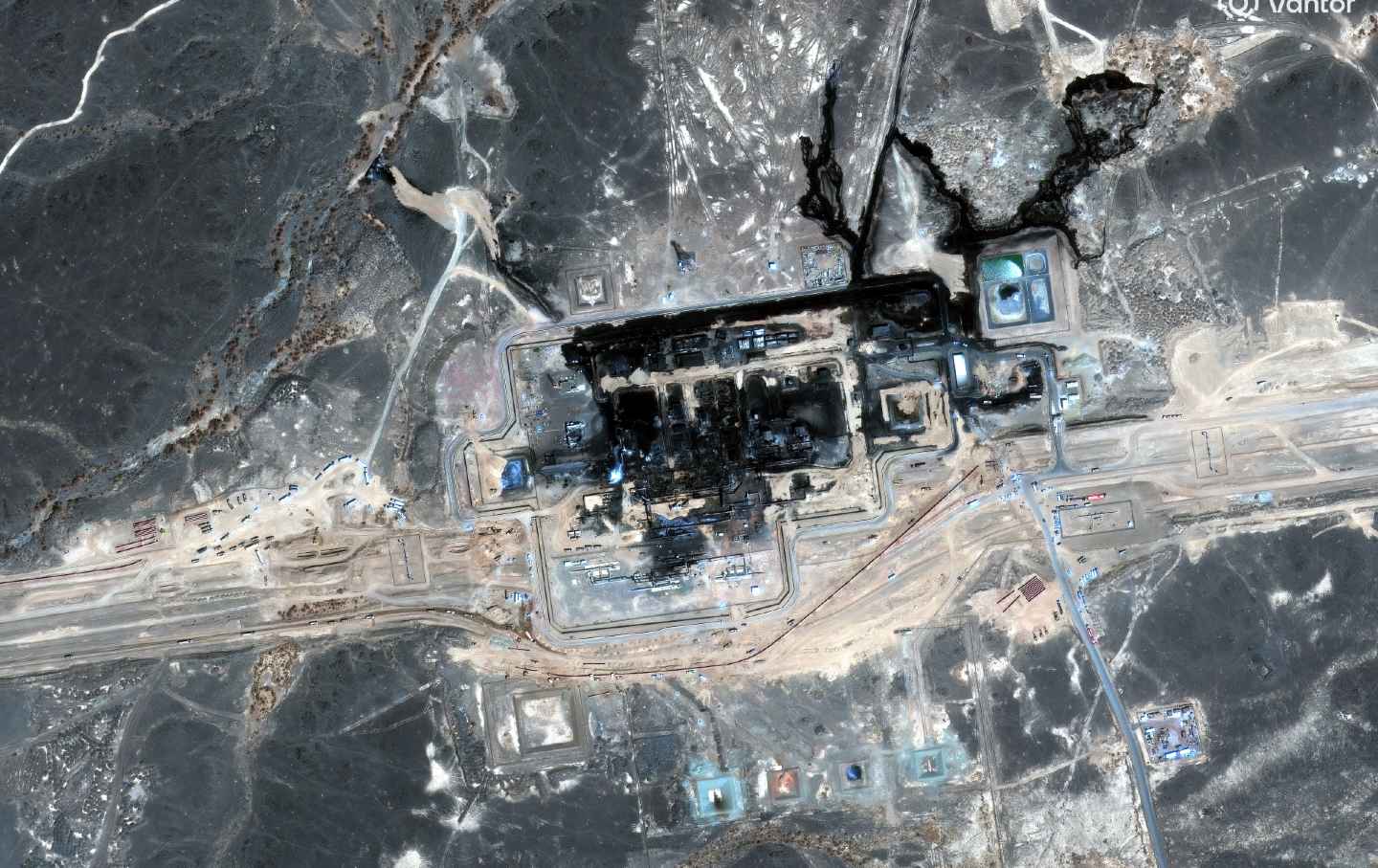
A Spreading War Rattles Global Energy Markets A Spreading War Rattles Global Energy Markets
Analysts say the consequences for energy prices and the world economy may be more serious in this later phase of a war that many had expected to be largely over by now.

