Will Europe Back Down Against Big Tech?
The attempt by Brussels to regulate Silicon Valley is a bargaining chip in the trade crisis.
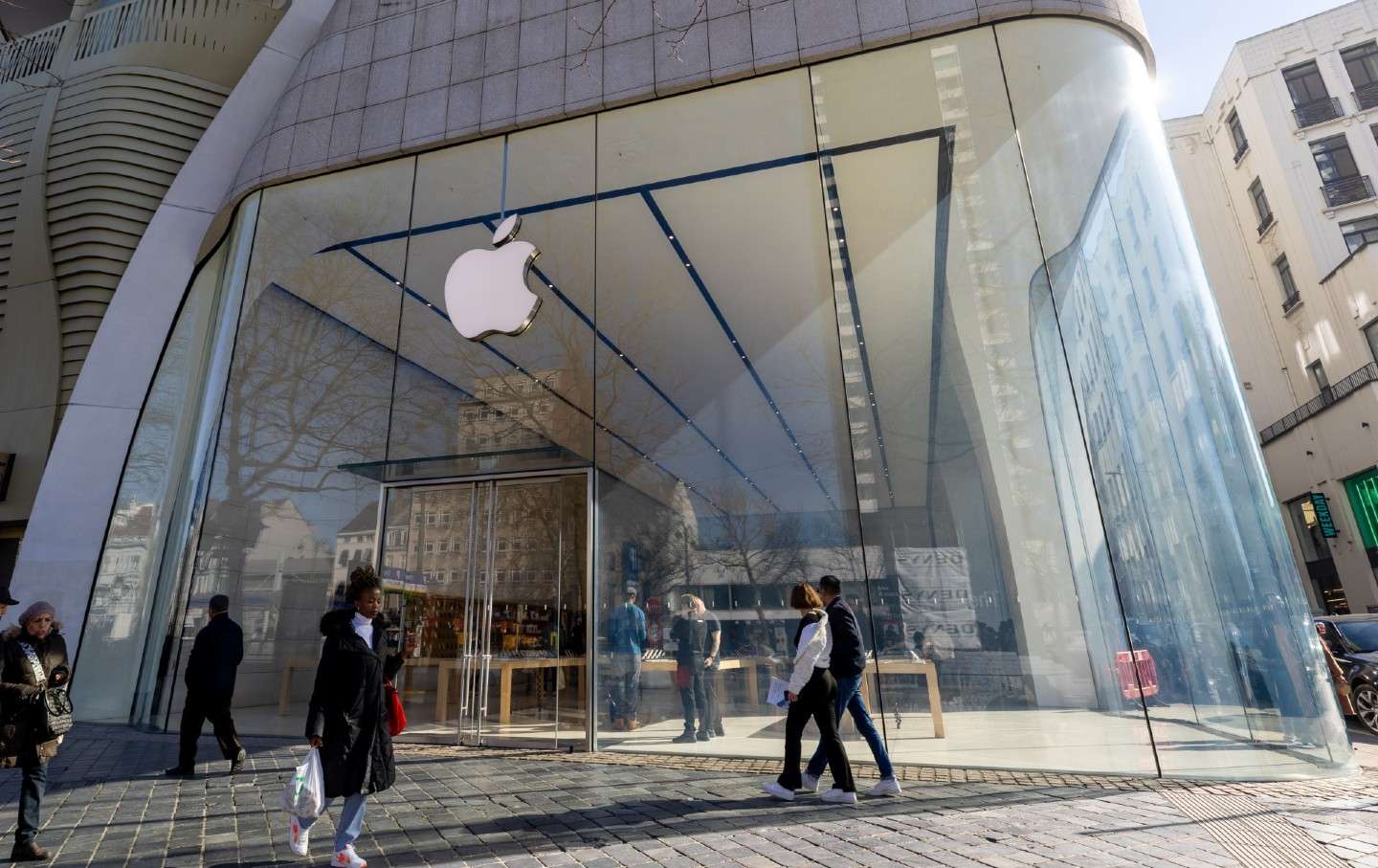
There have been few bright spots in European policymaking in recent years, what with the bloc’s leaders focused on sealing off the European Union’s borders to migrants from the Global South or resisting calls for a comprehensive industrial policy. Perhaps one exception is the growing willingness in Brussels to confront the world’s biggest technology companies. Though limited, legislation like the Digital Services Act and the Digital Markets Act (DMA) have created content-moderation guidelines for large online platforms and curbs on anti-competitive practices. Adopted in 2022, they empower the European Commission—the EU’s executive arm—to launch investigations and order financial penalties for abuses of market power by the Silicon Valley giants. It’s still a long way from full trust-busting, but sizable fines have already been levelled against Microsoft, Apple, and Meta, with several other investigations still ongoing.
But the EU’s appetite to take on Big Tech could fall victim to Donald Trump’s trade war. In early April, with great pomp, the White House announced 20 percent minimum levies on European imports to the United States, before ordering a 90-day pause on the “Liberation Day” tariffs that lowered the surcharge to 10 percent. In the lead-up to negotiations, Washington has angled for Europe to back off from its regulatory offensive. Already in late February, Trump issued a memorandum condemning foreign fines and regulations targeting US technology companies as “overseas extortion” liable for retaliatory US tariffs.
As it attempts to present a unified front to Trump, Brussels is faced with balancing the conflicting interests of its member states and domestic industries. The EU boasts a sizable trade surplus in goods with the United States, although its deficit in services reached €109 billion in 2023, in part thanks to American domination of the digital economy. For member states like France, that’s just where the United States ought to be hit. There is talk of Brussels deploying Europe’s so-called “anti-coercion instrument,” or imposing targeted taxes on online advertising and digital services. But states like Ireland, which hosts a number of US tech firms, and Germany have voiced caution, worrying that Europe just doesn’t have the leverage to wage a concerted campaign against Silicon Valley.
Technically, enforcing the EU’s digital rules shouldn’t be part of the tariff haggling. Of course, Trump makes little distinction between the application of law and deliberate attempts to shackle US interests. But to advocates of regulation, Europe has also allowed its tech investigations to be drawn into the broader trade dispute. For several weeks starting in late March, the commission noticeably delayed the announcement of fines against Apple and Meta for DMA violations. On April 23, it finally settled with a €500 million penalty against Apple for anticompetitive violations in its App Store and a €200 million fine for Meta’s payment model in its collection of users’ data. The penalties will be seen as an attempt to not further aggravate tensions between Brussels and Washington, with sources close to the commission having already moved to lower expectations on the coming sanctions.
Much like anti-monopolist Lina Khan’s tenure at the head of Federal Trade Commission, Europe’s digital regulations have become a favorite punching bag for Silicon Valley billionaires, who broached trouble with Brussels in their political horse-trading before last November’s election. Though Meta is now back in US court for Facebook’s early-2010s acquisition of Instagram and WhatsApp—a case opened in the waning days of Trump’s first term—Mark Zuckerberg in January complained on Joe Rogan’s podcast that EU regulatory fines were “almost like a tariff.”
For all the White House’s bluster about a military withdrawal from Europe, the Trump administration will tolerate no encroachments on US technological supremacy. JD Vance has even alluded to the two being a package deal, warning last fall that Europe’s tech regulations could jeopardize the United States’ security guarantees to its NATO allies. Elon Musk has also taken to lambasting EU content moderation rules. (In January, Musk’s X was ordered by regulators to hand over information about its algorithm). As European governments and companies weigh contracting with Musk’s Starlink satellite service, Trump’s FCC chair, Brendan Carr, vented to the FT about what he saw as a growing “bias” against US technology, putting Europe’s choice in stark terms: keep the door open to the US giants, or accept digital subservience to China.
That was meant as an ultimatum. Yet the FCC chair put his thumb on just what’s motivating Europe’s fledgling steps to defy Big Tech. This has been made possible by an uneasy convergence between anti-monopolists and digital rights advocates on the one hand, and boosters of the EU’s own tech sector on the other. For some, confronting Silicon Valley means giving European technology the chance to develop on more autonomous footing, though the EU’s long-hailed “champions” are still few and far between. For others, the goal is to foster a more horizontal digital commons and marketplace. Either way, Europe’s own “liberation day” may be bartered away to avoid Trump’s.
Support independent journalism that does not fall in line
Even before February 28, the reasons for Donald Trump’s imploding approval rating were abundantly clear: untrammeled corruption and personal enrichment to the tune of billions of dollars during an affordability crisis, a foreign policy guided only by his own derelict sense of morality, and the deployment of a murderous campaign of occupation, detention, and deportation on American streets.
Now an undeclared, unauthorized, unpopular, and unconstitutional war of aggression against Iran has spread like wildfire through the region and into Europe. A new “forever war”—with an ever-increasing likelihood of American troops on the ground—may very well be upon us.
As we’ve seen over and over, this administration uses lies, misdirection, and attempts to flood the zone to justify its abuses of power at home and abroad. Just as Trump, Marco Rubio, and Pete Hegseth offer erratic and contradictory rationales for the attacks on Iran, the administration is also spreading the lie that the upcoming midterm elections are under threat from noncitizens on voter rolls. When these lies go unchecked, they become the basis for further authoritarian encroachment and war.
In these dark times, independent journalism is uniquely able to uncover the falsehoods that threaten our republic—and civilians around the world—and shine a bright light on the truth.
The Nation’s experienced team of writers, editors, and fact-checkers understands the scale of what we’re up against and the urgency with which we have to act. That’s why we’re publishing critical reporting and analysis of the war on Iran, ICE violence at home, new forms of voter suppression emerging in the courts, and much more.
But this journalism is possible only with your support.
This March, The Nation needs to raise $50,000 to ensure that we have the resources for reporting and analysis that sets the record straight and empowers people of conscience to organize. Will you donate today?