The Palestinians the World Forgot
For decades, thousands of Palestinians were trapped in a camp in Egypt, within shouting distance of their homeland in Gaza. This is what happened to them.
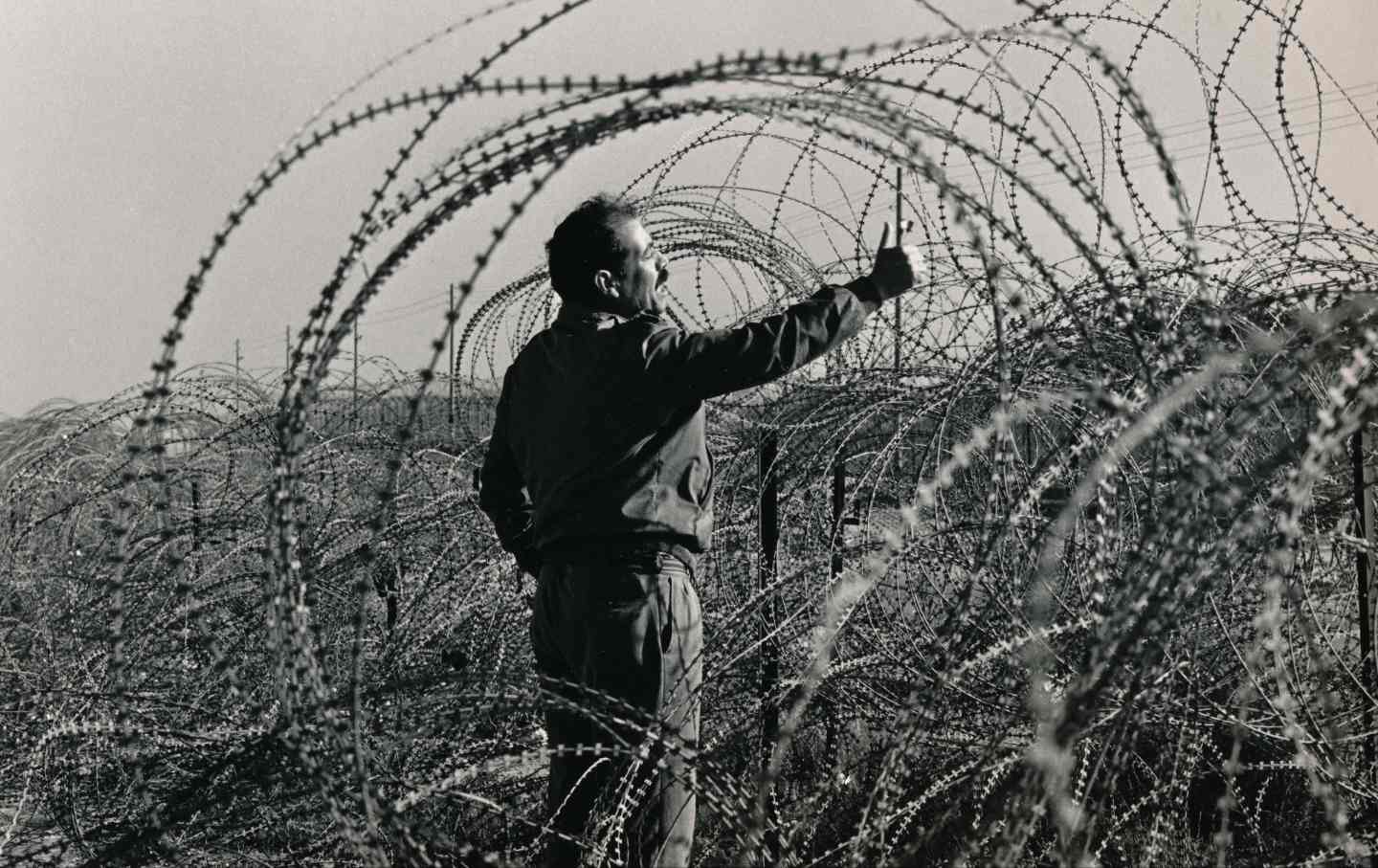
A Palestinian man at the “shouting fence” between Gaza and Egypt, 1984.
(JC Tordai)Cairo—“Don’t forget us! Don’t forget Canada Camp!”
It was July 1994. The wails lifted from thousands of displaced Palestinians marooned in Egypt’s Sinai. They were pressed into a plot of land ringed by a barbed-wire barricade dividing Egypt from Gaza’s southern city of Rafah, still remembered among residents as the “shouting fence.”
Just behind the spindly partition erected after Israel relinquished its occupation of the Sinai Peninsula in 1982 was the newly established international border between Gaza and Egypt. Over 4,000 Palestinians who had been “accidentally” deserted on the Egyptian side of the border were craning to catch a glimpse of Palestine Liberation Organization (PLO) chairman Yasser Arafat, who was making his triumphant return to Gaza after 27 years of exile in Tunis.
The 64-year-old Egyptian-born leader was being hailed by a pageant of rapture across Gaza City. But things took on a far darker cast on the Egyptian side. Mothers wept for children on the other side of the border, some of whom they had not seen in over a decade.
The “Canada Camp” the families referred to was the original name for a housing complex constructed by Israel in the early 1970s to warehouse Palestinian refugees whose homes in Rafah were demolished under the innocuous-sounding pretext of a “road widening” and “security clearance” campaign. (The clearance operations were led by Ariel Sharon, then-commander of the Israeli army’s southern force.) The camp name came from a former Canadian military housing barrack that was set up following the 1956 Suez Crisis in then-Israeli-occupied Sinai. The site, located just southwest of Rafah on the Egyptian side of the border, was repurposed into a UNRWA resettlement project. Lex Takkenberg, UNRWA’s former chief of field relief and social services, called it a “forgotten no-man’s land.”
By 1982, that land was in Egyptian hands, handed back by Israel as part of the Camp David Accords. Egypt and Israel devised a plan to begin relocating the families back to Gaza within six months. But it would be 18 years before everyone was allowed to return. Writing in The Washington Report on Middle East Affairs, Dick Doughty observed that the move constituted “the only instance of an exiled Palestinian community—[in their many thousands], re-entering Israeli-controlled territory since the beginning of the 1967 occupation.”
During that time, contact between Palestinians in Gaza and their displaced relatives was measured in 50 kilometers of sand, patrolled by Egyptian and Israeli soldiers. Those stranded on the wrong side were left in administrative purgatory, orphaned between two jurisdictions—never absorbed as Egyptian citizens, nor permitted to cross back into Israeli-occupied Gaza.
Today, this dreadful repatriation process, from Sinai back to Gaza, feels eerily contemporary, a prototype for the postwar United States–led “Board of Peace” that has already fast begun recruiting its new technocratic “Palestinian” government, and made plans to deploy an international occupation force and ghettoize Rafah. Only now, instead of 4,000 people, over 200,000 Palestinians are languishing in Egypt, driven out of Gaza by Israel’s genocide. Who is willing to stake political capital on their return?
Just as it was some 30 years ago with Camp David, the stubborn “catch-22” in yet another deal mortgaging Gaza’s future is never Israel’s illegal military occupation and apartheid regime but rather how to warehouse all of its “inconvenient” leftovers. Time and again, Egyptians are being asked to “manage” Palestinian life spatially rather than reckon with Palestinians’ inalienable right of return.
At 18, Rafah-born Nisreen Najjar left Gaza to attend Birzeit University in the West Bank. She was there the moment the Washington-brokered Sinai-return bargain lurched from parchment to practice, effectively separating her from her parents, who were quarantined on the wrong side of the newly drawn border.
Before the 1982 boundary was established, Rafah had historically been a contiguous urban center, teeming with shared Egypt-Gaza markets and heavily integrated municipal life, according to Najjar. The town straddled what had been the old Ottoman administrative boundary between Egypt and Palestine, but for both sides, it had yet to acquire the force of a true border.
The lightly enforced frontier, though marked on maps since the 1949 armistice, had not yet been transformed into the elaborate border apparatus that would soon cleave the jointly administered city. It remained porous enough to sustain the social amalgam of kinship, commerce, and Bedouin life that bound Rafah’s Egyptian and southern Gazan communities, allowing families, merchants, and traders to cross with little sense that they were ever entering a different country.
By Najjar’s account, Gaza felt less like a periphery than an extension of the Egyptian nation itself. “Egypt felt like a walk across town, not another world. Crossing was an unremarkable feature of daily life for many,” she says. She adds that during former Egyptian President Abdel Gamal Nasser’s era, “and only his,” Palestinians were granted scholarships to Egypt’s most elite universities.
“Our borders once meant kinship—families crossing at ease, students attending top universities through fully funded scholarships, cultures mingling, trade flowing,” Oroub ElAbed, associate professor in the Forced Migration Programme at Birzeit University, tells me.
ElAbed spent more than two decades interviewing Palestinian refugees across Egypt for her 2009 book, Unprotected: Palestinians in Egypt Since 1948. She says that under President Gamal Abdel Nasser Palestinians were met with radical inclusion in Egypt—granted access to public-sector employment and scholarships to attend top private universities and obtain property. In practice, they moved through public life with many of the same guarantees as Egyptian citizens. Their children enrolled in state schools. Universities charged them domestic fees. The promise extended outward, eventually encompassing PLO fighters and cadres, as well as Palestinians who had served within Egyptian state institutions.
Najjar, now 62 and living in Georgia (USA), remembers the dominance of Egyptian culture from her childhood in 1960s Rafah. Fashion was made up of loafers and brogues paired with crisp trousers or flamboyant skirts—sartorial residues from Egypt’s colonial past. Mohamed Mounir’s Nubian folk used to saturate the streets of Rafah. Cairo’s distinctive accent was slung back and forth among shopkeepers from dusk to dawn. Evening markets were alive with revolutionary Egyptian poet Ahmed Fouad Negm’s unvarnished verses. “It was in every sound. Egyptian music was on the radio, on TV, in our classrooms. Our curriculum was entirely Egyptian. Our books. Our literature. Our hearts have always leaned that way,” Najjar says.
That brief housewarming slammed shut after 1967, when Israel occupied Gaza, the West Bank, East Jerusalem, the Sinai, and the Golan Heights. Nasserism suffered a devastating blow. Palestinian national movements gained greater autonomy from Arab states. And Pan-Arabism, one of Israel’s most formidable obstacles on the road to Camp David, began to retreat.
By 1969, roughly 33,000 Palestinians remained in Egypt, according to ElAbed. They lay suspended between a flash of pan-Arab ambition and experimentalism that had largely expired and a “temporary” displacement from their homeland that was quickly turning permanent. “Palestinians lost their lifelines to Gaza and Egyptians lost a neighborly intimacy that had once blurred any difference between them,” ElAbed says. “What had always been warmth and friendship turned into surveillance, deep suspicion, and ultimately where we are today on a national scale: estrangement and exclusion.”
Then, in 1982, the Israeli military bulldozed a 50-meter swath just south of Rafah, fencing it out on either side. Thousands of families, Najjar’s among them, were marooned in Canada Camp. By the time Najjar graduated and returned to Gaza to live with her grandparents in 1985, her parents had found themselves trapped on Egyptian soil for three years. They were effectively stateless.
Soon after, barbed wire was erected, and those who had once crossed into the West Bank for work found that access was withdrawn. Proximity initially prevailed; hands could meet across the barbed fence. But not long after, Israel balked at the closeness between Canada Camp and Gaza and imposed a 10-meter buffer between the two fences that would later swell to 40. Separated families could meet only by appointment.
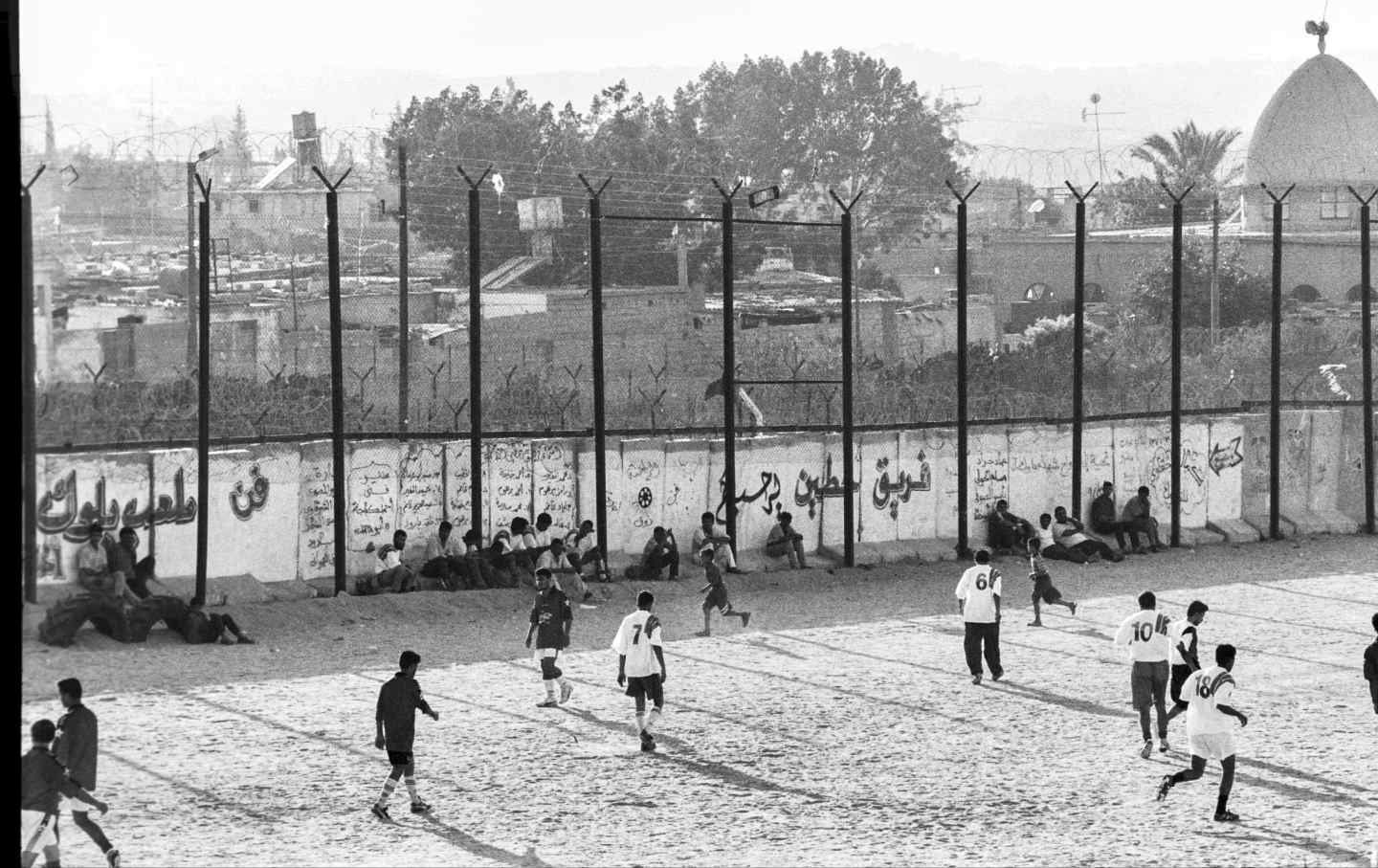
The partition acquired an infamous nickname—the “shouting fence”—at two designated points along the barbed wire, positioned a stone’s throw apart from one another. Because the border ran so absurdly close, separated families in Rafah easily traded greetings—within a literal shouting distance—across it. Hands waved, names were yelled, kisses were blown. The divide was close enough for brides on one side to twirl in the sand in front of their parents on the other side.
“One of the cases my family remembers well is of a newlywed woman from our town who was forced to return to Canada Camp after the temporary three-month permit to Gaza expired. Israeli authorities repeatedly denied her requests to reenter and be with her husband after the wedding,” says Najjar. “She was pregnant and had her baby in the camp. The father did not even get to hold his own child until she was 3 years old.”
Lex Takkenberg, former UNRWA chief operator and head of the food distributions to Canada Camp, saw this too. “I witnessed it on countless occasions: neighbors and relatives speaking across the [barrier],” he says. “Eid celebrations and big family news traveling over the wire. Children were lifted above shoulders to show parents how much they had grown.”
At the fence, Najjar shouted across to her parents that she had found the love of her life, a painter she had met in college. “Every girl needs to hold their father’s hand on their wedding day. He was supposed to walk me down the aisle. Yet even this, he had to ask Israel’s permission for. It was hard to afford the costly Israeli permits to return to Gaza every three months.”
Najjar’s father found his daughter’s wedding increasingly impossible to attend. Palestinians jettisoned onto Egyptian soil could not move—not toward their local markets where they once bought their favorite snacks, not toward their children, spouses, nor workplaces in the occupied West Bank.
“Usually, when one visited the shouting fence, it was known…. we never got to stay long,” Najjar says, “both sides would inevitably kick you out. But I was emotionally unable to stay regardless. It was too much…. Just too much.”
Neither Egypt nor Israel hurried to repatriate Najjar’s family, or any of the other residents of Canada Camp to Gaza. Ann M. Lesch, a professor of political science at the American University in Cairo, concluded in a study in 1985 that the major obstacle to progress for the camp’s residents was “internal opposition [in Israel] to letting the Palestinians return from Sinai to Gaza,” where Israel had already established illegal settlements. According to the late Ron Wilkinson, then head of Cairo’s UNRWA office, “Even despite the availability of funds and land, there were various [moments] when the process of relocation was stalled by the lack of political will, on both ends.” By October 1991, Egypt’s formal admission of insolvency offloaded “the Palestinian problem” to UNRWA, already starved of funds.
In the end, nearly 20 years elapsed before the last residents-in-limbo of Canada Camp, a total of 4,388 individuals as UNRWA recorded, were finally allowed to move to the Tel-Al Sultan housing project in Gaza. Under Canadian prodding, a timetable was drawn up to shepherd the process to its long-resisted finish line. Canada offered up more funds to pay for the final infrastructure in Tel al-Sultan.
UNRWA’s camp administrator compiled household registries and submitted them to Egyptian authorities in Rafah via the Liaison System of Egypt (LSE), who then transmitted the names of proposed returnees to Israeli officials. Once Israel assented, confirmation traveled back through the LSE to UNRWA in Canada Camp. Families sent word outward, notifying their sons working in the Gulf or Libya, and to their daughters studying abroad, to return, timing their reunions to the uncertain moment when a plot of land in the newly developed Tel-Al Sultan camp was deemed “habitable.”
The rebuilding fell to the fathers and their sons. The head of the household, often with one or two boys in tow, crossed through Rafah’s Salah Al-Din Gate to commence the building project by hand. Weekends were spent back in Canada Camp, with families still waiting.
Though newly built, Tel al-Sultan had limited infrastructure and chronically underfunded municipal services. It was a prerequisite for the head of the paternal family to build a dwelling and bring it to a standard deemed “livable” before the crossing of the full household could be authorized. Israeli officials decided when that threshold was met—a task later taken over by the nascent Palestinian Authority. Once it was determined that a shanty was ready, families in Canada Camp packed their scant belongings, hired a truck, and traveled south to the Al-Ouja/Nizzana crossing, where return was capped at four households a day. From the Israeli side, another truck was hired to carry them the final leg to Tel al-Sultan.
“My parents finally came back after almost two decades of unnecessary exile, in 1995,” Najjar tells me. “My father’s house alone cost more than $80,000. They gave him 12 [as compensation]. Twelve thousand for a life dismantled. Twelve thousand for walls that once held and lost generations. And those who took it built shelters of asbestos.”
With Canada footing the bill, the last 10 families returned to Gaza in December 2000. The modest reversal of their banishment—not restoration to their original homes, but a rerouting to a new camp—was bittersweet and short-lived. As the Second Intifada gathered momentum in 2000, Israel unilaterally widened the Rafah buffer zone to 200–300 meters, installing a corrugated eight-meter metal barrier that stretched over a kilometer and a half, compressing it into the heart of what had once been a densely inhabited quarter of Palestinian life.
After the death of Israeli soldiers in the buffer zone in May 2004, Israel formally approved plans to widen the zone even further, enforcing demolition of all homes within 300 meters of Israeli military outposts—roughly 400 meters from the border itself—prompting widespread destruction that left swaths of Rafah, once more, depopulated.
Egypt, predictably, kept pace with its treaty-bound friend. On the Egyptian side of Rafah, the state began its own clearance operations in the mid-2010s, razing thousands of homes and forcing Bedouin families out in the name of anti-smuggling and Islamist counterinsurgency. Beginning in 2014, the Egyptian military was pushing outward to roughly 1.5 kilometers inland from the border, flattening residential and commercial structures and displacing several thousand Egyptian families in North Sinai.
Popular
“swipe left below to view more authors”Swipe →Rafah is now an aggressive buffer zone that has time and again dispossessed both northern Egyptians and Rafah’s southern Palestinians. This was never about territorial adjustment but social clearance and militarized housekeeping: land incrementally hollowed on both sides, pressed inward against civilian life, until Rafah was refashioned into a disconnected terrain where ever-expanding steel barricades and armored perimeters injure our most vulnerable.
At times throughout her life, Najjar wondered what no fence at all would look like—an unbroken expanse of Palestinian backyards stitched together in a quilt of soil, sun, and the poetry of Gaza’s nature. A quilt of harvested herbs, Rafah’s finest cherry-red kalaniyya flowers, an endless sea of grass and aubergine beds. Sinai’s Bedouin and Rafah’s children playing in the open space, their limbs flinging toward earth and air like they had every right to be there; parents free from the cruelty of man-made borders and all-encompassing grief and estrangement.
“No matter who sits in Egypt’s palaces, my people love them,” Najjar says. “Egypt has always been our second home. That love is older than governments, older than fences. Older than any corruption. It is the music and sorrow still playing in our hearts.” When proletarian cries of “bread, freedom, justice” detonated in Egypt’s Tahrir Square in 2011, cheers of recognition and allegiance fanned across Gaza’s streets, Najjar tells me, the likes of which she had not seen before. After all, Gazans and Egyptians remained kin in everything but policy.
Today, as the lone Arab state to house hundreds of thousands of Palestinians without the auspices of any UN-affiliated or humanitarian camps, “Egypt’s stance is unique in that it has always acted, [rhetorically] on the pretense of preserving [Palestinian] identity,” says Maysa Ayoub, associate director at the Center for Migration and Refugee Studies at the American University in Cairo.
“The irony is undeniable,” says ElAbed. “Today, while condemning Israel’s siege, Egypt enforces similar restrictions at Rafah and within its own territory.” By excluding Palestinians from the formal labor market, professional syndicates, social welfare programs, and state-issued refugee identity documentation, the state converts temporary refuge into an intergenerational legal vacuum. “Cairo justifies this as ‘national security’—shielding Sinai from further volatility through the influx of Palestinian nationals—but the effect is collective Palestinian punishment,” ElAbed adds.
“Stripping a people’s rights and reducing them to misery, in the name of preserving their return, is legally bullshit,” Takkenberg says.
Nearly three decades have passed since the last of Canada Camp’s families returned to Gaza. But their cries have outlived every “ceasefire.” For those shuttled back after each violent round of displacement, their invisible lives in Egypt are defined by just the same accursed wait from the same forsaking hands: for refugee documents owed by international law, for sustenance yanked from precarious, “underground” networks, for recognition. For return.
Peace in the Middle East, the victors called it. A table set for everyone but the Indigenous, who remain as Canada Camp and every subsequent relocation has left them: unconsulted and unaccounted for. Long after the credits roll and the world moves on, they will still be here, lugging the same exhausted cries—relics of a hundred-year war that never ended.
“Don’t forget us.”
Become a Sustaining Donor This September
Between the reemergence of right-wing red-baiting and Donald Trump’s use of the chilling National Security Presidential Memorandum–7 to criminalize left political organizing, we’re seeing McCarthyism reborn before our eyes.
This assault on democracy cannot be ignored or wished away. Resisting it requires bravery in the face of threats and repression, a steadfast commitment to the truth, and the unwavering belief that we can—and will—overcome this darkness.
We must have an independent media that sets the record straight, unearths corruption and abuses of power, and advances a politics of justice and dignity for all if we’re to win this fight.
That’s why I’m writing to you today. This September, The Nation needs to add 100 monthly donors to sustain our progressive journalism. Your contribution makes the next investigative report, the next truth-speaking column, and the next pathbreaking essay all possible.
I hope you’ll support our work with a recurring donation today. If you donate $10 or more a month, we’ll send you a brand new “Hands Off the Free Press!” sticker to recognise your commitment to our cause. Please, donate today.
Onward,
Katrina vanden Heuvel
Editor and Publisher, The Nation
More from The Nation

Accountability for the Gaza Genocide Can’t Focus on Netanyahu Alone Accountability for the Gaza Genocide Can’t Focus on Netanyahu Alone
Getting rid of one bad leader won’t bring justice.

How the AfD Benefits Politically From the Ukraine War’s Backlash How the AfD Benefits Politically From the Ukraine War’s Backlash
No election result is monocausal, and there are clearly many factors that have converged to make the AfD Germany’s most popular party.
Cuba: The “Pandora’s Box” of US Humanitarian Assistance Cuba: The “Pandora’s Box” of US Humanitarian Assistance
As the US strangles Cuba economically, Marco Rubio is running a $100 million “hearts and minds” program on the island.
The Palestine of Soraya Antonius and Annemarie Jacir The Palestine of Soraya Antonius and Annemarie Jacir
In The Lord and in Palestine ’36, the story of Mandatory Palestine comes into focus.
Let Them Eat Spreadsheets Let Them Eat Spreadsheets
How the EU is contributing to the rise of Europe’s far right.