
Woody Allen’s New York—and Mine
The director’s vision of New York City once seemed aspirational, but his endorsement of Andrew Cuomo suggests he may not understand the city beyond its fiction.
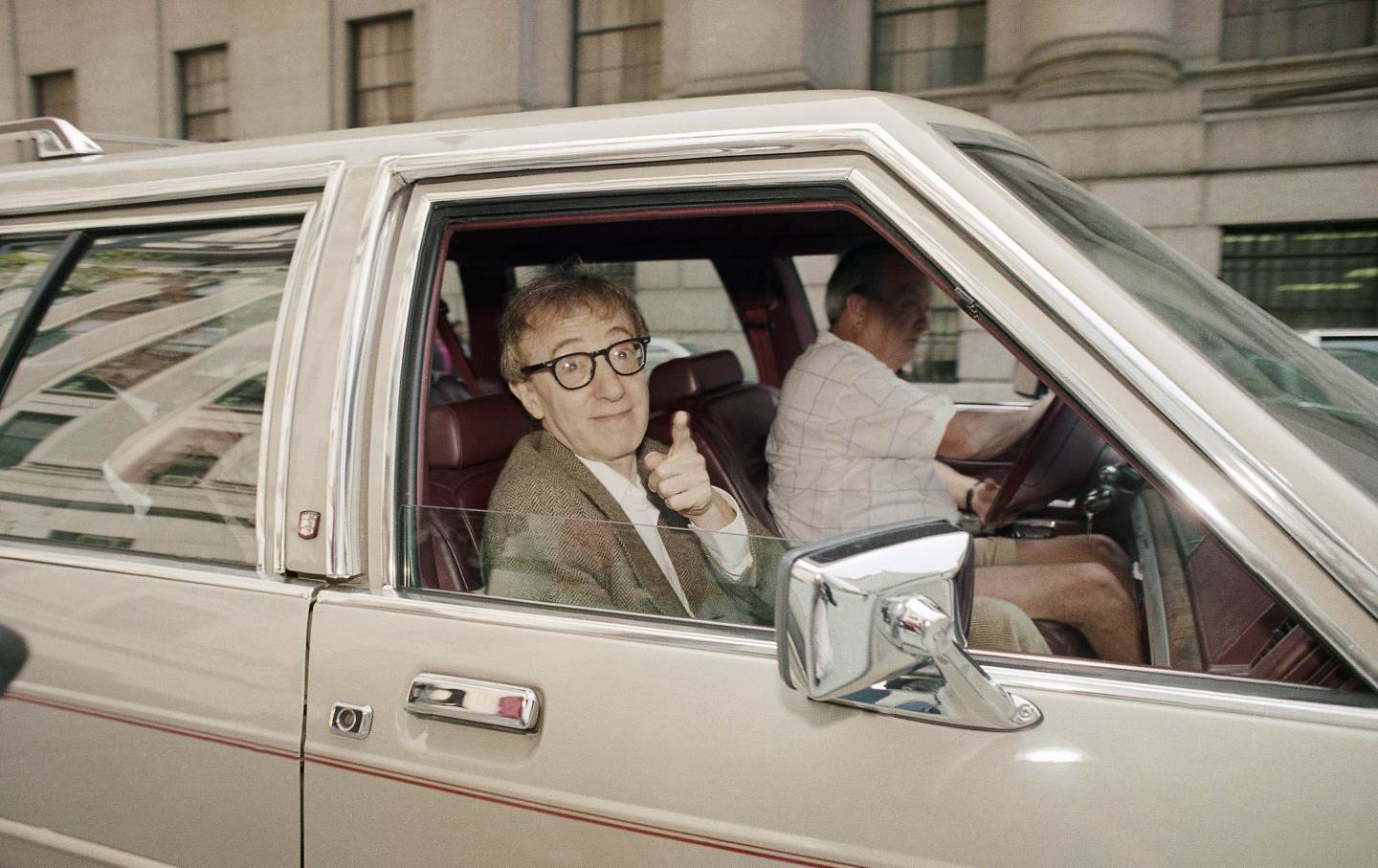
Director Woody Allen leaves Manhattan surrogate court in a car, New York, June 10, 1993, following a second day of hearings on efforts by ex-lover Mia Farrow to undo his adoption of children.
(Mario Cabrera / AP Photo)Isaw Woody Allen onscreen for the first time as a 17-year-old, a senior at an all-girls Catholic school in a small New England town called Riverside. In the middle-class Rhode Island suburb where I was brought up, the type of person Woody Allen plays in Manhattan—a glib, disaffected, neurotic, middle-aged TV writer—did not exist. Or if they did, I had no knowledge of them—and that’s probably the way it should be, though one really cannot tell the story of Allen’s life and work without thinking at least a little about strange relationships between middle-aged men and high-school-aged girls.
But I met this kind of character through Allen’s movies. They opened me up to the then-unthinkable possibility that life was about something other than gainful employment and relationships designed to lead to marriage. That an adult could not only write for a living but could tire of that work, could quit because they found it too boring, as Isaac Davis, the protagonist of Manhattan does, was strange to me, surrounded as I was by adults who worked far more strenuous jobs in order to live much more modest lives, whose concerns seemed to revolve around supporting their children, sending money back to relatives abroad, and keeping up a respectable veneer, even as the truth of their marriages and family systems were no doubt just as fraught as the sexual dysfunction and romantic indecision Allen’s filmography is so full of.
I’ll be 28 this winter. A decade has passed since I watched these films for the first time, a decade in which I left home, went to college and graduate school, settled in New York and wrote a novel, all while never really registering how unrecognizable my life has become from the way I lived as a child. In the months leading up to the publication of my first book this past summer, I gave self-promotional interviews through my computer screen from the second-floor apartment of the Brooklyn brownstone where I now live. I paid my rent each month without giving it a second thought because I was fortunate enough to have income from my book advance. I was single then, living alone. I went to analysis a few times a week, where I talked about my boredom with writing, my anxieties about living a frivolous life in a major city and other bourgeois nonissues. I spoke to friends who told me they were depressed, late on deadlines, having affairs, or thinking of splitting up with their boyfriends. I felt ambient dread about the potential reception of my novel. In those slow-moving weeks I decided to turn to none other than Woody Allen himself.
I watched and rewatched his oeuvre, comforted by the romantic and now-familiar images of metropolitan skylines, foggy riverfronts. and charming interiors populated by bohemians and pseudointellectuals to whom nothing bad happens except for heartbreak. Viewing these films a decade after seeing them for the first time, rather than looking at their casts from a distance with a mix of awe, pity, and confusion, I felt my own, real ambivalence about my proximity to people, or even my own similarities to Isaac Davis. I was sad to realize I, too, had become a glib, disaffected, neurotic writer.
Distracting myself with Allen’s archive, I saw that what his films offered were predictable and often masterful riffs on the themes I had come to expect from the director: married people falling in love with technically unavailable, also married partners; solipsistic writers using self-deprecation to conceal their vanity; the aimless search for meaning in Uptown restaurants. Interiors, Annie Hall, Crimes and Misdemeanors, Bananas, Another Woman, Husbands and Wives, Hannah and Her Sisters—in Allen’s case I don’t think it is pejorative to say that if you have seen one, you have seen them all. Woody Allen, at his best, imports directors like Bergman, Buñuel, and Trauffat for popular American audiences. It’s Fellini for philistines or Hitchcock with less heft. It is what, among other things, Joan Didion accused Allen of in her 1979 New York Review of Books essay on the director. What Didion gets wrong about Allen’s films, however, is that their frivolity and navel-gazing are not oversights but part of their design. They are middlebrow romantic comedies and not works of social realism.
If Allen’s films do not entirely transcend their genre, they represent the very best of it by sticking to what they do well: selling a fantasy of New York City. While sitting in my boyfriend’s living room in London rewatching Manhattan I saw the black and glowing East River onscreen and I was reminded of the final line of Ursula Parrott’s novel Ex-Wife: “New York lights blurred behind us…that was a shining city.” In Allen’s films, the city does have a sheen that is witnessed more rarely in life. My writing this essay now in my Brooklyn apartment is in some ways a testament to the allure of his plots, settings, and casts.
“New York was his town and it always would be,” I remember Isaac Davis saying in Manhattan. Initially, it came to my ears as a neutral declaration of identification with a hometown, an enthusiastic connection to one’s geographical origins that I did not possess. I have no strong sense of regional identity—this was not something my family particularly modeled or valorized—but I’ve always admired it in New Yorkers. Whether it is real or contrived, I respect their investment in their home and all the myriad ways this sense of identification manifests racially, socially, and politically. I imagine that when the late Caribbean American drill rapper Pop Smoke called himself a New Yorker, he meant something different from what Allen, born in 1935 to a middle-class Jewish family in Midwood, meant when he made the films Pauline Kael described as an “ongoing poem to love and New York City,” and that is a testament to the city’s richness.
These different perspectives are not on display in Allen’s films; the auteur’s general indifference to depicting the problems that plague most working adults in one of the most expensive cities in the world can feel callous. A generous reading is that these narratives do not take place in reality but in the realm of Allen’s wishes and fantasies. His characters may be hypochondriacs, but they never get seriously ill or go bankrupt from medical bills. They may quit their jobs, but they never fear impoverishment. If they misbehave sexually, they don’t fear ostracization or professional fallout. This last one, however, may be the most lifelike aspect of his films.
Last month, Woody Allen appeared in a video on Bari Weiss’s Free Press to promote his debut novel What’s with Baum? , which was released with what appeared to be nothing more than a whisper. By this point in time, Bari Weiss may be one of the only journalists to give the director that much space to promote his work. In the video, Weiss presents herself as more of a fan than a reporter, tossing Allen mostly friendly, sycophantic questions. An hour in, she turns to the topic Allen holds so close to his heart: New York City. With the mayoral election on the horizon, Weiss prefaces her question about which way Woody Allen will vote by acknowledging that Allen does not think of himself as a “particularly political person.” Allen then goes on to endorse Andrew Cuomo, explaining that while front-runner Zohran Mamdani is “perfectly nice,” he feels that Cuomo is more fit for the job, no further evidence provided, though one cannot help but draw comparisons between the two men for the sexual controversies that, in some ways, define their lives and careers. Allen’s endorsement, while not necessarily surprising, forced me to wonder, how well does Woody Allen actually understand New York? Does the director actually understand the place rather than the fiction? Or is he content to entertain us so long as his portraits are only of the city as a playground for the rich and frivolous?
This summer, as I made my way through Allen’s romantic filmography, I also happened to be knocking on doors for Mamdani in my neighborhood of Bedford-Stuyvesant. I walked down the block with a friend, another novelist, a classmate from graduate school. Here were the two of us: Black and white Americans, in raincoats, situated on the cusp between two generations, hanging informational materials about free buses and affordable childcare on doorknobs. We were not feeling sophisticated or ironic or jaded, but rather truly, genuinely thinking about something other than ourselves or our careers. What mobilized me and many others to wade through the streets in the pouring rain, I realized, was Mamdani’s ability to produce his own cinematic vision of New York: not one populated solely by bourgeois bohemians but a place hospitable to the working class. He may not be a trained auteur like Allen, or his own mother, but he is attuned to the dominant visual medium of our time: short-form video circulated on social media platforms.
The ability to create compelling images, to be persuasive on screen and to depict a future that people want to vote for and live in remains a quintessential part of a political candidate’s viability across the political spectrum. Whether it is the White House’s inhumane clip that seems to brag about mass deportation, Andrew Cuomo’s bizarre AI-generated advertisement where he poses as a train conductor, a cabaret dancer, and a window washer, or documentation of Mamdani shaking hands with everymen while walking the length of Manhattan, we are all forming our opinions based on the onscreen images we are offered. A great deal is communicated through a politician’s cinematographic vision.
The first time I watched a Woody Allen movie was just before I left high school. I was just a few months older when I watched President Trump’s first acceptance speech in Bard College’s campus center. I saw people weep and call their parents. I saw #MeToo play out on my college campus as a passive onlooker, bearing witness to both the affordances and limitations of personal testimony as well as the inarticulable pain of having to publicize the most private events of one’s life. I saw a police vehicle lit on fire through my cellphone during the Black Lives Matter uprisings. I got Covid. I watched Cuomo lie to his constituents on cable news livestreams, then resign in disgrace.
Like films, I watched the major events of my lifetime unfold on screens at a rapid pace with details too strange to assimilate. When Manhattan’s Isaac Davis says that New York is his town and always would be, it is part of a first chapter-in-progress. It is a series of false starts, one of which begins: “He adored New York City. To him, it was a metaphor for the decay of contemporary culture.” Perhaps fixing this degradation requires accepting that this decay is not figurative, but real.
More from The Nation
New Mexico’s Grand Experiment New Mexico’s Grand Experiment
Last November, the state made childcare free for children of all ages, for all families. The impact has already been profound. “I feel like I can breathe," one mother said.

Should Parents Be Convicted for Mass Shootings Committed by Their Children? Should Parents Be Convicted for Mass Shootings Committed by Their Children?
Given that our politicians are refusing to deal with the reality of gun violence, it’s tempting to say yes. But the ultimate responsibility for such violence lies elsewhere.

Anthropic Wants You to Be Kind to Claude Anthropic Wants You to Be Kind to Claude
…even as AI courts serial real-world disasters, defaces the environment with data centers, and is not about to return your empathy in kind.
“We Can’t Punish Our Way Out of This”: A Conversation on Meaningful Accountability After Cornell “We Can’t Punish Our Way Out of This”: A Conversation on Meaningful Accountability After Cornell
A discussion with Rebecca Solnit and Rabbi Danya Ruttenberg about what accountability should look like for survivors of sexual assault and rape.
Smoke and Mirrors: The Right's Latest Attacks Against Trans People Smoke and Mirrors: The Right's Latest Attacks Against Trans People
The MAGA movement is redoubling its attacks on trans healthcare in an attempt to win votes this November.
The Real AI Threat Is Already Here The Real AI Threat Is Already Here
Never mind some future apocalypse—AI is being used right now to cause enormous suffering.

