
Trans Kids Are Facing a Terrifying New Reality
The nationwide drive to eliminate gender-affirming care has trans youth and their families contemplating a series of agonizing choices.

Daniel Trujillo, 17, sits in front of the Supreme Court.
(Courtesy of Lizette Trujillo)Last December, then–US Solicitor General Elizabeth Prelogar and ACLU attorney Chase Strangio stood before the justices of the Supreme Court to argue against Tennessee’s ban on gender-affirming care for minors.
The case, United States v. Skrmetti, seeks to address Tennessee Senate Bill 1, which prohibits “a minor to identify with, or live as, a purported identity inconsistent with the minor’s sex” or to treat “purported discomfort or distress from a discordance between the minor’s sex and asserted identity.” Prelogar and Strangio—the first openly trans lawyer ever to argue a case at the Supreme Court—told the justices that Tennessee’s law violated the equal protection clause of the 14th Amendment.
Outside the court, thousands of trans youth, community activists, and families marched and rallied. Efforts were coordinated in large part by the Gender Liberation Movement, cofounded by veteran LGBTQ+ activists Eliel Cruz and Raquel Willis. Soon after the protests subsided, Cruz and about 30 others staged a bathroom sit-in at Capitol Hill. “We understood the stakes, but we also understood the lengths that the government will go to to eliminate trans people from public spaces,” Cruz explained.
The conservative war on trans people was well underway when the protest took place. Since then, things have become exponentially worse, with the Trump administration all but attempting to drive trans people, and trans care, out of existence. Conservative—and, increasingly, Democratic—politicians and talking heads parrot tropes about trans people as a public threat in bathrooms, sports arenas, and libraries. At the legislative level, bills barring transgender service in the military and mandates of one’s assigned gender on their passport are far more than symbolic. Their justifications always sing a familiar tune: that we must “protect women and children,” and that promoting or even acknowledging trans people in the public eye is somehow antithetical to that virtue.
Gender-affirming care for minors is often at the heart of these attacks. Apart from Trump’s efforts at the federal level, 27 states have either restricted or banned gender-affirming care for trans kids; these laws affect an estimated 40 percent of all trans youth in America. Many of the new bills policing procedures like hormone-blocking implants are based on erroneous scientific claims, and ignore that gender-affirming care early on in one’s life can be foundational and life-saving—something well-substantiated by medical literature.
This landscape has forced trans kids and their families to confront an increasingly chilling new reality: one where the care they need is either out of reach or in danger of being cut off.
Daniel Trujillo, a high school senior in Tuscon, Arizona, was at the December rally. He is no stranger to advocating on behalf of trans people. By the time he was 9, he was going to lobby legislators at the Arizona State Capitol. (On one occasion, Daniel passed state Senator Rosanna Gabaldón a sticky note with a message, urging that he be treated like a human being.) Since then, he’s found spaces in which he’s affirmed. “Tuscon is a little blue bubble in a big old Red state,” he told me. “We have a lot of community here.” In fact, Tucson became one of the first places with a citywide nondiscrimination policy in the 1970s, with trans people added to the policy 20 years later.
Daniel’s mother, Lizette, had always been an impassioned activist but never expected to become an advocate for trans youth before she had her son. “We began seeing gender incongruence when he was around 2 and a half, but it took us time to figure out the best path forward to affirm him,” she said. As anti-trans rhetoric has become more intense in the past few years, she said, Daniel has gone from a self-proclaimed “shy little kid” to bearing a heavy-felt sense of responsibility. “We drive to a different school district which we were told had really great nondiscriminatory policies,” she said.
Though Lizette and her husband initially thought themselves to be one of the only sets of parents of a trans kid in Arizona, their family has been judicious about finding a fostering statewide and national community. “The December rally almost felt like a family reunion,” Daniel said.
Lisette and Daniel are preparing for every possible outcome of the Skrmetti decision, which legal experts speculate will be handed down in June. Lizette maintained that the number-one focus is ensuring a supportive environment for her son. “To have the government step in and strip him of care feels really cruel.… You hear these statistics about suicidality and wonder how people are finding a continuation of care outside of their state,” she said. Luckily, Lizette continued, “Daniel has never struggled with suicidality because he’s been affirmed.”
One evening in 2021, Derrick Fielder’s wife shared the news that their 9-year-old child had come out to her the night before. “I think I’m supposed to be a boy,” Talon had said.
From that moment, Derrick, who was deployed with the Iowa National Guard, and his wife confronted their own misconceptions about trans people, consulting medical professionals and parents of trans kids. Eventually, they began having real conversations around whether their son would be safe in Iowa. (The state banned gender-affirming care for minors in 2023, and this February, Governor Kim Reynolds signed a bill that removes state-level civil rights protections from trans and nonbinary people.) They decided to move to Tuscon.
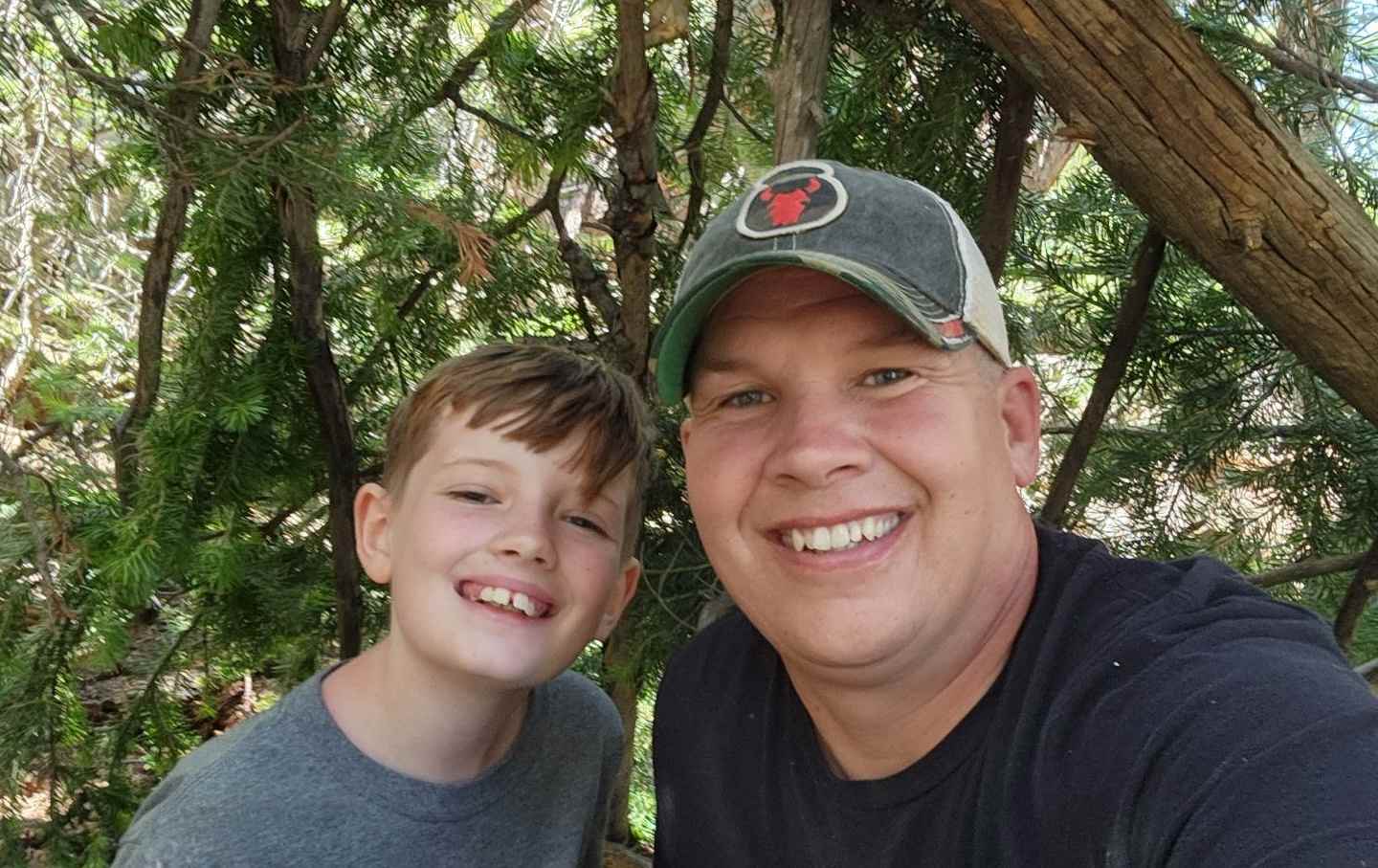
After socially transitioning in late 2021, Talon was able to begin hormone blockers under TriCare, the insurance provided by the US military. However, a funding resolution under the National Defense Authorization Act passed in December now bans TriCare from covering gender-affirming care for minors. The Fielders have a choice: attempt to switch to a potentially more costly private option, or stick with TriCare and be denied coverage entirely.
Meanwhile, Talon wants to follow in the footsteps of his father. “He’s already eyeing the junior ROTC program,” Derrick said. But an executive order signed within the first week of Trump’s administration has moved to ban transgender troops from serving openly in the military.
Whereas some families are seeking out Blue oases to find affirmational spaces for their kin, others are wondering whether staying put might be the best option. In Hooksett, New Hampshire, Rosie’s 8-and-a-half-year-old daughter, Emily, who is nonbinary, attends a Montessori School and summer camp for gender-nonconforming and trans kids. New Hampshire, a Republican-leaning purple state, recently introduced a bill to bar trans people from bathrooms and locker rooms. The bill is a carbon copy of an anti-trans bill in 2024, which passed through the House and Senate but was vetoed by then–Republican Governor Chris Sununu. Some families of trans youth, including Rosie, have their contingency plans at the ready. “This might sound a bit alarmist, but Canada’s not far!” she told me half-jokingly. “Everything has become proactive. We had her name and passport changed, and are proactively getting a hormone blocker implant.… We don’t know if it’ll be available in the next six to nine months.
It’s difficult not to look at the US v. Skrmetti case as causing a similarly impossible situation for families as the rollback of Roe v. Wade did for thousands of women. In both cases, our nation’s vulnerable are being forced to make critical, lifesaving decisions across state lines, risking their health, financial security, and privacy. For some families of trans youth, this is a new and somewhat terrifying reality.
Support independent journalism that does not fall in line
Even before February 28, the reasons for Donald Trump’s imploding approval rating were abundantly clear: untrammeled corruption and personal enrichment to the tune of billions of dollars during an affordability crisis, a foreign policy guided only by his own derelict sense of morality, and the deployment of a murderous campaign of occupation, detention, and deportation on American streets.
Now an undeclared, unauthorized, unpopular, and unconstitutional war of aggression against Iran has spread like wildfire through the region and into Europe. A new “forever war”—with an ever-increasing likelihood of American troops on the ground—may very well be upon us.
As we’ve seen over and over, this administration uses lies, misdirection, and attempts to flood the zone to justify its abuses of power at home and abroad. Just as Trump, Marco Rubio, and Pete Hegseth offer erratic and contradictory rationales for the attacks on Iran, the administration is also spreading the lie that the upcoming midterm elections are under threat from noncitizens on voter rolls. When these lies go unchecked, they become the basis for further authoritarian encroachment and war.
In these dark times, independent journalism is uniquely able to uncover the falsehoods that threaten our republic—and civilians around the world—and shine a bright light on the truth.
The Nation’s experienced team of writers, editors, and fact-checkers understands the scale of what we’re up against and the urgency with which we have to act. That’s why we’re publishing critical reporting and analysis of the war on Iran, ICE violence at home, new forms of voter suppression emerging in the courts, and much more.
But this journalism is possible only with your support.
This March, The Nation needs to raise $50,000 to ensure that we have the resources for reporting and analysis that sets the record straight and empowers people of conscience to organize. Will you donate today?
More from The Nation

The Real Reason Americans Love Guns The Real Reason Americans Love Guns
With a weak social safety net, a gun offers a false sense of personal power and security.

The Endless Hypocrisy of Bari Weiss The Endless Hypocrisy of Bari Weiss
She claims to be a free speech champion. But as her actions at CBS News keep showing, she seems to think free speech should run only in a rightward direction.
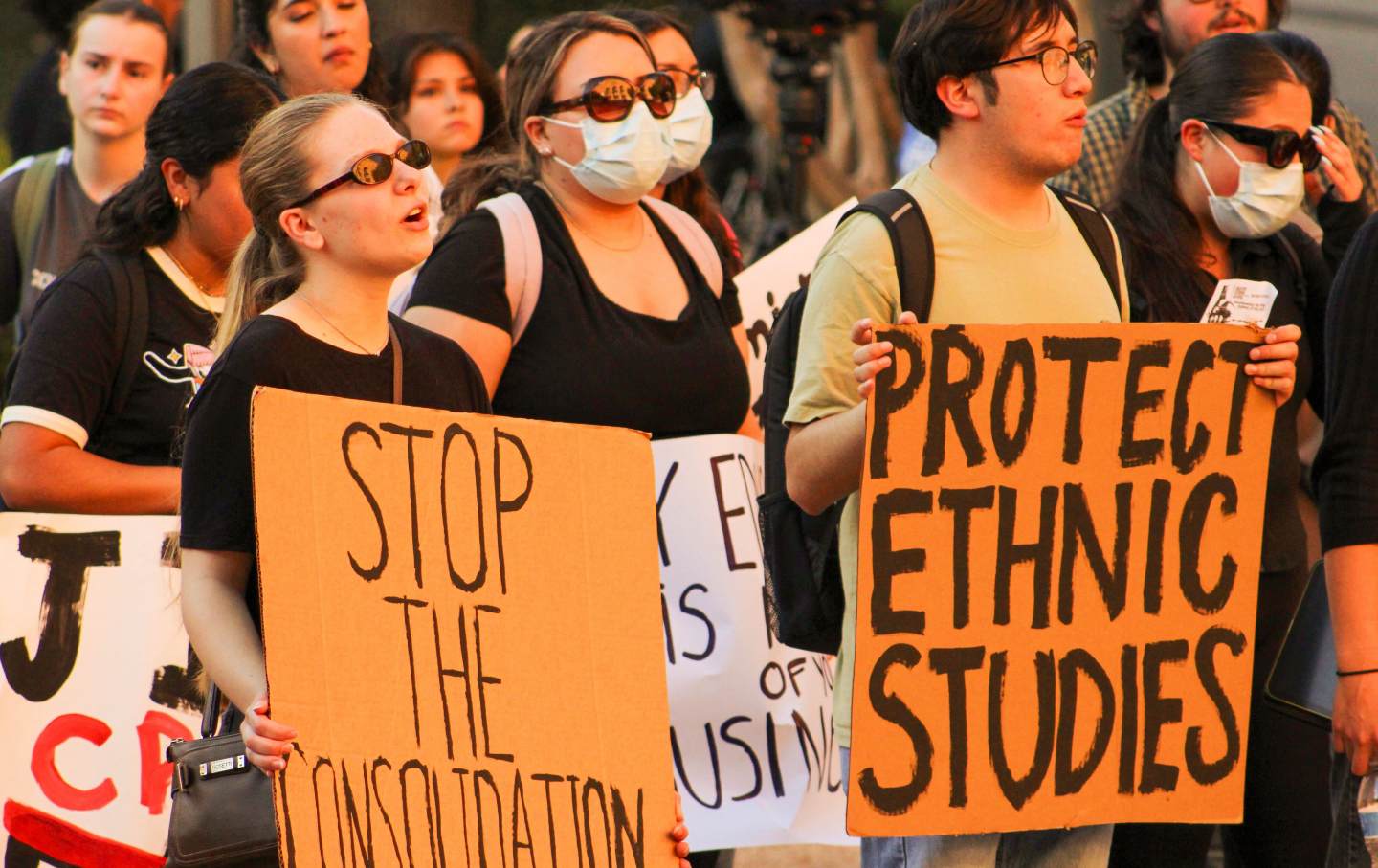
What Will Be Left After the University of Texas Destroys Itself? What Will Be Left After the University of Texas Destroys Itself?
UT-Austin has collapsed its race, ethnic, and gender studies into a single program while a new policy asks faculty to avoid “controversial” topics. But the attacks won’t end there...

The Corporate Media Is Head Over Heels for the Iran War The Corporate Media Is Head Over Heels for the Iran War
Donald Trump’s attack may be surreal, unjustified, and illegal. But that’s not stopping the press from turning the propaganda dial way up.
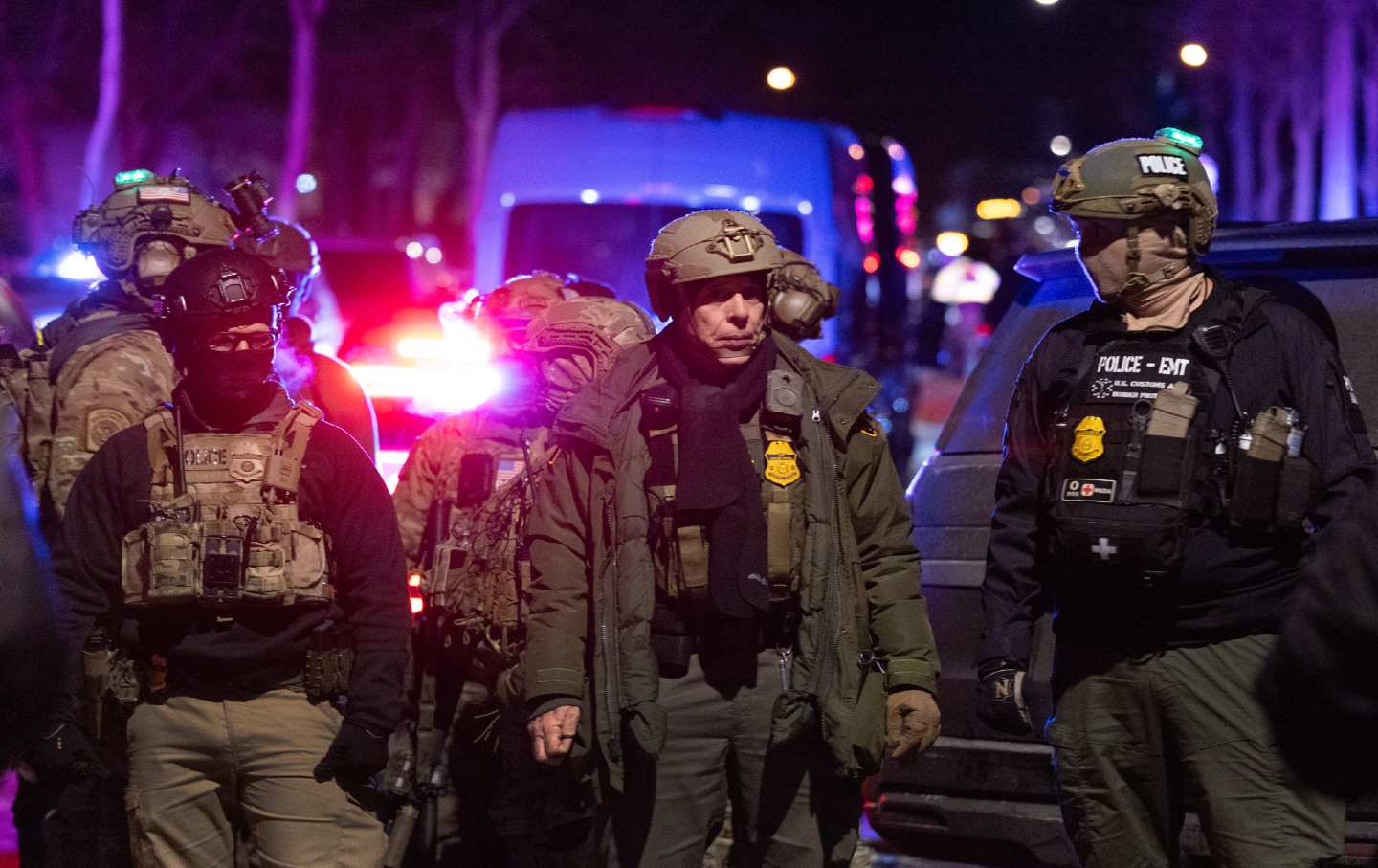
The Disturbing History of ICE’s “Death Cards” The Disturbing History of ICE’s “Death Cards”
The Vietnam-era practice is yet another example of ICE agents thrilling to the brutality they have been encouraged to cultivate.

The Red State–Blue State Healthcare Divide Is Dangerous for Everyone The Red State–Blue State Healthcare Divide Is Dangerous for Everyone
Whether or not you have access to independent, scientifically sound public health guidance may depend on how your state voted for governor.

