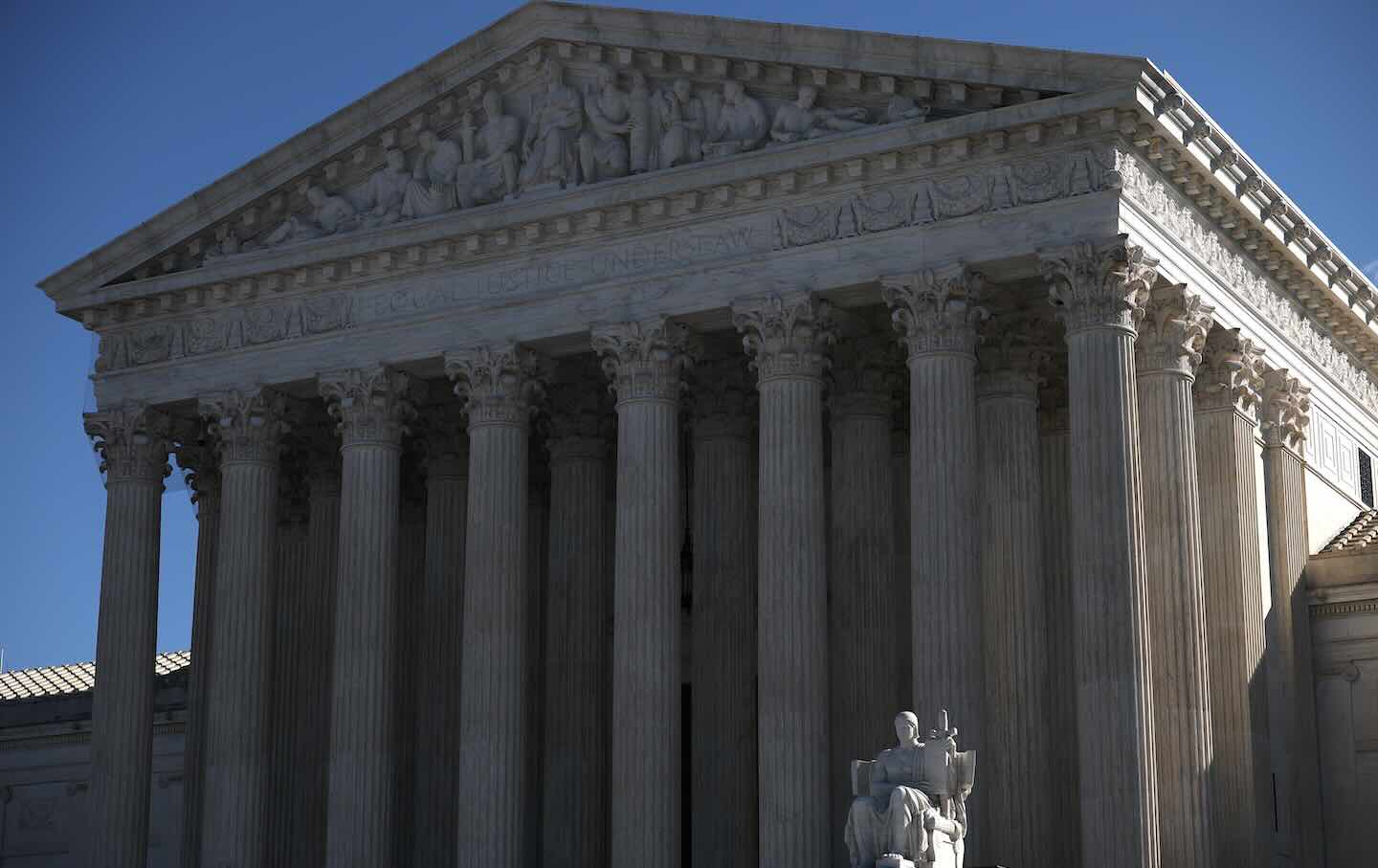
In a 6–3 decision written by Chief Justice John Roberts on Friday, the Supreme Court issued a decisive blow against the Trump administration’s “Liberation Day” tariff scheme. According to Roberts, Trump’s view that he could “impose tariffs on imports from any country, at any rate, for any amount of time” was not grounded in law or reality.
While on the surface it was a case about tariffs, the ruling underscores widespread concerns about the preservation of the rule of law in the United States with a president who shows contempt for checks and balances and scorns co-equal branches of government. Notably, after the ruling came down, the president quickly assembled a press conference, where he called the justices “fools and lapdogs for the RINOs and the radical left Democrats.”
Despite President Donald Trump’s worst inclinations, the decision ultimately affirmed the rule of law and restrained his unlawful reaches. Even Justice Neal Gorsuch took the administration to task for bypassing Congress, saying in his sharply worded concurring opinion that while “it can be tempting to bypass Congress when some pressing problem arises.… the deliberative nature of the legislative process was the whole point of its design. Through that process, the Nation can tap the combined wisdom of the people’s elected representatives, not just that of one faction or man.… deliberation tempers impulse.”
This decision in Learning Resources, Inc. v. Trump, concerned whether the International Emergency Powers Act (IEEPA) authorized the president to impose unprecedented tariffs that selectively targeted some countries and not others. The plaintiffs, family-owned businesses that create and distribute educational products, were directly affected. They claimed that if allowed to stand, Trump’s tariffs would exponentially inflate their importation costs from under $2.5 million in 2024 to more than $100 million in 2025.
To understand the importance of this case and the court’s decision, consider that nowhere in the IEEPA does the statute use the word “tariff” or “tax.” Further, no president had used it to impose tariffs before in its 49-year history.
However, according to Trump, not only did the IEEPA grant him this broad authority, but Congress had delegated this power to him—claims the US Court of International Trade first rejected nine months ago. That ruling barred Trump from imposing the tariffs, explaining that the IEEPA does not authorize the president to tax and implement his tariffs. Trump appealed the decision, losing at the appellate level and now at the Supreme Court.
We remain concerned that this decision, restoring checks and balances at least in this specific case, may be short-lived and largely symbolic for three reasons.
First, Trump has indicated that his government will not voluntarily return the almost $2 billion that it unlawfully took under IEEPA. Rather, businesses will need to litigate in the courts to get it back, which can take years. Large companies may eventually receive the money, but smaller businesses that can’t bear the costs will lose out.
Second, within hours of losing the case, Trump declared a new global 10 percent tariff under another statute (section 122 of the 1974 Trade Act). The next day, he raised the rate to 15 percent. The never-ending shifts in tariffs continue at the president’s whim, as does the chaos.
Third, this president is bent on grasping all powers from an acquiescent Congress. The Republican-led Congress may be unwilling to pass statutes granting him the authority he wants, whether to impose tariffs or wield other prerogative authority, but it does not challenge him. The courts and American streets have become the only place to do so. As to the former, his administration has ignored numerous court orders. As to the latter, the risks are apparent in the unspeakable killings of Renee Good and Alex Pretti.
The problem we see is precisely what Gorsuch pointed to, although perhaps too late given that the Supreme Court itself is implicated in granting Trump unprecedented authority. This tariff case is just one example of this president’s perception that all powers accrue to himself, disregarding legislative or judicial checks. Over the past year, Trump has declared one “national emergency” after another, insisting that he alone holds authority—to impose tariffs, impound funds, ignore statutory procedures, end birthright citizenship, erase transgender identity, remove inspectors general, and fire Federal Reserve Board governors who disagree with him.
We do not believe that the majority’s decision will temper Trump’s impulsive governing nor mitigate the consequences of his unlawful executive orders or the illegal conduct of his administration. Instead, like Justice Clarence Thomas in his dissent, Trump may well perceive that Congress can surrender its enumerated powers to him—a dangerous concept indeed for a president who perceives no boundaries to his authority. In this case, it does not take a crystal ball to forecast who will be most harmed—namely small-business owners who cannot afford to litigate against the president to recoup this unlawful tariff. This, too, is a pattern Donald Trump cannot shake.