Extra! Extra! Steve Brodner’s Brilliance Recognized by Herblock Prize
Brodner, a frequent contributor to The Nation, is both a great caricaturist and a great portraitist.
Steve Brodner’s love of cartooning almost got him kicked out of college. Raised by a working-class single mother in Brooklyn, he started selling cartoons when he was in high school to make a little extra spending money. His first, a cartoon about local Brooklyn politics, ran in The Kings Courier, a local newspaper, in November 1971. He enrolled in Cooper Union to study fine art, but cartooning remained his ambition, particularly after he encountered the work of Thomas Nast, the 19th-century master of cross-hatching who famously helped end the reign of the corrupt Tweed gang that ruled New York politics.
“Nast was the big atom bomb in my early career,” Brodner told The Comics Journal in 2004. “Nast showed you could change the world with pictures.” Already radicalized by the civil rights movement and the Vietnam War, Brodner was well set for a career as an incendiary illustrator.
But the fine-arts ethos of Cooper Union wasn’t prepared to nurture a cartoonist. “It is not always easy to be a political person at art school,” Brodner recalls. “I draw with an eye towards what’s interesting to me, which is what is grotesque, bizarre, and strange.” Brodner ran into trouble in a class taught by “a very traditional academic artist who was a brilliant draftsman but who couldn’t tolerate what I was doing.”
Brodner’s clash with this teacher got so bad that the dean began to suggest that the young rebel should go elsewhere. Fortunately, at age 19, Brodner won a national cartooning contest, beating out a field of contenders that included the iconic New Yorker artist Charles Addams (creator of the Addams Family).
Brodner, of course, went on to become famous as a caricaturist, and this year he was awarded a much-deserved Herblock Prize worth $20,000.
Cooper Union’s mistake had been in thinking there was a dichotomy between cartooning and fine art—between being a caricaturist and a portraitist.
The secret of Brodner’s art is that he recognizes no such division. A successful caricature combines a plausible likeness of the subject’s visage with some element of fantasy or exaggeration that brings out the inner life. Brodner learned to unleash his wild imagination not just from Nast but also from more recent masters such as Ralph Steadman (whose hallucinatory visions rivaled those of his collaborator Hunter S. Thompson) and David Levine (whose elegant caricatures defined The New York Review of Books for decades). As with his influences, Brodner’s wildest flights of fantasy are undergirded by a portraitist’s sense of composition and attention to telling detail.
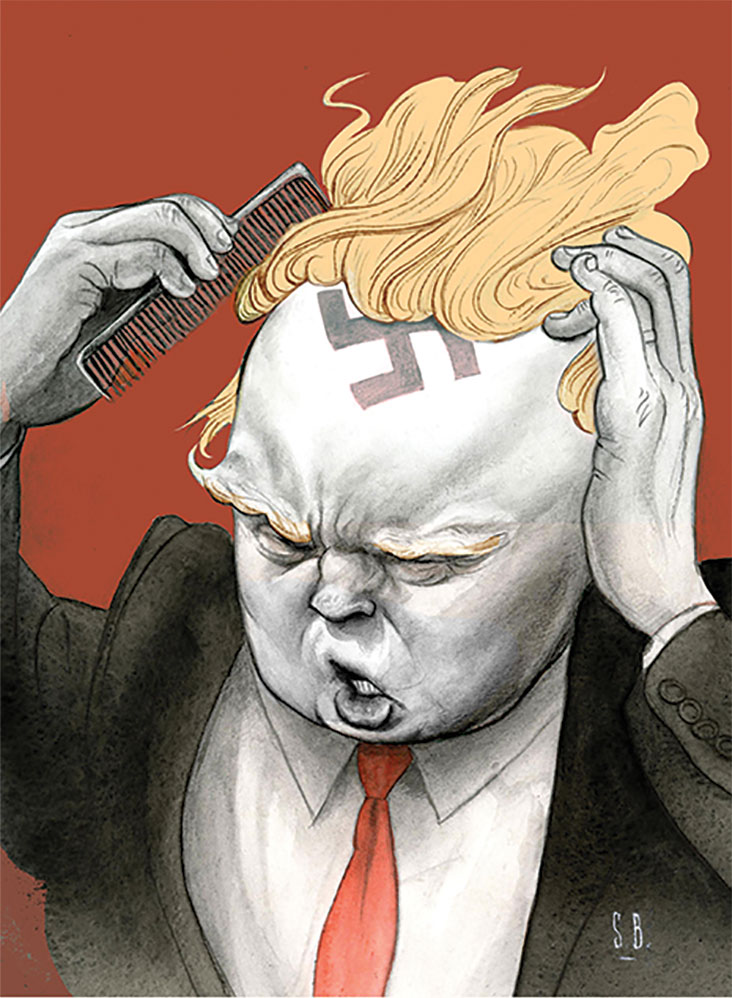
Brodner’s caricatures are so boldly grotesque, so willing to stretch familiar visages into the most unlikely silly putty, that it might seem odd to praise them for their subtlety. But consider Under Trump’s Comb-Over (2015). The caricaturist’s touches are immediately legible to the viewer: the absurd hair; the aggressive eyebrows; the beady, scrunched-up eyes. But live with the drawing for a bit and you notice how Brodner has captured Trump’s very peculiar fishy mouth, a pinched little orifice. This is both a likeness and something more, with the super-reality of the best caricatures.
Support independent journalism that does not fall in line
Even before February 28, the reasons for Donald Trump’s imploding approval rating were abundantly clear: untrammeled corruption and personal enrichment to the tune of billions of dollars during an affordability crisis, a foreign policy guided only by his own derelict sense of morality, and the deployment of a murderous campaign of occupation, detention, and deportation on American streets.
Now an undeclared, unauthorized, unpopular, and unconstitutional war of aggression against Iran has spread like wildfire through the region and into Europe. A new “forever war”—with an ever-increasing likelihood of American troops on the ground—may very well be upon us.
As we’ve seen over and over, this administration uses lies, misdirection, and attempts to flood the zone to justify its abuses of power at home and abroad. Just as Trump, Marco Rubio, and Pete Hegseth offer erratic and contradictory rationales for the attacks on Iran, the administration is also spreading the lie that the upcoming midterm elections are under threat from noncitizens on voter rolls. When these lies go unchecked, they become the basis for further authoritarian encroachment and war.
In these dark times, independent journalism is uniquely able to uncover the falsehoods that threaten our republic—and civilians around the world—and shine a bright light on the truth.
The Nation’s experienced team of writers, editors, and fact-checkers understands the scale of what we’re up against and the urgency with which we have to act. That’s why we’re publishing critical reporting and analysis of the war on Iran, ICE violence at home, new forms of voter suppression emerging in the courts, and much more.
But this journalism is possible only with your support.
This March, The Nation needs to raise $50,000 to ensure that we have the resources for reporting and analysis that sets the record straight and empowers people of conscience to organize. Will you donate today?