
“Shut Up and Serve”: The Professional Tennis Players Fighting a Rigged System
An antitrust lawsuit calls the professional tennis governing bodies “cartels” that exploit players and create an intentional lack of competitive alternatives. Can players hit back?
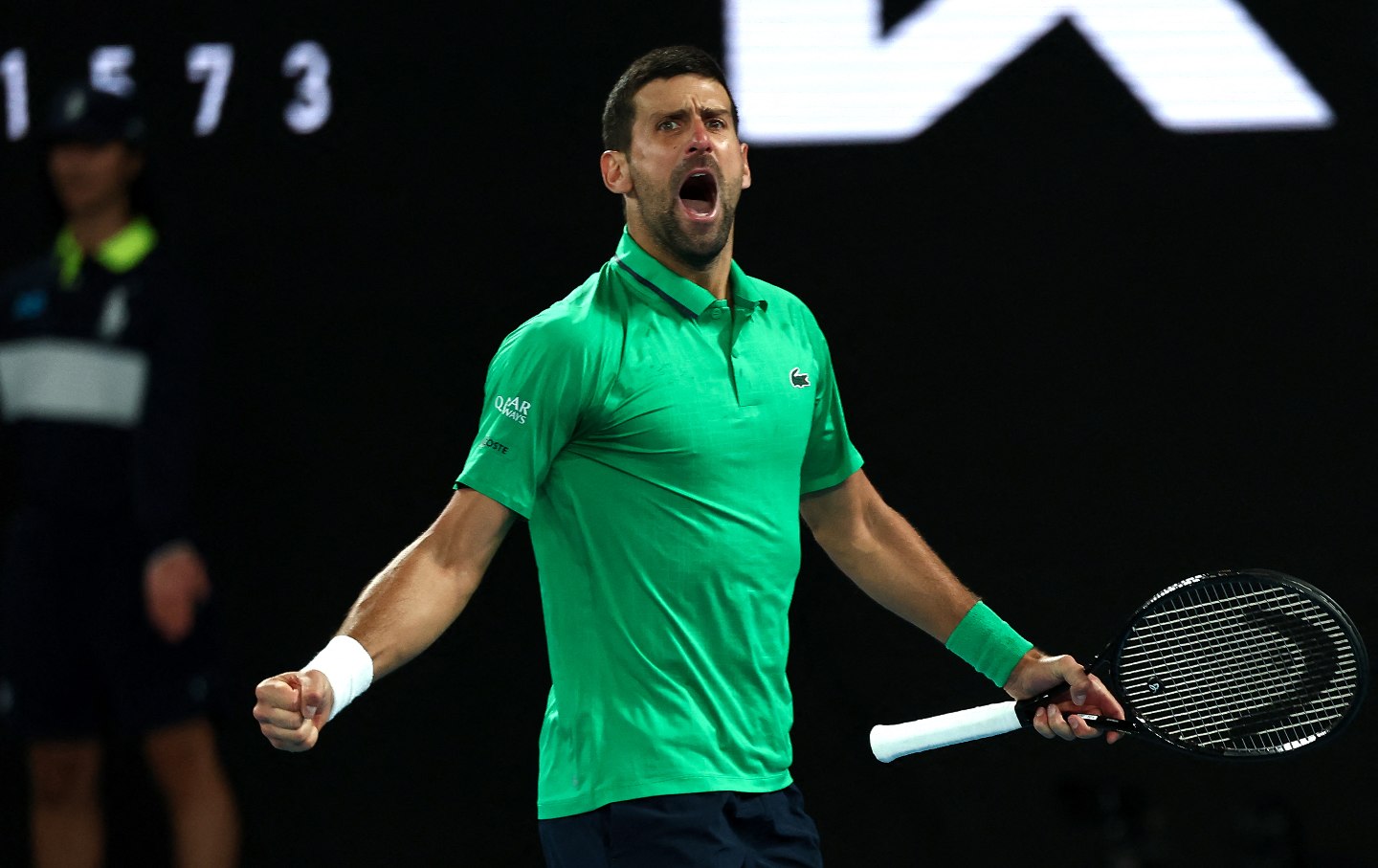
Novak Djokovic in the Australian Open tennis tournament on February 1, 2026.
(Izhar Khan / Getty)
Holger Rune is one of the most promising young talents that tennis has ever seen. Known for his blistering forehand and fiery on-court personality, the 22-year-old has already made history as the highest-ranked Danish man to play the sport, with a career-high ranking of fourth in the world. Then, during the Stockholm Open semifinals in October, Rune ruptured his Achilles tendon.
Even a sprained ankle, sustained from an awkward landing or a collision, can lead spectators to cringe and cover their eyes. Accidents happen, but Rune’s horrific injury was part of a pattern of overuse that has taken some of the sport’s brightest and youngest stars away from the court. At Grand Slam and Masters events this past season, players saw the largest rate of injury withdrawals or walkovers in over two decades.
Ben Shelton, a top-10 player in the world, was sidelined for more than a month because of a left-shoulder injury, cutting short his highly anticipated 2025 US Open. A stress fracture in his back led 21-year-old Arthur Fils to miss an entire rotation of Grand Slam events. And after bowing out of last year’s US Open, 24-year-old Jack Draper, the number-one player in Great Britain, has been away from the sport for over seven months due to a lingering left-arm injury.
In October, players posted on social media in support of Rune, while pointing the finger at the apparent cause for the uptick in injuries: the grueling, 45-week-long schedule. “Injuries are going to happen.… we are pushing our bodies to do things they aren’t supposed to in elite sport,” Draper posted on X. “However, the tour and the calendar have to adapt if any of us are gonna achieve some sort of longevity.”
The Association of Tennis Professionals (ATP) season is spread across six continents, starting in Australia and ending with the finals currently held in Italy. Players bounce from one time zone to another and are forced to adapt to three surface changes with different court speeds and balls. “The current schedule for the ATP/WTA is definitely too long. And 100 percent I believe the schedule has contributed to the rise in injuries and withdrawals in recent years,” said Richard Woodroof, fitness coach for Coco Gauff. “Travel days are not a day off. Travel is very difficult on the body. Stress related to travel, sitting in tight spaces for long periods of time, pressurized bad air, staying hydrated, etc.”
Not all players agree. The notion of tradition is deeply embedded in the sport: If older generations could put up with an 11-month-long schedule, they say, so can the players of today. During his ATP Finals campaign, Canada’s Felix Auger Alliasime said that “if you want to play fewer tournaments, stay home. Nobody’s forcing you to be here.”
But when players want to rest, withdrawing from tournaments can come with severe compromises. While the lawsuit alleges that players have been penalized for withdrawing from tournaments because of injuries, the official ATP Rulebook states players are only penalized if they withdraw from a tournament later than the Friday before the start of the tournament, and players must appear on-site at their own expense and be medically cleared by ATP medical staff. Additionally, players are granted only two late withdrawals per season before facing further penalties.
For those at the top, such as Rune, players must adhere to even more restrictions: competing in all four Grand Slams, all nine Masters 1000 tournaments, and at least five ATP 500 tournaments. Otherwise, these players lose their bonus eligibility, suffer deductions from their retirement fund, and risk future tournament eligibility.
“The main reason for these injuries is fatigue.… We’re still humans, we’re not machines or robots or anything,” Rune said in an interview with Sports Illustrated. “I think the [ATP] should also have to adapt a little bit to the players. Right?”
In 2020, 24-time Grand Slam champion Novak Djokovic cofounded the Professional Tennis Players Association in response to the impotence of the Player Advisory Council within the ATP. Although it acts as a union, professional tennis players are classified as independent contractors, which makes it impossible for them to collectively bargain. Nonetheless, the PTPA has been able to provide a variety of legal, medical, and health support for the Top 250 singles players and the Top 100 doubles players on the circuit. In March 2025, the PTPA submitted an antitrust lawsuit, referring to the governing bodies in professional tennis as “cartels” that exploit players and create an intentional lack of competitive alternatives.
“Tennis really is a rigged system. The more you learn about it, the more you’re like, ‘What on earth?’ And it’s all tangled up, and it’s all conflicted, and the players know it’s wrong,” PTPA executive director Ahmad Nassar told The Nation. “[The players] have to work incredibly hard to stay there and it doesn’t mean that they have to just ‘shut up and serve.’”
Aside from unrealistic scheduling expectations, the ATP exploited players even more grossly from a financial perspective, the antitrust suit alleges. In an individual sport where players are expected to cover a large portion—if not the entirety—of their travel expenses, they earn an abysmal fraction of revenue from competitions. athletes in the NBA can earn a maximum of 50 percent of basketball related income, tennis players earn just 15 percent of what is grossed at a Grand Slam event. At the 2024 US Open champions, for example, players earned a combined $8.9 million payout, roughly a quarter less than what the tournament generated in sales of its specialty cocktail—the “Honey Deuce”!
“It’s funny because people tried to say, ‘Oh, the PTPA, they’re just pointing out all the problems’ or ‘Where are the solutions?’ Guys, it’s literally called a complaint. Like, that’s what a lawsuit is,” said Nassar. “There’s a time to come up with solutions. But it’s not when you file a lawsuit, it’s when you settle a lawsuit, right? There’s so many people in this ecosystem who either don’t get it because they don’t want to get it or don’t get it and are malicious.”
In May of last year, a New York judge ruled that the ATP attempted to unjustly influence and coerce top players, including the likes of Shelton and Alexander Zverev, number four in the world. The governing body did so through proposing such players sign a denial of prior knowledge regarding the antitrust lawsuit. Since then, the ATP is prohibited from retaliating against any players—mentioned or not mentioned in the lawsuit—and must save all records of communication with players regarding the lawsuit as well.
Popular
“swipe left below to view more authors”Swipe →In December, alleged harassment of players resulted in Djokovic stepping away from the PTPA. “As part of its mission, the PTPA initiated litigation against the tours and Grand Slams to advance reforms related to governance, transparency, and player rights. As a result, we have been targets of a coordinated defamation and witness intimidation campaign through the spreading of inaccurate and misleading narratives intended to discredit the PTPA, its staff, and its work. A federal court has already ruled this type of harassment improper and ordered it to cease,” the PTPA wrote in a statement to The Nation after the announcement of Djokovic’s separation. “We are working closely with legal counsel, law enforcement and players to evaluate all available options to address the spread of misinformation. These attacks from non-player third parties will not distract us from our mission: pursuing meaningful reforms for all players.”
Nonetheless, while the first Grand Slam of the year recently came to a close in Australia, potential systemic changes could still take effect over the next few years. “I’m a traditionalist…and I enjoyed the early ’90s with Becker and Edberg. Things change, things evolve. And we have to understand that the athlete has evolved, and so has humankind,” said Dr. Robby Sikka, who oversees PTPA Mednet, which provides health and safety support for professional players. “I think empathy is recognizing pain in someone. Compassion is acting on it. We all advocate for empathy. Compassion is saying, ‘Let’s do something about it.’ We’re a compassionate group. We’re not an empathetic group. We’re past that. We’re one step past that. So what we want to do is act on the suffering that we’re seeing.”
More from The Nation
The AI Sector’s Crass Bid for Media Domination The AI Sector’s Crass Bid for Media Domination
When you’re a galactically rich tech mogul upset with adverse press coverage, you just buy yourself more flattering media outlets.

What Is Artificial Intelligence Anyway? What Is Artificial Intelligence Anyway?
Separating out the myths and facts of AI.

Tiger Woods Plus Donald Trump: A Tragedy Made in the USA Tiger Woods Plus Donald Trump: A Tragedy Made in the USA
Woods and Trump’s famous friendship is built on a shared knack for accumulation, vacuousness, and power worship. It’s as American as apple pie.

The Cost of the Iran War The Cost of the Iran War
“It takes money to kill bad guys,” Defense Secretary Pete Hegseth said as he sought $200 billion in funding for the Iran war in March. But the cost far exceeds money.
The Supreme Court Absolutely Shredded Trump’s Birthright Citizenship Case The Supreme Court Absolutely Shredded Trump’s Birthright Citizenship Case
But this also begs the question: why is this facially unconstitutional case before the court in the first place?

Why Black People Can’t Earn Our Way Out of Racism in Maternal Care: A Q&A With Khiara Bridges Why Black People Can’t Earn Our Way Out of Racism in Maternal Care: A Q&A With Khiara Bridges
In her new book, Bridges found that healthcare provided through private markets leaves more room for discrimination and unequal care to take root than in a public program like Med...

