The Occupation of Washington, DC, Reflects the Failures of Our Democracy
After fumbling the cause of DC statehood, Democrats now appear helpless as Trump sends troops into the city.
As the seat of national government, Washington, DC, tends to experience whatever the United States as a whole is experiencing, but in sharper relief. Its health tells us a lot about the nation’s health—and right now, both are in crisis. For months, Washington has been forced to host unprecedented deployments of National Guard troops and ICE agents, with the former largely functioning to simulate the experience of military occupation while the latter raids homes and worksites and tramples on the basic civil liberties of immigrants and citizens alike.
Washington isn’t the only city that’s under siege. The first major National Guard deployments, in June, were in Los Angeles, the hometown of Donald Trump’s homeland-security adviser Stephen Miller, for the specific purpose of confronting those who were protesting against ICE’s immigration raids. But the most common strategy, in which a phantasm of crime is used to justify a full-scale urban occupation, was first employed in the nation’s capital in August before spreading to Memphis and Portland, Oregon, in September and to Chicago in October. It is Washington—among the bluest cities in America, with more than 90 percent support for Kamala Harris in the election last year—that has served as a template for what Trump intends to inflict upon so many other cities. “We want to save these places,” Trump said, from what he erroneously claims has been a surge of violent crime under Democratic mayors.
Washington was a logical place to start, not only because the federal government is based there—and not only because it’s perceived (if no longer accurately) as a majority-Black city and thus a ripe target for an administration whose central premise is white grievance—but also because Washington has no real right to self-governance and thus exceptionally few legitimate options to resist federal incursions. The founders, in their wisdom, wanted to establish a national capital that would not be part of any state and instead would be under the direct control of Congress; they never anticipated that this designated federal district would eventually grow into a city of 700,000 residents.
In 1973, Congress passed the District of Columbia Home Rule Act, which handed most of the responsibilities of city governance to a locally elected mayor and city council. In the half-century since, there has been a perennial tension between the DC government, which like many other urban governments has seen its share of corruption scandals and financial mismanagement, and Congress—especially when the latter is controlled by Republicans, who have tended to treat DC’s mayors, all of whom have been Black, with outright contempt and have repeatedly threatened the city’s autonomy. Congress retains the power to block laws passed by the City Council and has done so on numerous occasions, almost invariably at the expense of a local progressive consensus on issues like abortion access, gun control, and marijuana legalization.
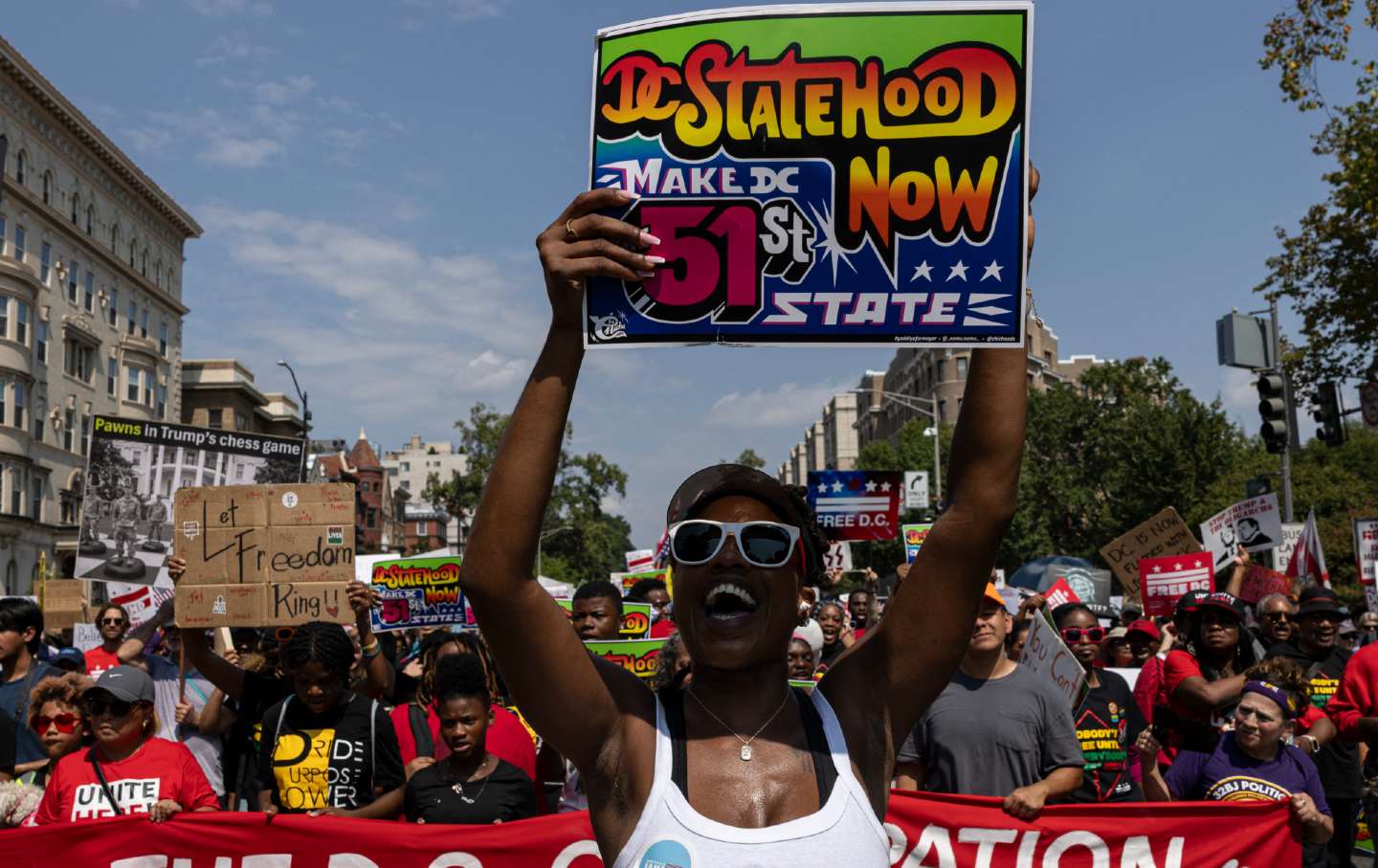
For many Washingtonians, the city’s disenfranchisement is a source of deep resentment and a spur to grassroots activism. In a 2016 referendum, 86 percent of DC residents supported statehood for the district, which is more populous than Wyoming and Vermont, and in 2021 the House of Representatives narrowly passed a DC statehood bill, which stalled in the Senate thanks to the opposition of Joe Manchin. But congressional Republicans are not merely opposed to statehood; they are determined to roll back the limited home rule DC has enjoyed since the 1970s. In February, Senator Mike Lee and Representative Andy Ogles introduced the Bringing Oversight to Washington and Safety to Every Resident, or BOWSER, Act—an acronym that just happens to spell the last name of the sitting DC mayor, Muriel Bowser, whose “radically progressive regime…has left our nation’s Capital in crime-ridden shambles,” according to Ogles.
Even if DC were a state, it probably wouldn’t be able to prevent Trump from unleashing federal forces on its streets. But Democratic governors like California’s Gavin Newsom and Illinois’s JB Pritzker have been far more forceful and outspoken in their opposition to Trump’s deployments than Bowser has been. The difference isn’t merely one of temperament: Bowser knows she has far less leverage than any governor or any other mayor of a major city, and that the very existence of her office is something Congress could withdraw at any time.
For decades, Democrats have failed to treat the cause of DC statehood with the urgency it deserves. Now they appear helpless as Trump and the GOP not only send troops to occupy the city but also inflict likely irreparable damage on its economy, via sweeping cuts to federal agencies like USAID and the IRS, and on its cultural institutions, from the Kennedy Center to the Smithsonian. Ominous signs of a regional recession are already present, including an estimated 20 percent drop in federal jobs.
As a born and raised Washingtonian, I remember when the district was poorer, more dangerous, and more politically dysfunctional than it is today, but I can’t remember a time when my friends and family were so pessimistic about the city’s future. The guardsmen on the streets are constant visual reminders of DC’s disempowerment. The city Trump has called “the swamp” feels defeated, and everyone knows someone who has been directly harmed by MAGA misrule.
America’s major cities—dense communities defined by racial and ethnic diversity, immigrants, white-collar industries requiring high levels of education, and liberal norms on gender and sexuality—overwhelmingly did not vote for Donald Trump in 2016, 2020, or 2024. Though Trump himself is a son of New York City, the party he leads is fundamentally hostile to urban values, and since returning to power, he has repeatedly threatened to use military force to punish cities for rejecting him. The president has named New Orleans, New York, Baltimore, San Francisco, Oakland, and St. Louis as potential targets for such interventions—all of which voted heavily for his opponent, and none of which have asked for the help. Trump’s occupation of blue cities is lawless, heavy-handed, illiberal, and dangerous—and it could be coming to your town next.