How Nebraska Became a Volleyball Paradise
Covid-19 is back on the rise. We must take precautions, or we could again lose the type of joy that 92,003 fans experienced at Memorial Stadium this week.
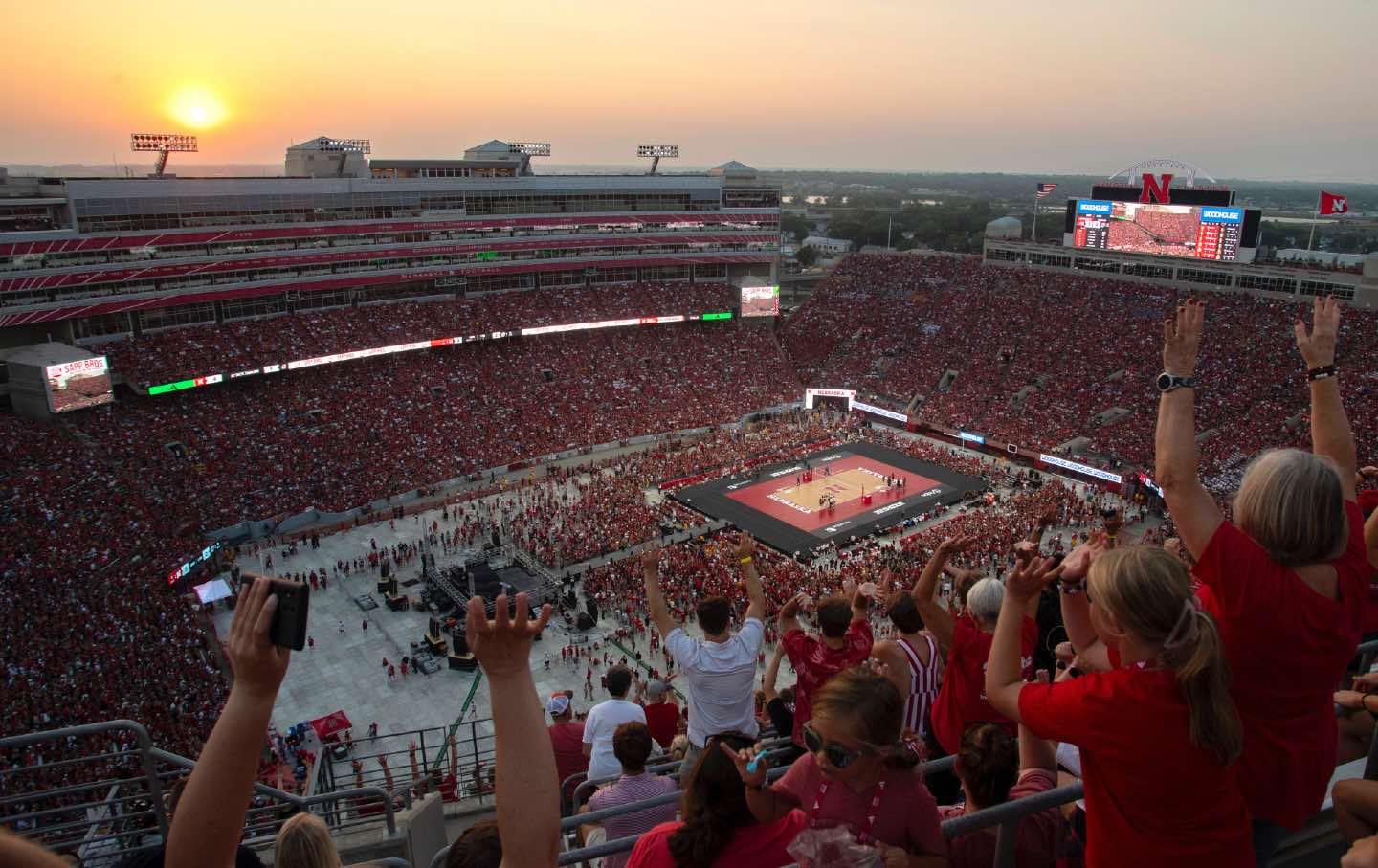
Fans do the wave during a college volleyball match between Nebraska and Omaha at Memorial Stadium on August 30, 2023, in Lincoln, Neb.
(Kenneth Ferriera / AP Photo)From the perspective of a sports fan, there are so many times I wish Covid-19 were some fever dream from which we could all awake. Instead, when it comes to sports, I’ve been in denial. I have gone to games unmasked all summer, wanting to feel the breeze on my face. That was a mistake, and I will be changing my behavior.
I thought about this denial when I felt unfettered joy at the news out of Nebraska where 92,003 fans watched the five-time NCAA champion Nebraska volleyball team beat Omaha three sets to none. This was the largest crowd to ever witness a women’s sporting event: bigger than even the 1999 Women’s World Cup final, which packed the Rose Bowl in Pasadena to the rafters. For everyone who has ever doubted the power of women’s sports—and for everyone who has doubted the incredible fan experience that is competitive volleyball—it was time to feel a little humility and a lot of comeuppance. For those still looking to tear down Title IX, that evening in Nebraska was an expression of what has long been the guiding spirit of those who applied the 1972 law to athletics: If you build it, they will come. (I know that’s from Field of Dreams, which came out 17 years after the passage of Title IX, but the point stands.)
This comes on the heels of the NCAA Women’s Basketball Final between victorious LSU and Iowa, which drew ratings greater than the Major League Baseball playoffs. It’s clear that women’s sports are having more than a moment. What we’re seeing is the fruition of a decades-long movement. The women at the heart of this know the power of what is being built—and not only because of the name, image, and likeness dollars that are flowing in their direction. Angel Reese, the star player at LSU, tweeted the morning after Nebraska volleyball garnered headlines around the world, “Women’s sports is growing and i love that for us.” Now Reese wants to hoop in the LSU football stadium. I’m certain those seats would sell out.
The volleyball match is also a tribute to the excellence of the women of Nebraska’s squad and the quality of their program, which has won five NCAA championships. This wasn’t a free exhibition either. In what was being dubbed “Volleyball Day in Nebraska,” tickets—originally priced at $25 for adults and $5 for kids—were going for $400 on the secondary market.
Nebraska middle blocker Andi Jackson captured the buzz running through Memorial Stadium when she said, “It’s incredible. I don’t have enough words to describe it. We were walking out of the tunnel after the second set, and we heard on the speaker we had just broken the world record. Everyone was trying to stay locked in, but we were also so excited. I can’t describe how grateful I am to be a part of it.”
The success and support for Nebraska women’s volleyball did not come out of nowhere. It came after 306 consecutive sellouts. But this game was different. The team’s coach, John Cook, said it made him feel “like a football coach,” running into the legendary century-old Cornhusker stadium to an ocean of Nebraska red.
It also has to be noted that the team—unlike many across the country—is operating with full support of the athletic department and school administration. In fact, Nebraska canceled classes that day so students could attend. It’s a beautiful thing. As the crowd cheered, Cook said that just three things had ever shut down school at Nebraska: “One, snowstorms. Two, Covid. Three, Nebraska volleyball in the stadium.”
Amazing. But if Nebraska wants to avoid closures in the future, we have to mask up again and offer masks at the front gates of all sporting events. The NFL better step it up and not do a “Roger Goodell special” and pretend the problem doesn’t exist.
The Nebraska game was a glorious moment, and I am not trying to be a scold. We need sports. We need spaces where we can collectively feel joy. At the height of Covid-19, people were isolated, and the experience scarred many of us. To avoid fresh wounds, we need to care for one another when we gather. Onward volleyball. Onward Nebraska. Onward women’s sports. Let’s keep playing, and let’s be as safe as we can. The risks of Covid are too high, but the risks of shutting down again are too high as well.
Support independent journalism that does not fall in line
Even before February 28, the reasons for Donald Trump’s imploding approval rating were abundantly clear: untrammeled corruption and personal enrichment to the tune of billions of dollars during an affordability crisis, a foreign policy guided only by his own derelict sense of morality, and the deployment of a murderous campaign of occupation, detention, and deportation on American streets.
Now an undeclared, unauthorized, unpopular, and unconstitutional war of aggression against Iran has spread like wildfire through the region and into Europe. A new “forever war”—with an ever-increasing likelihood of American troops on the ground—may very well be upon us.
As we’ve seen over and over, this administration uses lies, misdirection, and attempts to flood the zone to justify its abuses of power at home and abroad. Just as Trump, Marco Rubio, and Pete Hegseth offer erratic and contradictory rationales for the attacks on Iran, the administration is also spreading the lie that the upcoming midterm elections are under threat from noncitizens on voter rolls. When these lies go unchecked, they become the basis for further authoritarian encroachment and war.
In these dark times, independent journalism is uniquely able to uncover the falsehoods that threaten our republic—and civilians around the world—and shine a bright light on the truth.
The Nation’s experienced team of writers, editors, and fact-checkers understands the scale of what we’re up against and the urgency with which we have to act. That’s why we’re publishing critical reporting and analysis of the war on Iran, ICE violence at home, new forms of voter suppression emerging in the courts, and much more.
But this journalism is possible only with your support.
This March, The Nation needs to raise $50,000 to ensure that we have the resources for reporting and analysis that sets the record straight and empowers people of conscience to organize. Will you donate today?