Mike Johnson’s “18th-Century Values”
The new speaker of the House says he’s a history buff. But has he learned from it, or is he condemned to repeat it?
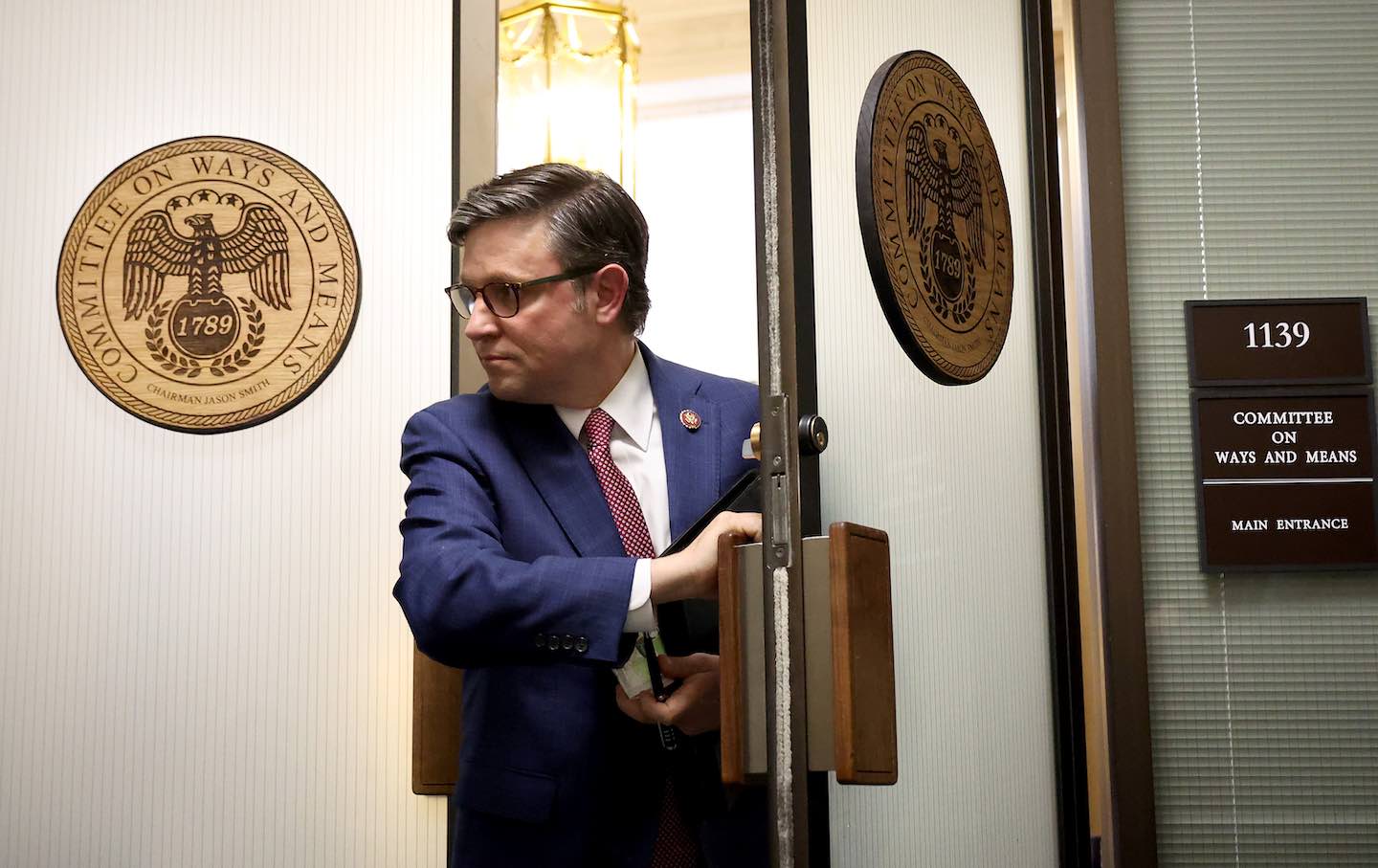
Even by the standards of today’s Republican Party, ultra-MAGA Bible thumper Mike Johnson (R-La.) is pretty far out there. After the mass shooting in Lewiston, Me., in October, he blamed such murders on no-fault divorce, the sexual revolution, the teaching of evolution, “radical feminism,” and legal abortion. According to the Brennan Center, “Johnson was the congressional architect of the effort to overturn the 2020 election, advocating an interpretation of the Constitution so outlandish that not even the Supreme Court’s conservative supermajority could swallow it.” This was the “independent state legislature” theory, which would grant state legislatures powers to control federal elections, so if they don’t like the way an election goes, they can just decertify it.
So I was worried at first when Johnson was elected speaker of the House this October. But it turns out that he and I share something in common: We both love history. When I read that Johnson told an anti-abortion gathering in 2013 that we need to get back to “18th-century values,” I said, “Yes! Bring back the Enlightenment!” The age of Voltaire and Hume and Diderot and Condorcet and Mary Wollstonecraft and Mozart and Robert Burns, of questioning religious dogma and government by kings, and of optimism for the human project. Let’s throw in my favorite poet, William Blake, too, although he lived into the 19th century. True, he was in some ways an anti-Enlightenment figure, but he was a free spirit and no friend of church or state or any kind of orthodoxy: “Prisons are built with stones of law, brothels with bricks of religion.” For all its faults—slavery, colonialism, the energetic use of capital punishment, the lack of rights for women, to say nothing of chamber pots and wigs—the 18th century saw the beginning of what’s good about modernity: the idea that we human beings can decide our fates, collectively and as individuals. We seem to have lost that confidence, probably for good reason, but it was a beautiful worldview while it lasted.
It turns out, though, that what Johnson meant by “18th-century values” was not the Enlightenment but its opposite: the state enforcement of religion, the very thing the 18th century was beginning to get away from. At a 2013 Louisiana Right to Life forum, he cited George Washington’s farewell address—“Of all the dispositions and habits which lead to political prosperity, religion and morality are indispensable supports”—along with similar remarks by John Adams. I don’t know about 18th-century morality—can an enslaver really be a good person? Twenty-five of the 55 delegates to the Constitutional Convention owned slaves, including Washington. Thomas Jefferson owned more than 600. Somehow, though, these same founding fathers approved a Constitution that banned religious tests for office, mandated the separation of church and state, and does not mention God at all. Granted, most Americans at the time were Christians, as they are today; the founders could have declared the United States a Christian nation, but did not. At a time when most European countries had a state religion, they chose to keep faith a personal matter. Jefferson even cut-and-pasted together a revised version of the New Testament, The Life and Morals of Jesus of Nazareth (often called the Jefferson Bible), from which he excised all references to angels, prophecy, the divinity of Jesus, miracles, and the supernatural, including the Virgin Birth and the Resurrection. (It was a short book.)
Whatever Washington and the others personally believed, they were not Christian warriors. They may have been “divinely inspired,” as Johnson has claimed, but they did not set up the government “according to Biblical principles.” If they had done so, we’d be living in a theocracy, in which leaders took advice from ranting street preachers—or didn’t, to their ruin. And that may be what Johnson wants. As reported in Rolling Stone, he’s hung an “Appeal to Heaven” flag outside his office. Originally flown by Washington’s men during the Revolutionary War, today the flag is a Christian nationalist banner popular with Trumpists and associated with the New Apostolic Movement, which holds that God wants Christians to control every aspect of American society. End times, here we come.
Mike Johnson, history buff, might consider there’s another thing the Constitution doesn’t mention: abortion. In fact, when our nation was founded, abortion before “quickening” (the moment the pregnant woman feels the fetus kick, sometime between the 16th and 24th week of pregnancy) was legal in every state. It remained so until 1821, when Connecticut passed a law banning the use of “poison” to end a pregnancy, and was criminalized state by state only after the Civil War. In the 18th century and thereafter, abortifacients were plentiful, openly sold, and advertised in newspapers with euphemistic phrases like “relief for Ladies.” Abortion was understood as women’s business, and I very much doubt the founders wanted to hear anything about it, any more than most men today want to hear about the bloody details of female biology. (Interestingly, abortion is not mentioned in the Bible either.)
On Veterans Day, with the latest budget agreement about to expire, Johnson was scheduled to attend the Worldwide Freedom Initiative in Paris, a gathering of fascist-adjacent crackpots and second-raters. Erstwhile Trump campaign manager and credibly accused sexual harasser Corey Lewandowski was there with his (apparently longtime) girlfriend, the family-values-crusading South Dakota Governor Kristi Noem (both are married to other people), along with Nigel Farage, Devin Nunes, some minor Republican politicians, and assorted European Islamophobes.
Oh, Paris—how could you? Still, let’s not forget that back in the 18th century, Paris gave the world the French Revolution, which produced a nation even more secular than our own.
Maybe Johnson didn’t mean the 18th century after all. The Middle Ages would suit him much better.
Support independent journalism that does not fall in line
Even before February 28, the reasons for Donald Trump’s imploding approval rating were abundantly clear: untrammeled corruption and personal enrichment to the tune of billions of dollars during an affordability crisis, a foreign policy guided only by his own derelict sense of morality, and the deployment of a murderous campaign of occupation, detention, and deportation on American streets.
Now an undeclared, unauthorized, unpopular, and unconstitutional war of aggression against Iran has spread like wildfire through the region and into Europe. A new “forever war”—with an ever-increasing likelihood of American troops on the ground—may very well be upon us.
As we’ve seen over and over, this administration uses lies, misdirection, and attempts to flood the zone to justify its abuses of power at home and abroad. Just as Trump, Marco Rubio, and Pete Hegseth offer erratic and contradictory rationales for the attacks on Iran, the administration is also spreading the lie that the upcoming midterm elections are under threat from noncitizens on voter rolls. When these lies go unchecked, they become the basis for further authoritarian encroachment and war.
In these dark times, independent journalism is uniquely able to uncover the falsehoods that threaten our republic—and civilians around the world—and shine a bright light on the truth.
The Nation’s experienced team of writers, editors, and fact-checkers understands the scale of what we’re up against and the urgency with which we have to act. That’s why we’re publishing critical reporting and analysis of the war on Iran, ICE violence at home, new forms of voter suppression emerging in the courts, and much more.
But this journalism is possible only with your support.
This March, The Nation needs to raise $50,000 to ensure that we have the resources for reporting and analysis that sets the record straight and empowers people of conscience to organize. Will you donate today?