
Will the Government Ever Do Right by Mahmoud Khalil?
Khalil is suing the government for false imprisonment and other harms. He should win—but will the courts let him?
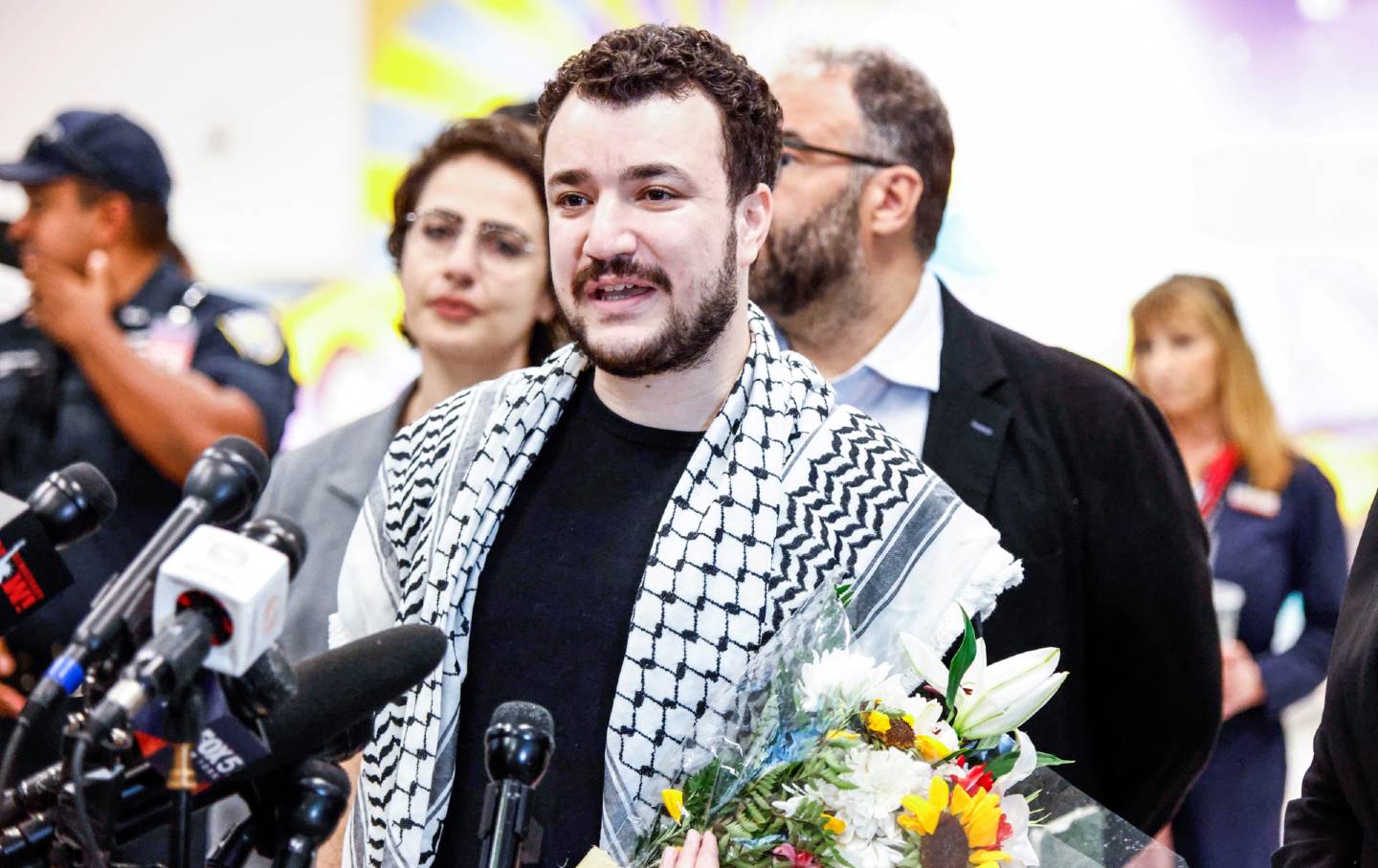
Former Columbia Univrsity student Mahmoud Khalil speaks to the press as he arrives at Newark airport on June 21, 2025.
(Kena Betancur / AFP via Getty)Mahmoud Khalil, the former Columbia student activist who was kidnapped by ICE and sent to a detention camp in Louisiana, is now in the process of suing the Trump administration over his abduction and arrest. He’s using a law designed specifically to combat the federal government’s claims of immunity from accountability or liability when it injures people or destroys their property.
Khalil spent 104 days in a detention facility in Jena, Louisiana, as one of the first victims of the Trump administration’s brutalization of Palestinian rights activists. In addition to the horrors and human rights violations he experienced at the facility, the government’s abduction of Khalil caused him to miss the birth of his child. He was released on bail when a judge ruled that his arrest was likely an unconstitutional violation of the First Amendment. The government is still prosecuting Khalil and appealing his release.
Khalil is countersuing the government for $20 million—or an apology—alleging false arrest, false imprisonment, and malicious prosecution. His claim for damages should be allowed under the Federal Tort Claims Act (FTCA). The law, passed in 1946, permits individuals to sue the government for civil damages following government misconduct. In a just country, Khalil would be entitled to legal recourse and monetary recompense for his unlawful arrest and imprisonment.
But in this country, six Republicans on the Supreme Court will likely stand in the way of justice and instead continue to protect Donald Trump and his fascist administration from accountability. They’ll do this by weakening the FTCA, if that’s what it takes to help Trump.
The FTCA is one of the main tools we have to hold the federal government accountable for its actions. As many readers know, government agents, like those working for law enforcement, enjoy “qualified immunity,” which prevents them from being held accountable for actions that violate the civil or constitutional rights of their victims. But while qualified immunity protects the individual agents who cause harm, the FTCA allows the federal government as a whole to be sued for damages.
The way the law works requires people who have been hurt by the government to file a complaint with the relevant federal agency that caused the harm. That’s the stage Khalil is at now: He’s filed a complaint with the federal agencies that arrested and detained him. Those agencies—the State Department, the Department of Homeland Security, and US Immigration and Customs Enforcement—have six months to respond.
I’m going to assume that neither Marco Rubio nor Kristi Noem nor Todd Lyons will be willing to let their agencies settle this case with Khalil. I know I’m really out on a limb here predicting bad faith and recalcitrance from Trump-appointed ghouls.
After six months of likely inaction from the relevant federal agencies, Khalil will be allowed to sue the government under the FTCA. The law contains what’s called the “law enforcement proviso,” which explicitly allows people to sue the government for “intentional torts” committed by law enforcement. Intentional torts are things people do on purpose, as opposed to by accident. Examples of intentional torts include: assault, battery, false arrest, false imprisonment, and malicious prosecution. It’s important that the FTCA specifies that law enforcement can be sued for these things, because beating people up and putting them in jail is pretty much all law enforcement can think to do. The FTCA means that a government agency cannot escape accountability just because its cops say, “I was doing my job.”
But that’s where the good news for Khalil may end. Because what the FTCA means and what Supreme Court Justice Neil Gorsuch can make it mean could be two very different things. There is an exception to the FTCA that might prove big enough to drive an entire gestapo through. It’s called the “discretionary function exception.” The exception prohibits the government from being held liable for any actions its agents or officials take that are not required by their government jobs. In other words, the government just has to claim its officials were acting at their own personal discretion, and the government potentially gets off the hook.
What’s the difference between a required action and a discretionary one? Your guess is as good as mine. The discretionary exception is where most FTCA cases against the government go to die.
Just a few weeks ago, in an FTCA case completely unrelated to Khalil or the current Trump administration, the Supreme Court had an opportunity to clarify what the discretionary exception means. The case was called Martin v. US. In a unanimous ruling, the court decided that the law enforcement proviso does not apply to the discretionary exception, meaning that even if a law enforcement official does violate the FTCA, the government can claim the official was acting at their own discretion, and thus the government might still be able to escape accountability.
That part of the ruling was, more or less, expected. But the litigants in Martin asked the court to go further and resolve the underlying paradox of the discretionary exception. Arguably, every time law enforcement commits an intentional tort, they’re doing so at their own discretion. Much as cops like to pretend otherwise, they don’t have to beat people up and throw them in jail. But if the government is off the hook every time law enforcement decides to crack some skulls, then what is the point of the law enforcement proviso? How can you hold people responsible for intentional acts of violence when intentional acts of violence aren’t actually required?
Popular
“swipe left below to view more authors”Swipe →Neil Gorsuch, who wrote the unanimous opinion for the court, acknowledged that he was creating a problem, but didn’t want to do the work of fixing it. He wrote:
We readily acknowledge that different lower courts have taken different views of the discretionary-function exception. We acknowledge, too, that important questions surround whether and under what circumstances that exception may ever foreclose a suit like this one. But those questions lie well beyond the two we granted certiorari to address.… It is work enough for the day to answer the questions we took this case to resolve, clear away the two faulty assumptions on which that court has relied in the past, and redirect it to the proper inquiry.
I swear, only Neil Gorsuch can make even his own laziness sound like condescension.
In a concurrence in the case, Justice Sonia Sotomayor did try to resolve the conflict and explained that the discretionary exception does not shield the government every time someone makes a judgment call. Instead, she says, the exception “protects only those governmental actions and decisions that are themselves ‘based on considerations of public policy.’’’
The six Republicans did not join Sotomayor’s concurrence, so who knows if they agree, but even if they do, Sotomayor’s framing may not really help Khalil. The Trump government will surely argue, erroneously, that kidnapping Palestinian activists is very much based on “considerations of public policy.” It’s not hard to imagine at least five justices inventing an intentional tort exception to the FTCA that allows the government to falsely arrest political prisoners for public policy reasons.
Khalil and his lawyers are now facing the problem everyone else is: To hold Trump and his ruling henchmen accountable, they have to get through Trump’s first line of defense. And that first line is the Supreme Court. It has consistently ruled to protect Trump and prevent his government from being held accountable to the people, and I don’t think it’s going to stop doing that anytime soon. The current Supreme Court is not here for impartial justice; it’s here to enforce Trump’s will. It’s part of the problem and the system Khalil is fighting against.
Still, all of that doesn’t mean this lawsuit is without point or purpose. Khalil was one of Trump’s first victims, but far from his last. As the numbers of people Trump kidnaps, deports, and otherwise violates grows, it can be far too easy to forget the individual stories of the people whose lives Trump has tried to destroy. Lawsuits like this one keep people like Khalil front of mind (and in the headlines) and continue to place a spotlight on Trump’s authoritarian policies. I haven’t written about Khalil since the early days of his abduction, and likely wouldn’t be doing so now absent some fresh legal development to cover.
It’s also about justice. Khalil was abducted by this government. He should be compensated for that. As Khalil and every Palestinian activist knows, sometimes you fight the fight not because you expect to win but because you can’t let the atrocities slide in silence.
More from The Nation
What Trump and Tucker Carlson Have in Common What Trump and Tucker Carlson Have in Common
Carlson has broken with Trump largely over the war in Iran. But on Ukraine and immigration, the two speak very much the same language.
The Jewish Case Against AI The Jewish Case Against AI
Haredi rabbis and the secular left agree: This technology is a threat to the entire social fabric.
The Fight for Educational Equality Is Also a Fight for a Just Supreme Court The Fight for Educational Equality Is Also a Fight for a Just Supreme Court
The court has severely weakened our ability to make an education system that fulfills the promise of Brown.
The Fall of “Scientific American” The Fall of “Scientific American”
When the beloved science publication got too political, its corporate owners stepped in. Now its future is uncertain.

The Bookstore Revolution in Taiwan’s Conservative Heartlands The Bookstore Revolution in Taiwan’s Conservative Heartlands
After Taiwan legalized same-sex marriage, gender-themed bookstores are working to build the social acceptance that the law alone couldn’t deliver.
Jalen Hurts Deserved Better. We All Do. Jalen Hurts Deserved Better. We All Do.
In a country that treats workers as expendable parts, Hurts’s playing through a blood clot is just the highest-profile example of the price workers pay in an oligarchy.

