In Ireland, “Nothing but Love” for the Palestinian Women’s Soccer Team
The Palestinian National Women’s Football Team defeated the Bohemian Football Club 2-1 in front of a sell-out crowd in Dublin. It was much more than a win for Palestine.
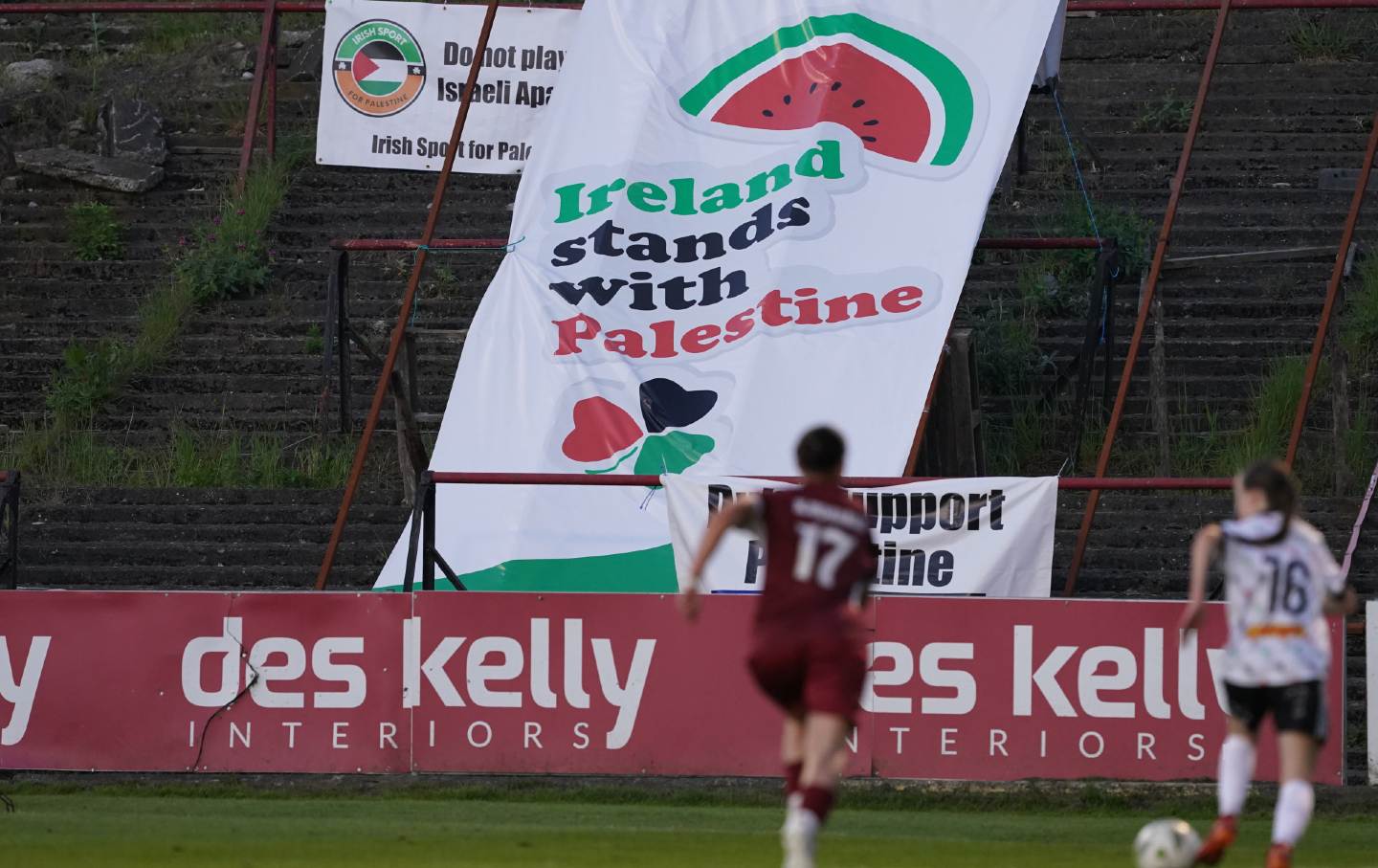
A banner drapes over the stands during a friendly match against the Palestine women’s national team in Dublin on May 15.
(Brian Lawless / PA Images via Getty)Every May 15, Palestinians and solidarity activists remember 1948 and the forced expulsion of an estimated 750,000 from the land now called Israel. They call that day the Nakba, which means “catastrophe” in Arabic. Yet Nakba Day is not just a time to mourn; it is a day to highlight the resistance of a people refusing to be erased. In Ireland, on the anniversary of the Nakba, this indomitability amid catastrophe was on display on the soccer pitch. In a year where May 15 carries extra weight, the Palestinian National Women’s Football Team played their first match in Ireland and defeated the Bohemian Football Club 2-1 in front of a sell-out crowd at Dublin’s Dalymount Park. The Bohemian Club invited the Palestinian team as an act of solidarity, and the game raised funds for both the Palestinian team’s travel as well as humanitarian efforts to aid Gaza in the face of an Israeli imposed famine.
As Palestinian captain Mira Natour told RTE, Ireland’s National Public News Service, “A lot of girls have different stories. Some lost someone of their families, some have brothers or cousins who have gone to jail. Despite the challenges and despite the circumstances we are facing, we have the right to play soccer, we have the rights to travel, we deserve respect.”
Palestinian flags were placed upon every seat in the arena before the match, creating a sea of red, white, black, and green backed by shouts of joy from the stands. The scene underscored team manager Deema Said’s comments to AJ+, where she said, “Sports is a way of resistance. It is a way of proving national identity and should be used as a vehicle as a way to carry our message.”
The bonds between Palestine and Ireland are strong and historic. I asked Irish Sport for Palestine member Rebecca O’Keeffe about these connections. She told me, “Ireland has a deep connection and long-standing solidarity with Palestine given our own historical struggles against colonization, occupation, oppression, brutality, and forced starvation. The enduring resistance of the Palestinian people paired with the steadfast support of the Irish people embodies the best of humanity, and we are united in advocating for freedom, liberation, and justice. However, the tendency of Irish politicians to rely on our historic solidarity without the accompaniment of concrete action only results in hollow rhetoric and empty, symbolic gestures. That’s why building on this solidarity through unwavering civil society mobilization, organization, and agitation is of critical importance.”
Irish Sport for Palestine, while not the event’s organizer, was a fervent supporter, with O’Keeffe saying that this match was “more than a game”; it was a “powerful symbol of the normalcy that is denied to Palestinians.”
The absence of normalcy in these players’ lives was unspoken but universally understood by fans. This Palestinian team has been training for the match against a backdrop of destroyed fields, bombed sports offices, and the killing of dozens upon dozens of athletes since October 7. As Said made clear, “It’s really hard for the players to be in their sports mindset to think just about the game. We carry their message—the people who have lost their lives. We keep them in our hearts deeply. And this is why we play.”
Considering how heavy their hearts must be, their reception from the moment the team touched down must have felt like sweet relief. It was celebratory, with Ireland embracing the team, enveloping them in cheers, hugs, and chants. “Since the second we landed at the airport, we have seen nothing but love,” marveled Said. Fans and Bohemian players met them at the airport waving flags and whooping rapturously. Several players pointed out that brandishing Palestinian flags can get you in tremendous trouble in Palestine, and yet in Ireland they waved freely and everywhere. Natour said, “Being in Ireland is like being home in Palestine.” And in a statement that showcased the unconquerable optimism of a people in the face of genocide, Said extended an invitation to the Irish players for a return match. This time in Palestine.
Support independent journalism that does not fall in line
Even before February 28, the reasons for Donald Trump’s imploding approval rating were abundantly clear: untrammeled corruption and personal enrichment to the tune of billions of dollars during an affordability crisis, a foreign policy guided only by his own derelict sense of morality, and the deployment of a murderous campaign of occupation, detention, and deportation on American streets.
Now an undeclared, unauthorized, unpopular, and unconstitutional war of aggression against Iran has spread like wildfire through the region and into Europe. A new “forever war”—with an ever-increasing likelihood of American troops on the ground—may very well be upon us.
As we’ve seen over and over, this administration uses lies, misdirection, and attempts to flood the zone to justify its abuses of power at home and abroad. Just as Trump, Marco Rubio, and Pete Hegseth offer erratic and contradictory rationales for the attacks on Iran, the administration is also spreading the lie that the upcoming midterm elections are under threat from noncitizens on voter rolls. When these lies go unchecked, they become the basis for further authoritarian encroachment and war.
In these dark times, independent journalism is uniquely able to uncover the falsehoods that threaten our republic—and civilians around the world—and shine a bright light on the truth.
The Nation’s experienced team of writers, editors, and fact-checkers understands the scale of what we’re up against and the urgency with which we have to act. That’s why we’re publishing critical reporting and analysis of the war on Iran, ICE violence at home, new forms of voter suppression emerging in the courts, and much more.
But this journalism is possible only with your support.
This March, The Nation needs to raise $50,000 to ensure that we have the resources for reporting and analysis that sets the record straight and empowers people of conscience to organize. Will you donate today?