February Storms in a Country That Still Works—for Now
The reliable knot that pulls together the threads of basic human life in America is beginning to unravel, and there suddenly arises the possibility that the center will not hold.
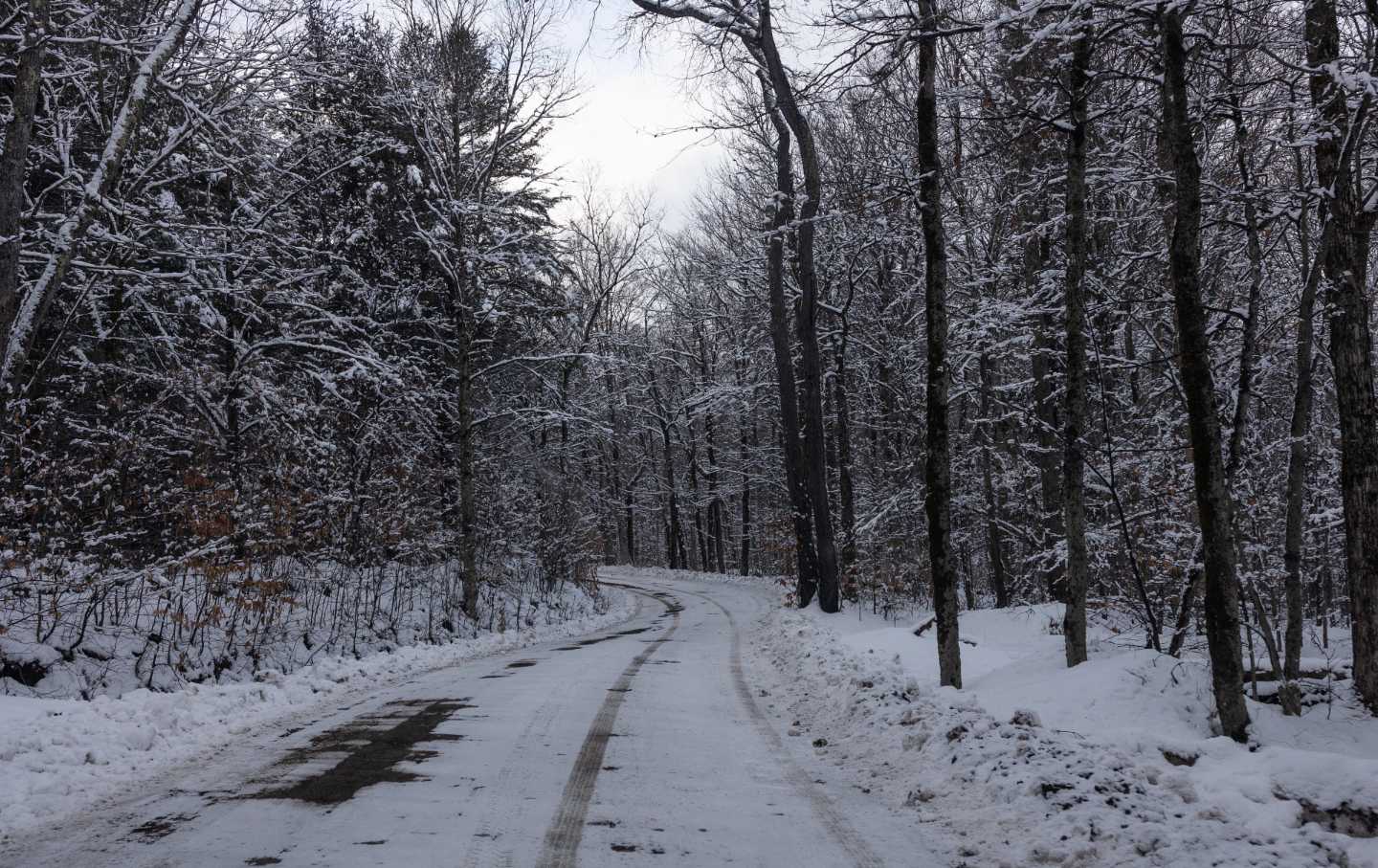
Spencertown, NY—We are having February storms like the snows we used to have. At the Hudson Valley farm where I live, sheets of ice cover the driveway and are broken up with salt on the roads—now freezing again and buried beneath a foot of soft white fluff that will harden up, making everything inaccessible.
Staying home is a gamble. To stay home is to risk being stranded in an isolated farmhouse without power for days. Everything stops. We worked with this for years, moving into the kitchen where there is a wood stove, lighting kerosene lamps and candles to read by at night, dreading the onset of the dark, figuring out what food can be prepared with only low heat and how to get through the day with the necessary coffee and tea without boiling water.
Cleaning anything without running water (having only a limited amount of water stored in jars in the house) is a project. The rest of the house is freezing. Going beyond the kitchen door to haul up firewood from the basement with a flashlight, keeping the wood stove going by feeding it hour after hour through the night, is hard work. Blackouts like this come on suddenly, and they end suddenly. Meanwhile, every minute there is tension: You are waiting it out… and the moment the lights come back on you forget the whole thing—you have the luxury of forgetting the whole thing.
But it brings back the reality that you live in a country that works, where you expect to have running water, the roads to be plowed, to get out and get around, to be able at any moment to get enough to eat, to be safe inside, and outside too, and to have a surround of people who share those core beliefs. You can differ in opinion—but you share the reality that you live in a country that works, and where you know that this is just a brief pause in the machinery.
But we now live in a moment and in a country where suddenly people everywhere—like the vast collection of animals we are—turn their eyes to the center. Where there suddenly arises the possibility that the center will not hold—that the reliable knot that pulls together all the threads of basic human life in America is beginning to unravel and that the country may cease to work. The familiar basic human needs of food and water and shelter and safety and a working system of roads may no longer be met. What we think of as readily available and solid as the ground beneath our feet may no longer be there. And things will die. And people will die.
What is the old adage? “If it ain’t broke don’t fix it.” Don’t play with the way things are—you’ll break the underlying system, evolved over years and years, that holds it all together. Don’t mess around with the “off” switch. How can you play with a mechanism as complicated as the United States without breaking it?
The storms are a kind of freezing in time. Moments to pause and think about how to let the wheel of America keep turning and not let it stop, not let it simply break in the hands of people who may be—like many of us—too comfortable, and too ignorant of history to know why the imbalance of too much power in one place is not the American thing. No one should have the strength to crush the lives of others without their having recourse in America today.
It is the story of Samson, the story of shams, the sun, whose locks, whose rays, are shorn by Delilah, confusion. Without its rays the sun becomes blind; it cannot shine and see what is before it. The sun was once what turned the wheel, bound to the very axis at the center of the temple that is the world. When, in the end, the blinded sun cannot move, it falls, pulling down the roof, killing everyone.