Art Is How We Remember What Power Wants Us to Forget
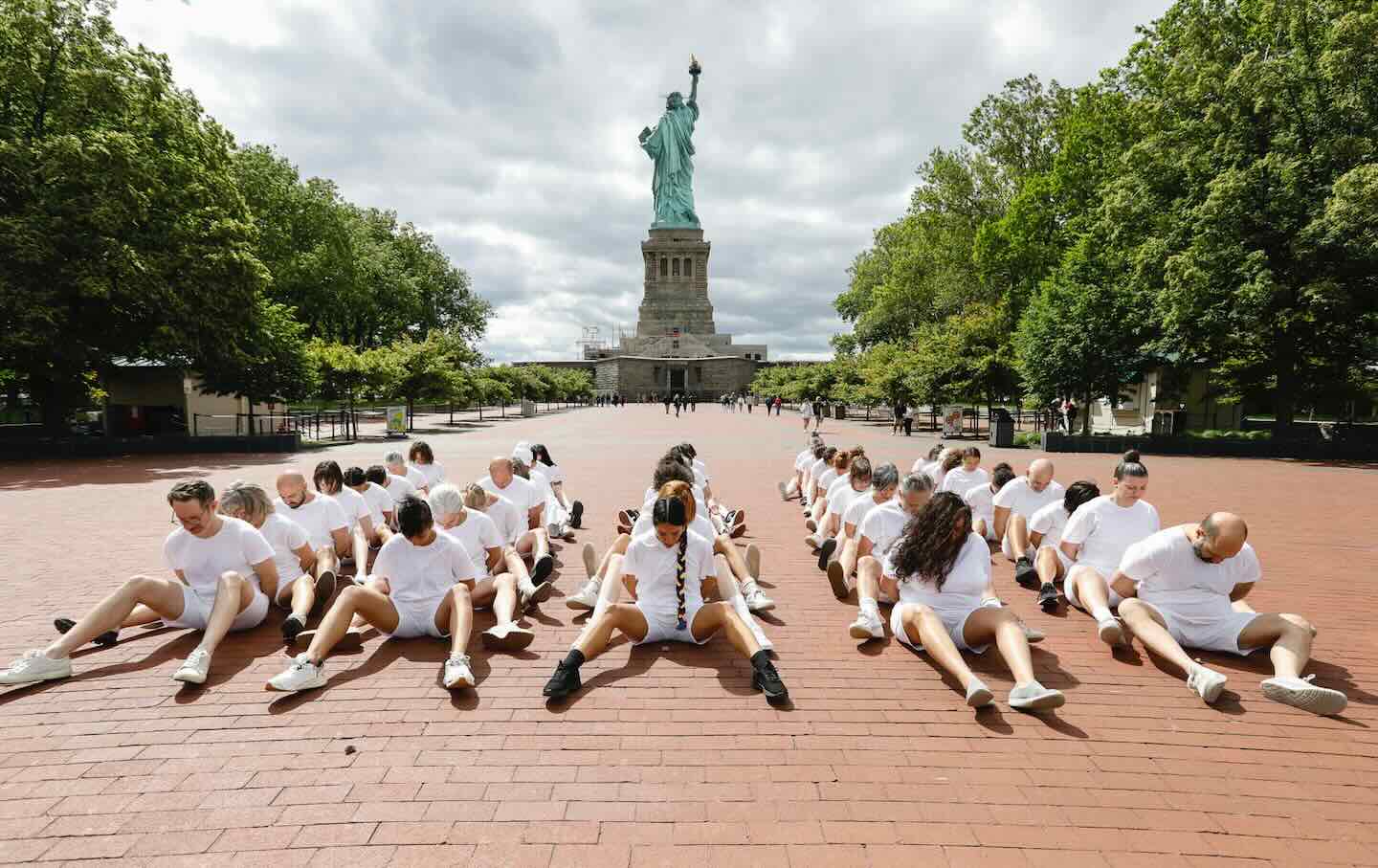
At the steps of the Statue of Liberty on Sunday, I organized more than 50 people to turn our grief into a collective demand: Free the 238 men unlawfully disappeared into CECOT.
In 2019, I spoke to a group of asylum-seeking women who told me of the months they spent trapped in a detention center in southern Texas after trying to seek asylum at the US-Mexico border. They were denied showers for weeks on end, forced to bleed through their clothes during their periods, and were given rotting food to eat. These women endured conditions meant to break them. But instead of staying silent, they organized a llanto de libertad—a cry for freedom.
One night, over a thousand women screamed in unison. It was a wail, a protest, a collective act of resistance, a demand to be heard and released.
Imagine the act of defiance: one thousand women screaming for their freedom as armed guards watched over them.
They believed if those of us on the outside heard them, we would care. But we refused to hear them and so no one came.
Their llanto de libertad has haunted me for years. A cry unheard. A story untold. I understand now: They weren’t only demanding their freedom. They were trying to warn us. If only we had paid attention.
In March, our government, acting in our name, forcibly sent 238 Venezuelan men to a notorious mega-prison in El Salvador known as CECOT. Some were removed under the 18th-century Alien Enemies Act. Many of these men were asylum seekers or had legal grounds to be in the United States. Yet they were rounded up in the dead of night, branded as criminals, and disappeared into a third country’s prison.
Though the United States government has insisted that these men are “dangerous,” it has produced no evidence to support such claims. Government officials have consistently misled courts and the public. These gross human rights violations are built on the government’s lies. The government must manipulate memory to conscript us into their false narrative and justify the erosion of our most fundamental values. It must erase history. It must overwhelm us with misinformation and fear.
This is the machinery of authoritarianism. And this is exactly where art becomes essential—not decorative, not symbolic, but urgent and necessary. In the face of institutionalized gaslighting, art becomes a vessel for truth-telling. It resists silence. Art insists: We were here, we saw, we remember.
On June 1, I turned my own grief into protest—and my protest into art.
I conceived, directed and organized more than 50 people who gathered at the steps of the Statue of Liberty to reclaim our public space as a site of memory and denunciation. We gathered to show that our country, a place that once welcomed immigrants, now disappears them. We insisted on truth in a country that is now being built on silence.
With the cold wind whipping around us, a beam of sunlight broke through the clouds just as I began to speak the names of the 238 men disappeared into CECOT. One by one. Each name a breath. Each name a wound. Each name a warning.
It was a ritual to their existence. A reckoning. A public refusal to forget.
And then from silence, we screamed.
Our own llanto de libertad.
A collective cry, a demand: Freedom for the 238 men who were unlawfully disappeared into CECOT.
Popular
“swipe left below to view more authors”Swipe →Art has always been our memory—etched on cave walls, woven into fabric, painted on the sides of buildings. It is how we have remembered ourselves through centuries of violence, silence, and erasure. We need only look a handful of years back to find roadmaps for resistance through art.
Across the globe, movements have used art to carry memory where governments tried to erase it. In Chile, the Brigada Ramona Parra (BRP) reminds us that walls are never neutral; they are battlegrounds for memory and truth. Under Pinochet’s dictatorship, public expression was crushed, protest criminalized, and the memory of the disappeared violently suppressed. But in the years that followed, BRP reclaimed the streets with bold, collective muralism—acts of defiance in color and form. They painted what official history tried to erase. They showed that art is not a passive reflection of a moment—it is a tool to confront power, carry memory, and ignite action.
In Argentina, Las Madres de la Plaza de Mayo turned grief into a form of performance art—a living, breathing denunciation of state terror. As the military dictatorship disappeared thousands of sons and daughters, the regime insisted they never existed. But the Madres refused erasure. They gathered every Thursday in Buenos Aires’s Plaza de Mayo, circling silently with white headscarves—symbols of mourning, defiance, and maternal power. Their march was not loud, but it was thunderous. They used their bodies as living testimony, a public performance that shattered the dictatorship’s carefully constructed silence. It was protest. It was art. It was memory made visible.
In my home country of Colombia, La Columna 13 in Medellín—once one of the most violent and marginalized areas of the city—has become a symbol of resistance through art, and at its heart is hip-hop. For decades, the Colombian state neglected the people who lived there, offering only militarization and abandonment. But the youth of Columna 13 reclaimed their story through rap, graffiti, breakdancing, and DJing—the four pillars of hip-hop. They turned pain into poetry, trauma into truth. Artists and local collectives began using hip hop as a tool to demand justice, document state violence, and celebrate community resilience. Their music and murals transformed the neighborhood’s steep, winding streets into an open-air archive of resistance.
On Sunday, as our screams echoed off the Statue of Liberty, our bodies stood frozen—rooted in a place of defiance, reverence, and collective power. No one wanted to move. It felt sacred, necessary to stay.
Then my dearest friend, Yara Travieso—Venezuelan, fierce, and full of fire—broke the silence and said, “Our desire for liberation is stronger than our fear of repression.”
We all repeated it. A mantra. A vow.
I carry those words with me now, not just as comfort, but as direction.
May they guide you, too—through fear, through doubt—as we fight for the heart and soul of our country.
Support independent journalism that does not fall in line
Even before February 28, the reasons for Donald Trump’s imploding approval rating were abundantly clear: untrammeled corruption and personal enrichment to the tune of billions of dollars during an affordability crisis, a foreign policy guided only by his own derelict sense of morality, and the deployment of a murderous campaign of occupation, detention, and deportation on American streets.
Now an undeclared, unauthorized, unpopular, and unconstitutional war of aggression against Iran has spread like wildfire through the region and into Europe. A new “forever war”—with an ever-increasing likelihood of American troops on the ground—may very well be upon us.
As we’ve seen over and over, this administration uses lies, misdirection, and attempts to flood the zone to justify its abuses of power at home and abroad. Just as Trump, Marco Rubio, and Pete Hegseth offer erratic and contradictory rationales for the attacks on Iran, the administration is also spreading the lie that the upcoming midterm elections are under threat from noncitizens on voter rolls. When these lies go unchecked, they become the basis for further authoritarian encroachment and war.
In these dark times, independent journalism is uniquely able to uncover the falsehoods that threaten our republic—and civilians around the world—and shine a bright light on the truth.
The Nation’s experienced team of writers, editors, and fact-checkers understands the scale of what we’re up against and the urgency with which we have to act. That’s why we’re publishing critical reporting and analysis of the war on Iran, ICE violence at home, new forms of voter suppression emerging in the courts, and much more.
But this journalism is possible only with your support.
This March, The Nation needs to raise $50,000 to ensure that we have the resources for reporting and analysis that sets the record straight and empowers people of conscience to organize. Will you donate today?