Our Back Pages / December 16, 2025

How the Border Patrol Moved Inland—and Created a Police State

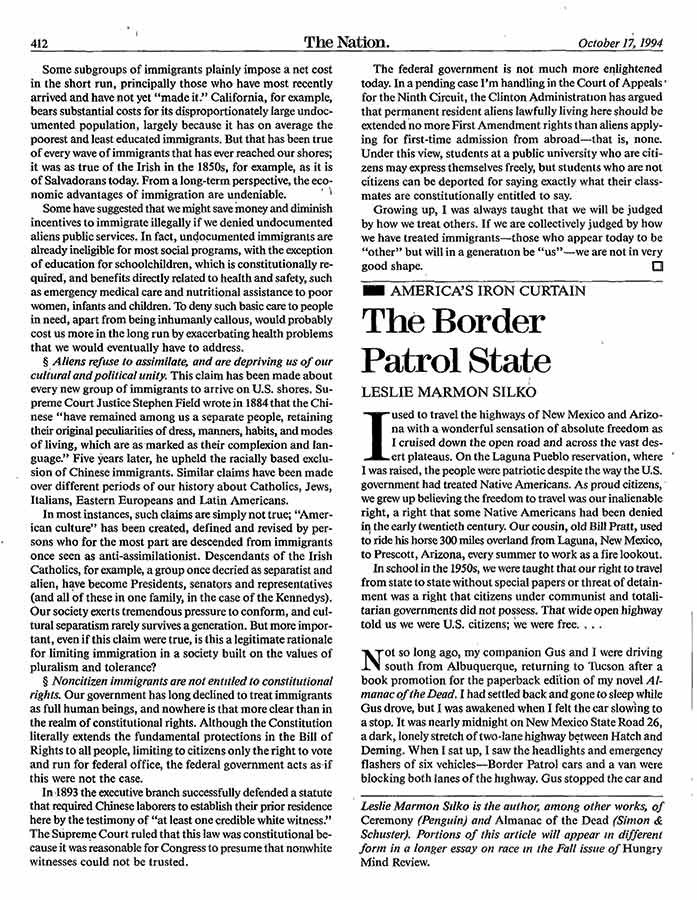
In 1994, the writer Leslie Marmon Silko wrote a piece for The Nation warning of a frightening new immigration regime.
Richard Kreitner

In recent months, as the Trump administration has grown frustrated by the pace of deportations organized by ICE, it has sicced the even nastier Border Patrol on American cities—first Los Angeles, then Chicago, and now Charlotte. The move is the vicious culmination of a decades-long trend of hyper-militarized immigration enforcement.

In 1994, The Nation published “The Border Patrol State,” an essay by the Laguna Pueblo writer Leslie Marmon Silko about the increased presence of the Border Patrol far from the actual border. Silko grew up on a reservation and knew how the US government had mistreated Native peoples. Even so, this didn’t change the “wonderful sense of absolute freedom” she felt as she “cruised down the open road and across the vast desert plateaus.”

“That wide open highway told us we were U.S. citizens,” she wrote, “we were free….”

That sense of freedom was destroyed, however, by an incident when she was driving with a companion from Albuquerque to Tucson. They came across a roadblock set up by the Border Patrol. The officers told them to step out of the car. “I will never forget that night beside the highway,” Silko wrote. “There was an awful feeling of menace and violence straining to break loose. It was clear that the uniformed men would be only too happy to drag us out of the car if we did not speedily comply with their request (asking a question is tantamount to resistance, it seems).”

“The weird anger of these Border Patrolmen,” Silko continued, made her think of a report she had read about the thousands of people who had been disappeared during Argentina’s 1970s dirty war.

It was also clear that travelers were being racially targeted. The Border Patrol “exercises a power that no highway patrol or city patrolman possesses,” Silko wrote. “Other law-enforcement officers need a shred of probable cause in order to detain someone. On the books, so does the Border Patrol; but on the road, it’s another matter.”

“This is the police state that has developed in the southwestern United States since the 1980s,” she added. Now, 31 years later, that police state has gone national.

Even at the time, though, Silko understood where it was headed: “Manifest Destiny may lack its old grandeur of theft and blood—‘lock the door’ is what it means now.”

How darkly ironic it was, she reflected, that just a few years after the Iron Curtain came down in Europe, the US government had begun building a steel wall on the border with Mexico. “It is no use; borders haven’t worked, and they won’t work,” Silko concluded. “The great human migration within the Americas cannot be stopped; human beings are natural forces of the Earth, just as rivers and winds are natural forces.”

Disobey authoritarians, support The Nation

Over the past year you’ve read Nation writers like Elie Mystal, Kaveh Akbar, John Nichols, Joan Walsh, Bryce Covert, Dave Zirin, Jeet Heer, Michael T. Klare, Katha Pollitt, Amy Littlefield, Gregg Gonsalves, and Sasha Abramsky take on the Trump family’s corruption, set the record straight about Robert F. Kennedy Jr.’s catastrophic Make America Healthy Again movement, survey the fallout and human cost of the DOGE wrecking ball, anticipate the Supreme Court’s dangerous antidemocratic rulings, and amplify successful tactics of resistance on the streets and in Congress.

We publish these stories because when members of our communities are being abducted, household debt is climbing, and AI data centers are causing water and electricity shortages, we have a duty as journalists to do all we can to inform the public.

In 2026, our aim is to do more than ever before—but we need your support to make that happen. 

Through December 31, a generous donor will match all donations up to $75,000. That means that your contribution will be doubled, dollar for dollar. If we hit the full match, we’ll be starting 2026 with $150,000 to invest in the stories that impact real people’s lives—the kinds of stories that billionaire-owned, corporate-backed outlets aren’t covering. 

With your support, our team will publish major stories that the president and his allies won’t want you to read. We’ll cover the emerging military-tech industrial complex and matters of war, peace, and surveillance, as well as the affordability crisis, hunger, housing, healthcare, the environment, attacks on reproductive rights, and much more. At the same time, we’ll imagine alternatives to Trumpian rule and uplift efforts to create a better world, here and now. 

While your gift has twice the impact, I’m asking you to support The Nation with a donation today. You’ll empower the journalists, editors, and fact-checkers best equipped to hold this authoritarian administration to account. 

I hope you won’t miss this moment—donate to The Nation today.

Onward,

Katrina vanden Heuvel 

Editor and publisher, The Nation

Richard Kreitner

Richard Kreitner is a contributing writer and the author of Break It Up: Secession, Division, and the Secret History of America's Imperfect Union. His writings are at richardkreitner.com.

More from The Nation

The Fight to Keep New Orleans From Becoming “Everywhere Else”

The Fight to Keep New Orleans From Becoming “Everywhere Else” The Fight to Keep New Orleans From Becoming “Everywhere Else”

Twenty years after Katrina, the cultural workers who kept New Orleans alive are demanding not to be pushed aside. 

Feature / Larry Blumenfeld

A still from the video of the 1992 police beating of Rodney King. LAPD chief Daryl Gates defended the department’s racist police regime until he was forced out in the wake of King’s beating.

Breaking the LAPD’s Choke Hold Breaking the LAPD’s Choke Hold

How the late-20th-century battles over race and policing in Los Angeles foreshadowed the Trump era.

Feature / Danny Goldberg

Mayor of LA to America: “Beware!”

Mayor of LA to America: “Beware!” Mayor of LA to America: “Beware!”

Trump has made Los Angeles a testing ground for military intervention on our streets. Mayor Karen Bass says her city has become an example for how to fight back.

Feature / Gail Reed

How LA Defeated Donald Trump

How LA Defeated Donald Trump How LA Defeated Donald Trump

And how the rest of the country can too.

Feature / Bill Gallegos

Donald Trump, October 2025.

The Remaking of Trump’s Washington, DC The Remaking of Trump’s Washington, DC

The ballroom and his other proposed building projects are many things, but they are not exactly works of architecture.

Books & the Arts / Karrie Jacobs

Seattle, Washington, 2022.

Organized Labor at a Crossroads Organized Labor at a Crossroads

How can unions adapt to a new landscape of work?

Books & the Arts / Nelson Lichtenstein