
Zohran Mamdani’s Win Could Change Everything
Mamdani won by uplifting and uniting some of New York City’s most forgotten voters. His coalition now has a chance to transform what’s possible for people everywhere.
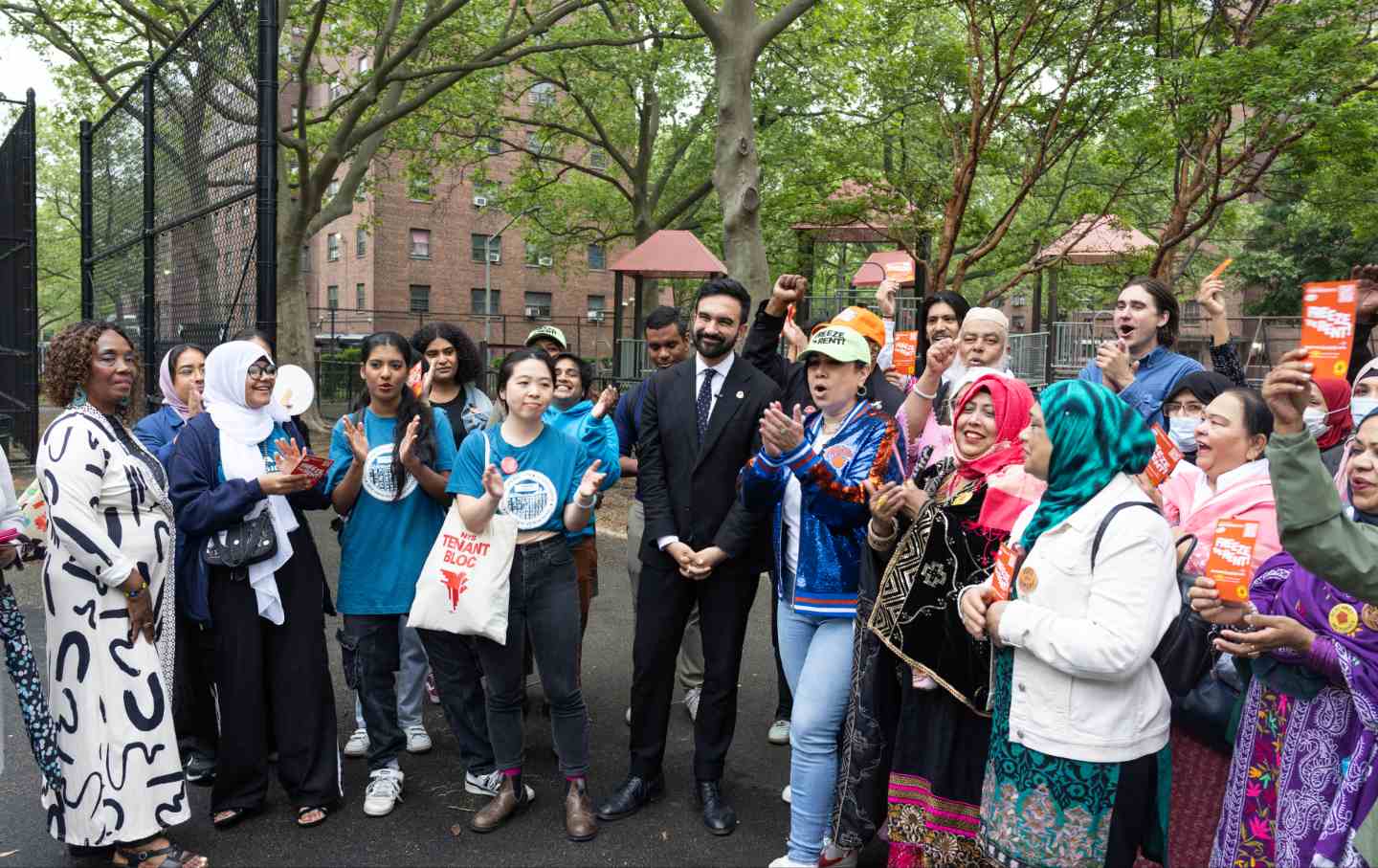
Zohran Mamdani with supporters in Brooklyn on May 4, 2025.
(Andrew Lichtenstein / Corbis via Getty Images)On a cold February day in 2017, the gates came down on thousands of bodegas across New York City. Many were Yemeni-owned, family-run stores—places that almost never closed, not for a blizzard, not for a blackout, not even for Eid. But just this once, they did. The occasion was Donald Trump’s first Muslim ban. The owners shut their lights, locked their doors, and taped notes to the glass: “Closed in protest. Closed for dignity. Closed for America.”
That day, they gathered outside Brooklyn’s Borough Hall under a winter sky, praying in the cold and waving American flags. It looked like a protest, but it felt like something deeper. It was a collective act of defiance—and belonging. For years after 9/11, Arab and Muslim New Yorkers had lived under the long shadow of surveillance and suspicion, told to keep their heads down, stay quiet, and be grateful. The 2017 bodega strike broke that silence. Here were Muslim workers and small business owners—unapologetic, organized, and standing shoulder to shoulder—not asking for permission but asserting their place in the city they helped build. It wasn’t just about Trump’s ban. It was a rupture with the post-9/11 politics of fear. It marked the emergence of a new kind of Muslim American politics—rooted in solidarity, visible in public, and grounded in power, not just presence.
Few saw it for what it was. But that day was not only an end to hiding. It was the quiet beginning of a realignment that would take clearer shape years later, when New York Democrats chose Zohran Mamdani as their nominee for mayor.
Mamdani’s win is historic in the ways the headlines capture. He is the first Muslim and South Asian nominee for mayor of New York, and the first democratic socialist in generations to have a real shot at leading a major American city. But the basic facts aren’t the real story. The real story is how he won—and why.
When Andrew Cuomo launched his comeback bid, the Democratic establishment seemed eager to pretend the last decade hadn’t happened. Cuomo ran as if it were still 2010, leaning on the same donors, repeating the same talking points, spending millions on television ads, and betting that a weary electorate would settle for the devil they knew.
But Mamdani saw something they didn’t. He recognized how much the ground had shifted. That shift began, in part, with the bodega strike in 2017. Some of the people who had organized or participated in that protest helped power his campaign. Others, who had been politicized by it or had been ignored since, joined his coalition. The memory of that moment—when immigrant communities stood up to say, “We belong here”—did not fade. It deepened. It matured.
These weren’t symbolic gestures. They were seeds. Mamdani’s campaign grew from years of organizing, frustration, and grief, especially among young progressives, immigrants, and Arab and Muslim communities who had long been pushed to the party’s margins. He didn’t just run against Cuomo. He ran against the political amnesia that forgot the people who showed up when it mattered.
No issue revealed that disconnect more clearly than Gaza. Over the past 20 months, as tens of thousands of Palestinian civilians were killed by American-made bombs, Democratic leaders offered excuses instead of action. Even as the party’s base shifted toward supporting Palestinian rights, the leadership stood firm.
In the primary, Cuomo followed this script, accusing Mamdani of extremism for his pro-Palestinian views and demanding loyalty tests. But Mamdani didn’t flinch. He named what was happening. He said that solidarity is not a slogan, that multiracial democracy must mean something for those most often asked to wait.
Voters didn’t punish him for it. They rewarded him. As a Bangladeshi Uber driver told me on election night, “Zohran is for peace, not war. He’s for ordinary people. We don’t want more wars. We need help here in New York.”
This clarity wasn’t rhetorical. It was the foundation of his campaign. And it worked. Mamdani didn’t just win in Park Slope or Cobble Hill. He won all over the city: in Jackson Heights, Richmond Hill, Sunset Park, Chinatown, and Flushing. He flipped swing districts like Oakland Gardens, places that had voted for Joe Biden in 2020, for GOP gubernatorial candidate Lee Zeldin in 2022, and for Donald Trump last year. He united two groups that rarely move in tandem: young progressives and working-class immigrants.
This coalition didn’t appear out of thin air. It was built over the course of a decade, starting with Bernie Sanders’s 2016 campaign, the rise of DSA in New York politics, the Justice Democrats victories of Alexandria Ocasio-Cortez and Jamaal Bowman, and the defeat of the Republican-aligned, Cuomo-backed Independent Democratic Coalition, a win fueled in part by the Working Families Party. It gained strength through protests, petitions, primaries, and losses. It learned how to win by learning how to lose—together.
By 2023, socialists held more seats in Albany than at any time in the past hundred years. Arab, Muslim, and Bangladeshi communities had begun electing their own leaders and forming durable institutions. Mamdani grew within that movement. When he ran for mayor, he was ready.
While national Democrats pulled back, Mamdani leaned in. He ran on a clear and grounded message: freeze rents, make buses free, build public grocery stores. His stance on Israel and Palestine wasn’t buried, and it wasn’t isolated. It was part of a broader argument about dignity, housing, and whose voices matter. He made democratic socialism sound like common sense. He invited people in—not to agree on everything, but to build something bigger than themselves.
He also understood that solidarity is something you do. His alliance with Brad Lander, New York’s progressive Jewish comptroller, was not just symbolic. It was strategic. Together, they showed that Muslims and Jews could share power without flattening their differences, and that real coalition is built through action, not just talk.
Popular
“swipe left below to view more authors”Swipe →Some will say Mamdani won because of Cuomo’s failures, or because young voters like TikTok. But this wasn’t a vibe campaign. It was a campaign about housing, buses, food, and war. Yes, the communications were sharp. Yes, Mamdani understood the moment. But what made his campaign powerful was its honesty. It didn’t just look good. It told the truth.
The danger now is that Democrats will take the wrong lesson from Mamdani’s triumph. They may try to copy Mamdani’s media strategy while ignoring the content of his message. Somewhere, someone is already pitching a crypto-friendly meme about the “Opportunity Economy” sponsored by JPMorgan. But what moved voters wasn’t the medium. It was the message.
Mamdani’s critics call him radical. So did critics of Fiorello La Guardia in the 1930s. The New York Times said La Guardia was obsessed with “socialistic playthings” like public power. Today, La Guardia is remembered not as a radical but as one of the city’s greatest mayors. They named an airport after him.
If Mamdani’s victory feels like something new, it is. But it is also a return. A return to a politics that sees dignity as nonnegotiable, solidarity as a strategy, and leadership as a tool for the many. In a city long governed by caution, voters chose boldness. They chose memory over forgetting.
They remembered the bodegas. They remembered the prayers in the cold. They remembered what it felt like to be left out—and what it felt like to fight back. And this time, they didn’t just protest. They voted.
The question now is whether Mamdani’s coalition can govern. If it can, it might not just change New York. It might change what’s possible everywhere.
Support independent journalism that does not fall in line
Even before February 28, the reasons for Donald Trump’s imploding approval rating were abundantly clear: untrammeled corruption and personal enrichment to the tune of billions of dollars during an affordability crisis, a foreign policy guided only by his own derelict sense of morality, and the deployment of a murderous campaign of occupation, detention, and deportation on American streets.
Now an undeclared, unauthorized, unpopular, and unconstitutional war of aggression against Iran has spread like wildfire through the region and into Europe. A new “forever war”—with an ever-increasing likelihood of American troops on the ground—may very well be upon us.
As we’ve seen over and over, this administration uses lies, misdirection, and attempts to flood the zone to justify its abuses of power at home and abroad. Just as Trump, Marco Rubio, and Pete Hegseth offer erratic and contradictory rationales for the attacks on Iran, the administration is also spreading the lie that the upcoming midterm elections are under threat from noncitizens on voter rolls. When these lies go unchecked, they become the basis for further authoritarian encroachment and war.
In these dark times, independent journalism is uniquely able to uncover the falsehoods that threaten our republic—and civilians around the world—and shine a bright light on the truth.
The Nation’s experienced team of writers, editors, and fact-checkers understands the scale of what we’re up against and the urgency with which we have to act. That’s why we’re publishing critical reporting and analysis of the war on Iran, ICE violence at home, new forms of voter suppression emerging in the courts, and much more.
But this journalism is possible only with your support.
This March, The Nation needs to raise $50,000 to ensure that we have the resources for reporting and analysis that sets the record straight and empowers people of conscience to organize. Will you donate today?
More from The Nation

A Conflict Without Reason Has Become a Dangerous Holy War A Conflict Without Reason Has Become a Dangerous Holy War
Lacking a clear rationale for the attack on Iran, Trumpists are increasingly talking like crusaders.
RFK Jr. America’s Snake Oil Salesman RFK Jr. America’s Snake Oil Salesman
Raw truth: MAHA is NUTS.
The Unfathomable Toll of the Syrian Civil War The Unfathomable Toll of the Syrian Civil War
How to make sense of the 13-year conflict?
Celebrate Kristi Noem’s Firing. But Keep Protesting ICE. Celebrate Kristi Noem’s Firing. But Keep Protesting ICE.
Finally, someone in the administration is paying for their cruelty and incompetence.
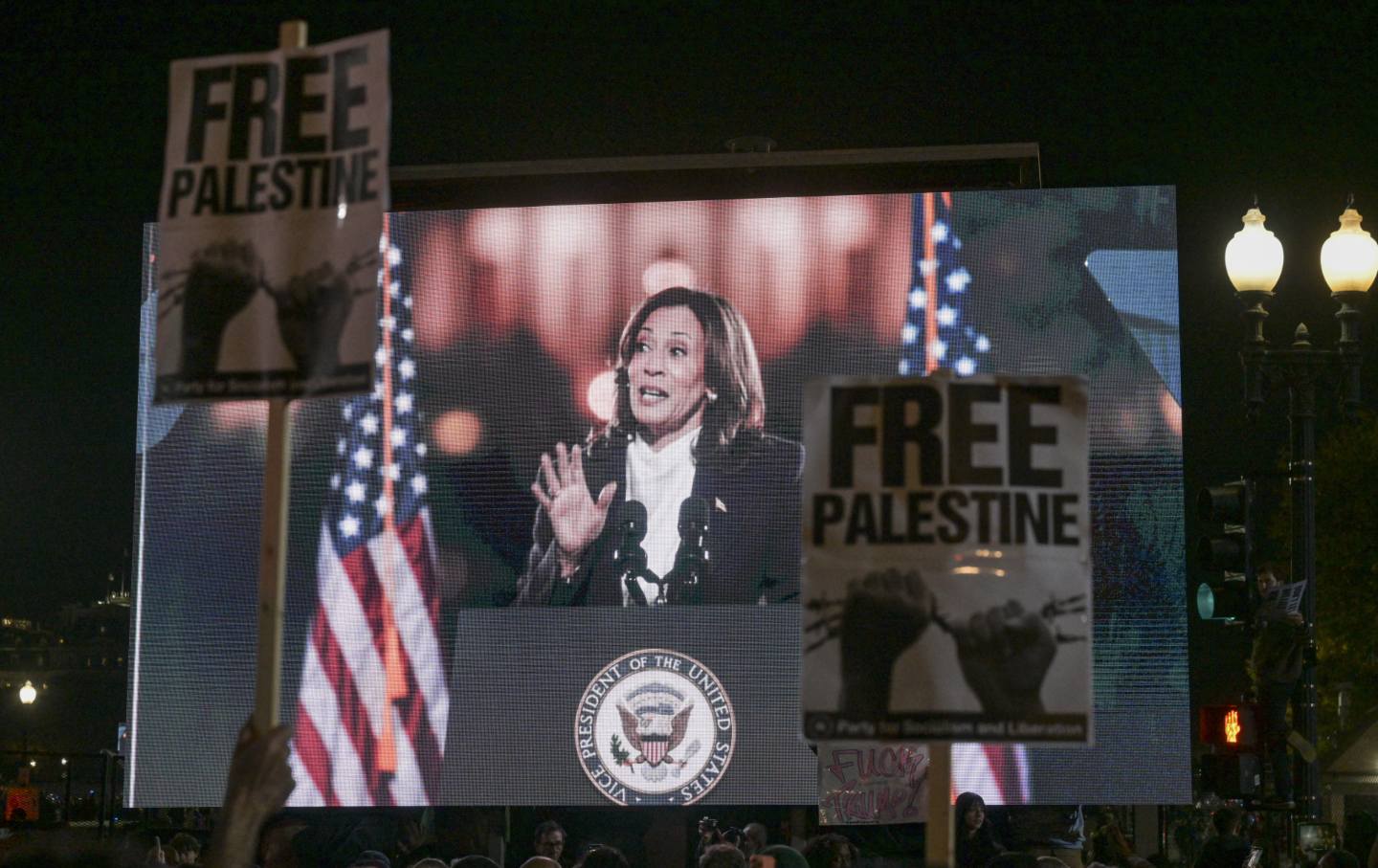
We Don’t Need an Autopsy to Tell Us the Democrats Failed on Gaza We Don’t Need an Autopsy to Tell Us the Democrats Failed on Gaza
The DNC is allegedly hiding a report showing that Kamala Harris’s Gaza policy helped cost her the 2024 election. But that report won’t tell us anything we don’t already know.
Texas’s Senate Primary Has Already Made History—and It’s Not Over Yet Texas’s Senate Primary Has Already Made History—and It’s Not Over Yet
Democratic nominee James Talarico is getting national media attention, but the real story is sky-high voter turnout, even amid GOP bids to suppress balloting

