
The USS Lincoln Is Part of a Long History of Naval Mistreatment
The USS “Lincoln” Is Part of a Long History of Naval Mistreatment
The ship has been out to sea for the longest stretch of time without a port call in modern history. Effects on physical and mental health are dire.
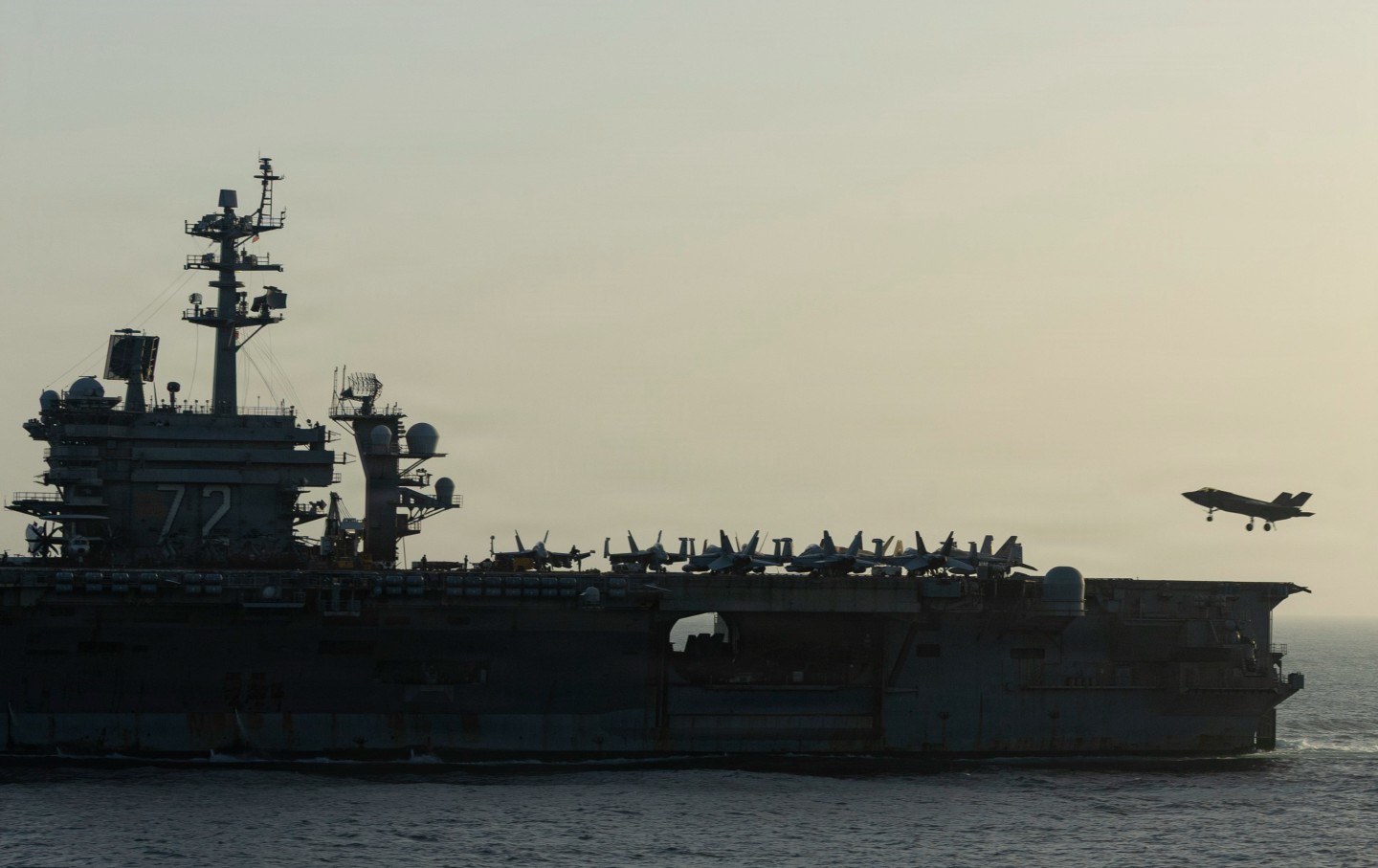
The USS Abraham Lincoln (CVN 72) conducts US blockade operations related to the Strait of Hormuz on April 16, 2026, in the Arabian Sea.
(Handout Photo by the US Navy via Getty Images)The USS Abraham Lincoln was designed to sail forever. The 100,000-ton vessel can transport 5,400 sailors and 90 jets for 25 years without refueling, thanks to the atomic fission of two Westinghouse nuclear reactors stored in the hull. The ship’s infinite power source offers an incredible military edge, one tempered by inevitable rust and oxidation from sea water, plus the basic human needs of the sailors aboard, among them clean water, food, soap, and the ability to engage, at least intermittently, with civilization.
Last November, for the ninth or 10th time, the Lincoln departed from the port of San Diego for the Middle East. The ship was worn down, and the crew was burnt out, thoroughly frazzled by what military leaders described as a quickening “operational tempo” that was soon to hit hyper speed—conditions that only nuclear reactors could endure.
For nearly half of 2024, the Lincoln had been deployed in the Eastern Mediterranean to deter Iran, the Houthis, and other proxy forces targeting Israel as the country unleashed a genocide in Gaza. In 2025, the crew of the Lincoln underwent a series of intense sustainment exercises across hundreds of nautical miles in Alaska and other locales.
The November deployment was slated to end in May, but three months in, President Trump launched the War in Iran, forcing the Lincoln to ramp up operations and remain on the water. As of this writing, the carrier has been out to sea for a whopping eight months—the longest stretch of time without a port call in modern history. Thousands of sailors worked hundreds of days without a single one off.
Military brass today express a posture of constant vigilance while also proclaiming that the Pentagon is “a people business.” Acting Navy Secretary Hung Cao has equated “troop welfare” with tactical success, as have countless leaders before him. The truth, however, is that war is a body business, its planners calculating the most brutally efficient ways to maintain morale and manpower. Military food, for instance, is designed within an inch of its life, made to fit specific caloric and dietary standards while also being lightweight and nonperishable. The rare perk of a “surf and turf” meal is seen by servicemembers not as some kind gesture, but instead an ominous harbinger of an unexpectedly long or heavy rotation to come.
The Pentagon frequently stretches the bounds of human will to keep the bombs dropping. This work is accomplished by specified training regimes that treat suffering, and even death, as crucial precursors to heroism and true manhood. Surrender, or even dissent, is seen as cowardly. This message is clear in the US Navy’s unofficial motto, “Don’t Give Up the Ship,” an order initially barked during the War of 1812 by the gravely wounded commander of the USS Chesapeake. In the end, the surviving sailors waved the white flag, making the pragmatic decision to spare their own lives after the prospect of victory had clearly eluded them.
“Victory” has had many meanings in the Forever Wars, a constantly shifting target that has pushed service members, and the equipment they rely on, to the limit. A quarter century into the war on terror, US troops and their families are contending with the military’s cold and callous approach to human resources in exceptional ways. They are a generation contending with profound distance and isolation brought on by historically long and repeated deployments. Back on American shores, many face moldy on-base housing, food insecurity, and a spate of physical and mental ailments brought on through their service. The Navy is particularly prone to these problems, beset by logistical, manpower, and construction issues stemming from the fact that that the branch is, as one former Naval commander warned a decade ago, “an 11-carrier Navy in a 15-carrier world.”
A deployment, no matter its length or locale, is emotionally grueling. One 2018 metanalysis of 185 studies found consistently adverse mental health effects from these odysseys. Nearly half of 1,000 sailors surveyed in 2025 claimed that the services available onboard to help address these stressors were grossly inadequate.
Sailors on the Lincoln have endured a particularly hard time on the seas, battered not not only by heavy combat operations, but also bad food, a lack of soap and toothpaste, dirty water, moldy showers, and severe plumbing issues. The mail system also went on the fritz, leading to lost care packages that have exacerbated the crew’s gnawing sense of isolation. (Other ships have experienced similar problems.)
In recent weeks, Navy families and sailors have taken the unusual step of speaking out on behalf of the crew as conditions have become especially dire. Reports say that multiple sailors have attempted to jump into the sea. Last week, a Lincoln sailor named Joshua Aviles wrote on Facebook that his father had been improperly detained by immigration authorities while waiting on his green card approval.
Earlier in the month, the Navy held a combative town hall in San Diego with frustrated families. According to Stars & Stripes, one wife reported that her husband recently texted her that “he hopes he doesn’t wake up tomorrow.” According to MS Now, “another parent said her daughter feels that she is never going to come home and believes she is going to die on the ship.”
Interestingly, the conditions aboard the Lincoln have even been turning the troops and their families, many of them Trump voters, against the war itself. According to MS Now, a woman in the town hall “questioned the mission and said she found it difficult to be proud of her sailor when she believed the military was ‘killing innocent civilians’ and her sailor expressed guilt about what he was doing.” Her comments were met with rousing applause.
Popular
“swipe left below to view more authors”Swipe →These disclosures spawned public outrage, but also backlash among certain military figures, men who snapped into the tired old line that abasement is a noble part of service. Veterans on Reddit derided struggling crewmembers as weak, while President Trump wished them more pain, asserting that the Lincoln’s record-breaking deployment was “not nearly long enough.”
In a particularly bizarre tirade on Fox News, Joey Jones, a Marine Corps Reservist who lost both his legs in Afghanistan, inveighed against the complaints from the Lincoln by himself loudly complaining on air about the many indignities he suffered overseas. Jones whined in particular about salty ramen noodles and six months without showering, insisting that this was all fine by him and that the sailors on the ship should buck up. “How weak are you?!” he shouted at one point to the camera.
Defense Secretary Pete Hegsteth, who, in his 2024 book The War on Warriors, fashioned himself as a champion of the troops, especially those who refused the Covid-19 vaccine, has repeatedly downplayed the suffering of the sailors as “misrepresented.” Then, a few days ago, Hegseth’s brass charged a sailor who jumped from the Lincoln for “intentionally faking an illness or hurting themselves to avoid work, duty or service.”
In a short interview with the press, Hegseth proudly nodded to his own suffering in the services, and insisted, with a forced sense of awe, that the “austere conditions” on the ship were not regrettable, but “incredible.”
This week, the Lincoln is expected to make a brief port call in Thailand before undergoing a month-long slog back to America. It’s a well-earned break, but one many military observers predict will inevitably devolve into a maelstrom of hard-drinking debauchery. It’s convenient to blame such behavior on the sailors, but these are the signature avenues the Pentagon offers troops to expel the intense stress, isolation, and pent-up social and sexual energy brought on by a deployment. The Pentagon takes such poor care of its people that even its efforts at rest and relaxation are bound to leave a mark.
More from The Nation


These Working-Class Populists Are Struggling to Win Over the Working Class These Working-Class Populists Are Struggling to Win Over the Working Class
And more insights from the second edition of our Economic Populist Tracker.
When Government Fails, Working People Pick Up the Slack When Government Fails, Working People Pick Up the Slack
This is happening in every working-class and poor community across the country.
We Were Warned in 2001 We Were Warned in 2001
Science-fiction nightmares are now current events.

2028 Democratic Hopefuls Take on Data Centers 2028 Democratic Hopefuls Take on Data Centers
Data center opposition can foster a bigger Democratic tent by aligning red and blue, and rural and urban communities.

Making America Accountable Again Making America Accountable Again
Corporate leaders say they should be shielded from congressional inquiries because they had no alternative but to collaborate with the Trump administration. History says otherwise...

