Americans Have Already Lived Through a Shutdown
While Republicans threaten to bring the government to a halt, Democrats are caving in to the austerity measures they demand.
This fall, as Washington geared up for the recurring spectacle of another prospective shutdown of the federal government, many Americans were experiencing a different shutdown—one already in its final stages. With the retirement of the $52 billion childcare stabilization program at the end of September, the last vestiges of the Covid-era welfare state have been expunged. Earlier casualties of America’s reversion to the old, austerian normal included the wildly popular and effective child tax credit, which netted more than $160 billion in annual tax savings for working families during the pandemic, as well as expanded Medicaid and SNAP benefits that helped to ensure that ordinary Americans could reliably access food, shelter, and healthcare during the economic perils of the lockdown. Meanwhile, during the debt-ceiling negotiations this past spring, the Biden administration agreed to suspend the Covid pause on student loan payments, plunging some 44 million Americans into renewed economic insecurity.
The impact of these myopic policy decisions has been immediate and devastating. The child tax credit, in particular, helped spark a record reduction in child poverty, and its cessation at the end of 2021 caused that grim social metric to more than double—from 5.2 percent that year to 12.4 percent in 2022, according to recent census data. Look for that trend to worsen with this year’s withdrawal of federal childcare support.
This baleful reversion to a Dickensian neoliberal consensus on the provision of basic income supports is a pressing material disaster for millions upon millions of working Americans. It’s also close to the textbook definition of an unforced political error for the Biden administration and the Democratic Party’s policy elite. Even as broad macroeconomic indicators such as employment and wage growth continue to support a robust overall economic picture, Biden’s poll numbers remain mired in the low 40s—a clear sign that most Americans don’t believe they’re living in a prosperous middle-class social order. Indeed, a recent Quinnipiac University poll even had a majority of respondents agreeing that Donald Trump would be a better leader in a national emergency than Biden—by a jarring 10 percent margin. “We’re seeing a withdrawal of pandemic support while inflation is still high—and when we certainly haven’t had deflation, people’s incomes haven’t kept up with that,” says Marshall Steinbaum, an economist at the University of Utah. “So this whole alleged mystery of why Biden’s poll numbers are bad—that’s laughable. A lot of people drank the Kool-Aid as to the transformativeness of this administration’s economic policies, and now they’re kind of left saying, ‘Wait, no one agrees with this grand vision I’ve conjured out of nothing?’”
This ideological tunnel vision is also unlikely to produce economic or political gains from a confrontation with the Republican House majority in a government shutdown—especially given the precedent of this administration’s capitulation on the student loan pause in the debt ceiling negotiations. “Given what the Republicans got on childcare and student debt, what they will do is keep targeting Democratic constituencies who will be betrayed by a Democratic administration,” Steinbaum says. “They’re carefully picking off all Democratic constituencies. And what’s galling about the politics of it is that the Democrats just expect people to be thankful for it not being worse. So Republicans are thinking, ‘We got a big betrayal of the Democratic constituency in May, and now we can do that in October’—all laying the groundwork for Trump’s reelection.”
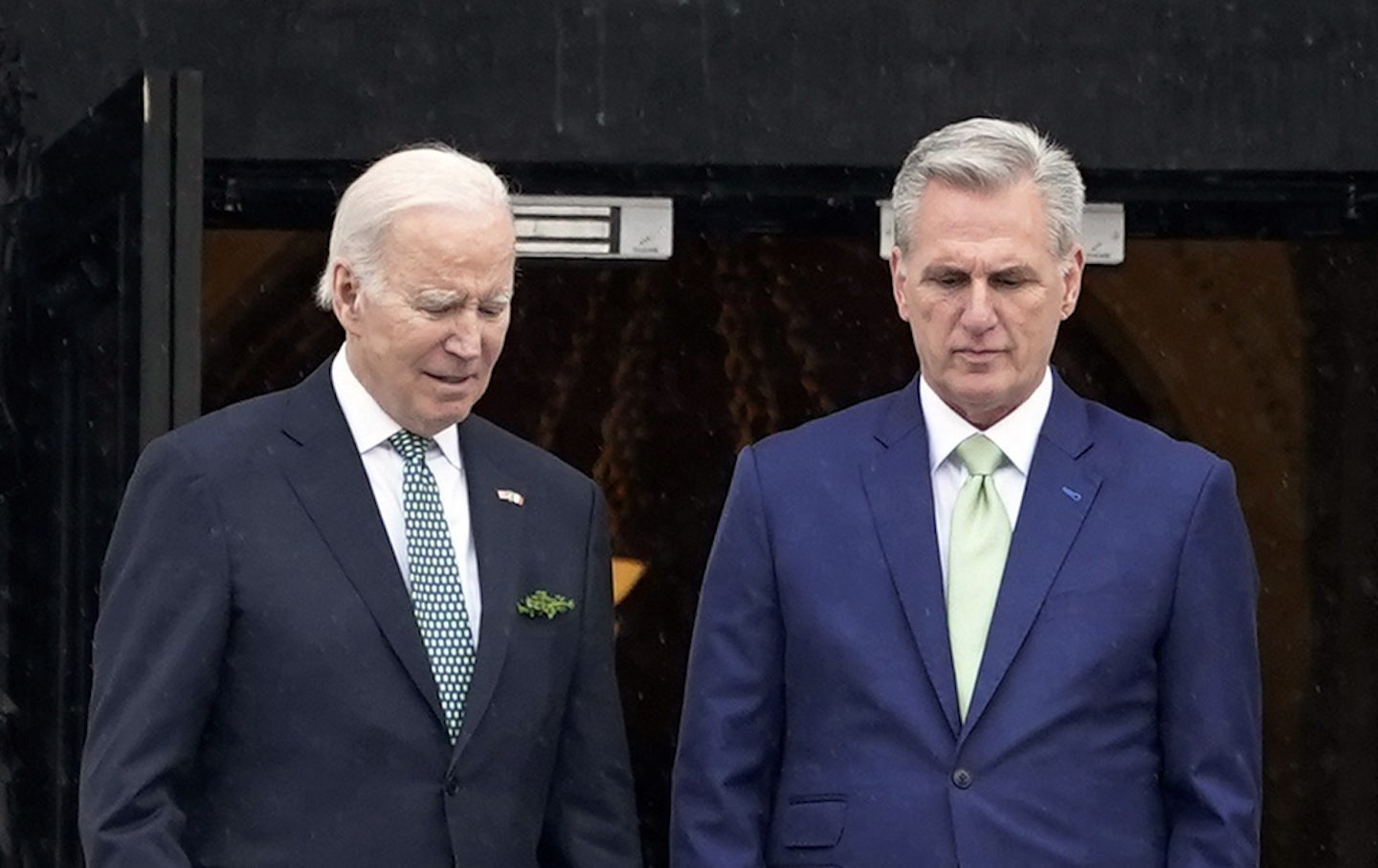
In order to forestall this death by a thousand budget cuts, the Biden administration would have to effectively call the bluff of House Speaker Kevin McCarthy and the anti-government ghouls who pull his strings. Bill Clinton supplied an object lesson in this kind of brinkmanship during the 1995–96 federal shutdown, which stretched into the holiday season. When vacationing Americans found that they could no longer visit national parks, the GOP-run Congress knew that its hard-line posture was politically unsustainable and caved soon thereafter.
Any comparable outcome seems unlikely this time around, in view of how extensively Biden and his supporters in Congress have already disarmed themselves on Covid outlays before the battle was truly joined. “The Democratic political consensus is that we have to be the party of order—for the people who believe the system is working,” Steinbaum says. “So using the political system to punish your enemies is totally antithetical to that. You see that in Democratic messaging about the Supreme Court: Any time you propose directly challenging the unlawful power of the court, the response is ‘Well, we can’t do that—that’s what the autocrats do.’”
Part of the reason that working families are so vulnerable in a shutdown fight is that Biden’s signature economic programs—codified in the Inflation Reduction Act and the CHIPS Act—didn’t take up the challenge of extending or expanding the Covid welfare state. “The American Rescue Act, the IRA, and CHIPS—25 percent of all three bills is going to road repair, road construction, and bridges,” says Robert Pollin, who codirects the Political Economy Research Institute at the University of Massachusetts Amherst. “There are good climate provisions there, but there’s nothing for sustaining the family investments in the American Rescue Act, and that could have been integrated into this.” Instead, feckless conservative Democratic Senators Joe Manchin and Kyrsten Sinema (now an independent) killed off an extension of the child tax credit in the Inflation Reduction Act.
These are painful failures and omissions for a White House keen to depict itself as a direct successor to the social democratic policymaking of the New Deal. “The New Dealers were consciously thumbing their nose at a political establishment that was hostile and punishing it for its hostility,” Steinbaum says. “Today, for all the time Democrats have spent patting themselves on the back for pandemic-era policies and how great they were, there was no thought of mobilizing a constituency behind that.”