
Foreign policy is arguably where US presidents are able to have the largest impact. Yet presidential candidates typically treat it as secondary to their domestic agenda. Elizabeth Warren is no exception; her main 2020 pitch is that she would take on the big banks and impose new regulations to save capitalism from itself. Still, while it has received less attention, she has rolled out a foreign policy vision that aligns with her domestic promises of “big, structural change.” It’s ambitious, bold, and progressive: It would end the “endless wars” since 9/11, prioritize fighting climate change, and aim to stamp out transnational corruption and kleptocracy. And like Warren’s entire platform, it’s the product of a team of wonks who believe deeply in their candidate, convened by an earnest expert who reports directly to Warren.
When I pitched a profile of the senator’s lead foreign policy adviser, Sasha Baker, to The Nation last October, Warren was surging in the national polls. Her main rival in the progressive lane of the Democratic primary race, Bernie Sanders, had just suffered a heart attack, and it was unclear whether his campaign would be able to continue. But by the time I filed my first draft, having managed to secure two interviews with Baker, Warren’s fortunes had fallen. By the time the piece was in its final form, she had come in third in Iowa and was polling well behind Sanders in New Hampshire.
This delay in getting my article into print was largely the result of lengthy interactions with members of the Warren campaign’s communications team, which, while friendly and professional, dragged out the reporting process. Initially, they declined to let me interview Baker on the record. Eventually, they agreed to let me tape interviews with her as long as that information would be considered off the record by default, meaning I couldn’t quote anything without clearing it with them first. A communications staffer sat in on our phone interview in November and our in-person interview in January at a pub near the campaign’s headquarters outside Boston. Based on discussions I’ve had with other reporters, this did not reflect any personal animosity toward me; the Warren team is cagey and does not generally make policy advisers available for on-the-record interviews.
But Baker deserves more attention. The 37-year-old staffer, who joined Warren’s team after a rapid ascent through the Obama administration, is the figure most responsible for shaping the Massachusetts senator’s foreign policy agenda. In person, Baker is smart, funny, and thoughtful about the daunting challenges facing any president who wants to rein in the American war machine. She is also exceedingly cautious, at least in the constrained context of our interviews, which seems reflective of the culture of Warren’s campaign. Baker described herself as a “behind-the-scenes person,” and that’s how the campaign prefers its policy-makers. Jon Donenberg, Warren’s policy director, told me in a statement that Baker “shuns the spotlight” and praised her “groundbreaking work, both in government and on the campaign.” A rising star, Baker could end up playing a major role in the making of any Democratic administration’s foreign policy, but her career and her policy approach also shed light on the strengths and the weaknesses of Warren’s campaign.
Popular
"swipe left below to view more authors"Swipe →
Baker’s Twitter bio reads, “Policy for team @ewarren (we write the plans),” which is a reference to Warren’s ubiquitous slogan, “I’ve got a plan for that”—the implication being that Warren and the people around her have done their homework, worked out the kinks, and aren’t just preaching revolution. But a campaign running on plans might have offered more of a spotlight to the people who write them and the values, temperaments, and experiences they bring to bear. Allowing those staffers to come forward as more visible surrogates would have reflected a campaign that felt more confident in its message and more willing to take risks in expressing it—one that might have been better positioned to channel a mobilized progressive base eager for a fundamental reassessment of America’s role in the world.
Born Alexandra Rogers in 1983, Baker grew up in the suburbs of northern New Jersey. Her mother, who is Russian Orthodox, was born to émigrés from the Soviet Union in a displaced persons camp in Germany after World War II and came to the United States as a refugee (a biographical detail she coincidentally shares with the father of Matt Duss, Sanders’s foreign policy adviser, whom I profiled for The Nation last year). Baker said that her family’s history gave her “a sense of how meaningful it is to be a citizen of this country and the obligation we have to give back.”
A product of public schools, Baker attended Dartmouth as an undergraduate, where she majored in government and was a freshman at the time of the 9/11 attacks. She opposed the Iraq War from the beginning and campaigned for then-Senator John Kerry, the 2004 Democratic presidential candidate, in New Hampshire. After graduation, she had a brief stint at a consulting firm in Boston, which she said she “knew pretty early on was not the right fit for me.” After the Democrats won back control of the House in 2006, she moved to Washington and crashed on a friend’s couch until she found a job working for the House Armed Services Committee, which at the time was trying to impose oversight of President George W. Bush’s wars. During this period, she traveled frequently to military bases around the country as well as to Afghanistan and Iraq. “It was the height of the surge,” she said, referring to the Bush administration’s decision to double down on its counterinsurgency efforts in Iraq beginning in 2007. “There was a sense of, ‘At what point do we say this is not working?’ Even then, 12 years ago, you could really see the impact on the ground of decisions that were made back in DC.”
After two years at Harvard’s John F. Kennedy School of Government, where she earned a master’s degree in public policy and was a fellow at the Belfer Center for Science and International Affairs, Baker returned to Washington during the Obama administration to take part in the prestigious Presidential Management Fellowship Program. She joined the Office of Management and Budget, where she worked in the homeland security division, supervising the relief efforts for Hurricane Sandy before moving to the national security division, where she oversaw counterterrorism projects. She was made special assistant to OMB Director Shaun Donovan and was then tapped by Obama’s secretary of defense Ash Carter to serve as his deputy chief of staff—her last job before she went to work for Warren in early 2017.
Baker considered leaving government after Obama’s second term, but Donald Trump’s victory, which she described as “personally devastating,” changed her mind. Shortly after Trump’s inauguration, she read in The Washington Post that Warren had joined the Senate Armed Services Committee, and soon Baker was interviewing for her current job. “It was the only Capitol Hill job I applied for,” she said. “I wanted to work for her because I’d seen how she was fearless in taking on entrenched power structures and challenging the status quo—and I saw a chance to bring that focus to bear on a national security complex that badly needs shaking up.”
Of Warren, Baker said, “She blew me away from the very first moment that I interacted with her.” Warren immediately asked her to summarize the debate about the impact of sequestration on defense readiness in plain English. “I really felt like we hit it off, and I never looked back.” Baker worked in Warren’s Capitol Hill office for two years before the presidential campaign heated up, after which she moved to Massachusetts with her husband, Sam Baker, who is the health care editor for the political news site Axios. “We don’t live that far from Senator Warren,” she said. “I keep looking to see Bailey,” Warren’s golden retriever and a social media star.
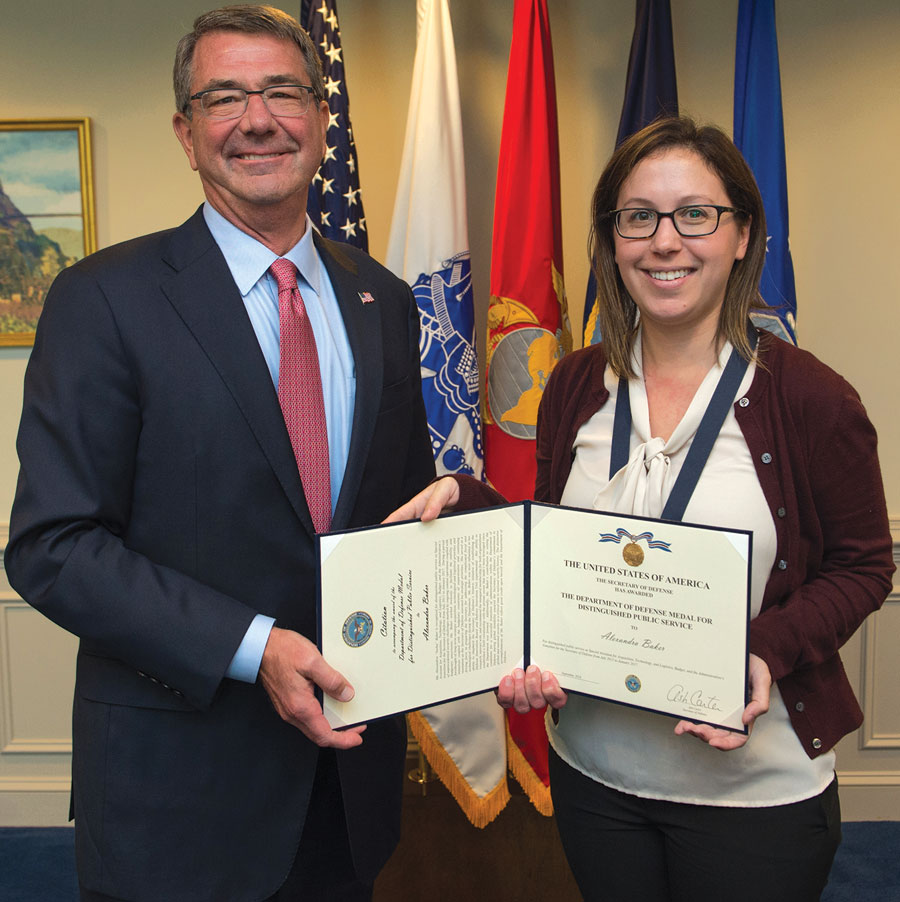
The informal team of foreign policy experts on whom Baker relies speak of her in glowing terms. “She combines compassion and open-mindedness with ninja problem-solving and bureaucratic skills,” said Loren DeJonge Schulman, the deputy director of studies at the Center for a New American Security, a Democratic Party–aligned think tank. She is another Obama administration alum and part of the Warren foreign policy brain trust (which is not formally employed by the campaign). “Warren talks big structural change,” Schulman continued. “Sasha is one of many engineers to get it done.”
In terms of foreign policy, “big structural change” means rebuilding the State Department, which has been gutted under Trump, while scaling back the Defense Department’s role. “Today we have a Pentagon that is so large and so overdeveloped, relative to our other instruments of foreign policy, that the way we engage with the world is through the military, and that’s completely backwards,” Baker said. Warren’s plans—all of which Baker has had a hand in—call for closing the revolving door between corporate defense lobbyists and Pentagon staffers, fighting global financial corruption by shutting down tax shelters, and reducing the military’s enormous carbon footprint.
“I think Sasha is fantastic,” said Ilan Goldenberg, a former Obama Pentagon official and a Middle East expert. “Her ability to put this incredible team together has a lot to do with how easy she is to work with and how smart she is and her vision and her ability. I’m just consistently blown away by her ability to collect these people, respond quickly in case of crisis, have a clear vision of what she wants to do, and be able to reflect the values and ideas of Senator Warren.” Other members of the team include former State Department official Jarrett Blanc, former Pentagon official Oona Hathaway, former US ambassador to Syria Robert Ford, and many other former Obama officials, most of whom have diplomatic or national security backgrounds relating to the Middle East, Afghanistan, Pakistan, or China. Of the first 14 names provided to me, seven are women—a level of parity unfortunately still rare in the national security field. Asked about her experience as a woman in national security, Baker acknowledged the disparity but said she hasn’t been held back.
“I’ve been very fortunate to have had a series of bosses who only cared whether or not you could do the job,” she said. “I’ve also had really great mentors, both men and women, who have encouraged me and who’ve never allowed me to think that my gender would be an impediment.”
Only a few members of the team have backgrounds in activism, such as the anti-war movement, or in media organizations antagonistic to US government policy. “I have enormous respect for my colleagues in the movement and the work they do to hold government accountable,” Baker said. “But I’ve also spent my career pushing for progressive change from the inside. And there’s a role for both in creating change. I think we’re going to need people who know how the bureaucracy and the system work if we’re going to be able to change it.” Her team, in other words, represents the progressive edge of the Washington foreign policy establishment—but it is still very much part of that establishment.
One name absent from the campaign’s list is Andrew Bacevich, the president of the newly founded Quincy Institute for Responsible Statecraft, an organization dedicated to military restraint. While I was reporting on Quincy for The Nation last year, Bacevich, a conservative who lives in Massachusetts, told me he’d been over to Warren’s house to meet with her and her husband, Bruce Mann. Warren had read Bacevich’s 2016 book, America’s War for the Greater Middle East, which criticizes decades of failed interventionist policy in the region. “We had tea sitting in the kitchen, and she pelted me with questions for an hour,” he said. “I was exceedingly impressed with Senator Warren.” In late 2018 he wrote an open letter to her in Le Monde Diplomatique, offering unsolicited advice on how to frame her approach to foreign policy. In the final weeks before Iowa, she wrote an op-ed in The Atlantic calling for an end to endless wars—one very much in line with Quincy’s positions—and she praised Bacevich’s book in an interview with Vice News. But neither he nor anyone else at Quincy or a similar organization is part of the campaign’s declared circle of advisers.
Last year the Warren campaign hired Max Berger, a 34-year-old activist and cofounder of the left-wing Jewish group IfNotNow, which opposes Israel’s occupation of the West Bank, as well as a veteran of Occupy Wall Street and Justice Democrats. Berger, not surprisingly, was targeted by right-wing pro-Israel groups after his hire, and the campaign quickly clarified that he would be working on progressive partnerships, not Middle East policy. Because of this, the Warren campaign would not allow me to speak with Berger for this piece—despite my argument that a figure with his activist background might offer a valuable perspective on the candidate’s Middle East policy.
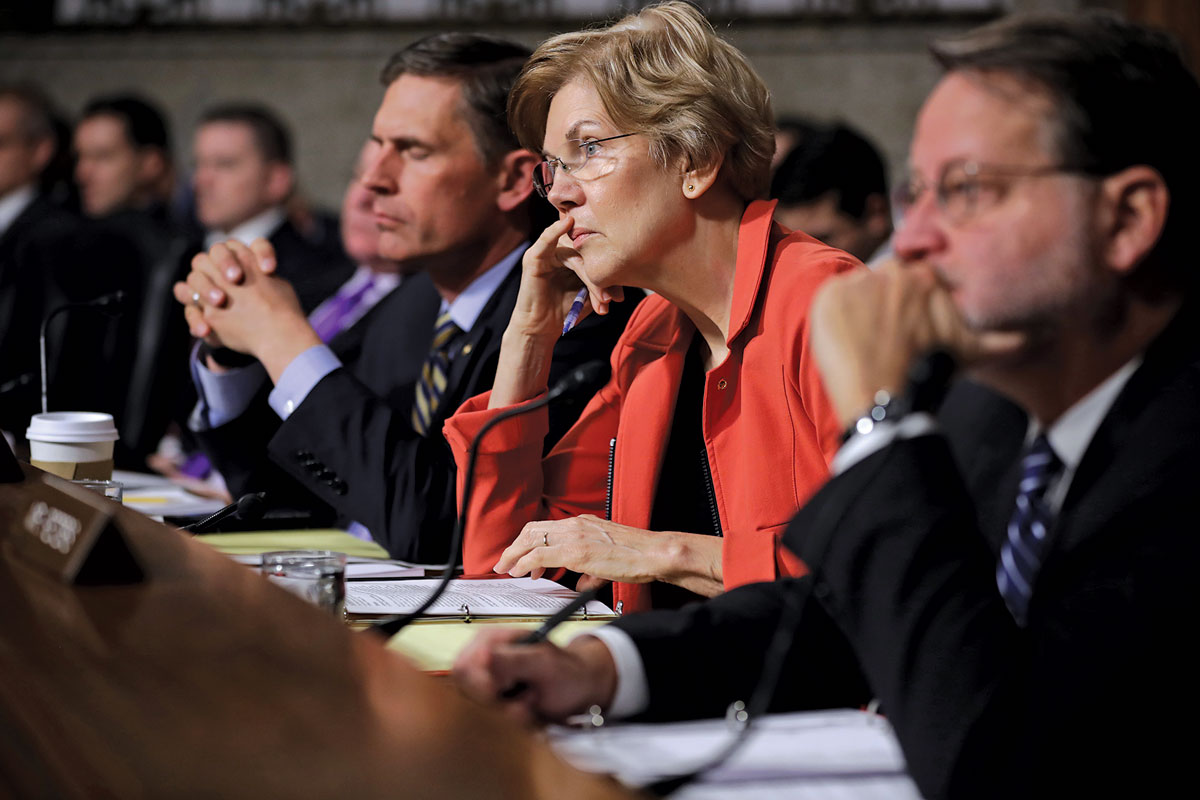
The Sanders campaign, meanwhile, draws many of its most prominent and outspoken staffers from activism and the alternative media. Duss, Baker’s rough equivalent on the Sanders campaign, came out of progressive blogging and anti-war advocacy rather than the Pentagon or some other federal agency. In December, Politico ran an article contrasting Sanders and Warren on foreign policy and drawing the conclusion that Sanders has run to Warren’s left, “further afield of the establishment.” The article contrasts Duss’s more unorthodox background with Baker’s more traditional one. The Warren campaign declined to allow Baker’s comments regarding the Politico article to go on record, along with her comments on Sanders’s campaign or his foreign policy in general.
In the wake of several major international developments, a rough pattern has emerged in which the Sanders campaign puts out a straightforward, uncompromising statement against Trump administration policy within 24 hours, while the Warren campaign’s reaction is more carefully worded and equivocal; the next day, the Warren campaign pivots to Sanders’s position. After the killing of Iran’s Maj. Gen. Qassim Suleimani in January, Sanders began his statement by citing his opposition to the 2003 Iraq War and called the Suleimani strike “an assassination.” Warren, meanwhile, called the strike “reckless” in her initial statement but prefaced it by saying that he “was a murderer, responsible for the deaths of thousands,” which was similar to Joe Biden’s statement that “no American will mourn Qassim Suleimani’s passing.” (Goldenberg addressed this discrepancy directly, saying, “When you don’t even acknowledge that, then the immediate accusation that comes back at you from Republicans is to accuse you of all this silliness about how you support terrorism.”)
The following day, Warren put out a more forceful anti-war statement, tweeting, “We’re on the brink of yet another war in the Middle East—one that would be devastating in terms of lives lost and resources wasted” and then referring to the strike as an “assassination,” as Sanders did. This pattern, of Sanders articulating the left’s response on Day 1 and Warren echoing him on Day 2, also played out in the wake of the recent coup against Bolivia’s president, Evo Morales, and in response to the news that Brazil’s government would prosecute journalist Glenn Greenwald for his antagonistic coverage of the country’s president, Jair Bolsonaro. (A Brazilian judge has dismissed the charges.)
In other words, the difference between Sanders and Warren isn’t always about substantive policy. Neither candidate would have targeted Suleimani, and both are committed to winding down the overseas deployments that led to the strike. Instead, it’s about tone, about approaching foreign policy confidently versus defensively. The Sanders and Warren campaigns have mostly similar ideas about how they want to engage with the world. But the campaign that has drawn more support from progressive voters is the one that more clearly communicates where it stands, without any need for hedging.
Beyond taking note of her official plans, parsing Warren’s feelings about US foreign policy can be challenging. At times, she has aligned herself more with the establishment than with the left, such as when she earned the approval of The Wall Street Journal’s editorial board for calling Venezuelan President Nicolás Maduro a dictator and dubbing his opponent Juan Guaidó the rightful president. (Sanders did neither.) Unlike Sanders, Warren does not have a long record in government or a history of anti-war activism, and her Senate career has included its share of hawkish votes, many but not all of which were prior to Baker’s hiring. I asked Baker about her own feelings, in hindsight, on a wide range of Obama-era international crises—Libya, Syria, Israel-Palestine, and more—but the Warren campaign did not allow me to share any of her thoughts on the record.
Baker is a liberal opposed to endless war, but she is wary of being defined by ideology or doctrine. Asked what she thinks of “the Blob”—the derisive phrase coined by Obama adviser Ben Rhodes for the permanent national security bureaucracy, which compulsively urges military intervention—she said she’s familiar with the term but doesn’t have much use for the concept, either. “Senator Warren values experience and expertise,” Baker said, “but it’s also important to be able to look at things with fresh eyes and to not get so wedded to the way we’ve done things in the past that we can’t imagine a different way of doing things in the future.”
Baker argued that framing Sanders’s agenda as more radical than Warren’s is unfair. “What she’s proposing makes a lot of people nervous, because it’s a big change from the status quo. And what she’s proposing as it relates to the military-industrial complex is beyond what any candidate out there has been proposing.” Much as Warren’s proposals have raised alarms on Wall Street, Baker continued, “that is also true of the defense community, where there is a dawning realization that what she’s proposing is actually quite radical and that she’s serious about it.”
The future of Warren’s campaign is still unclear. But no matter who wins the nomination, it remains an open question whether that candidate will be able to combine radicalism and pragmatism in the way Baker described. Baker represents a new generation within the defense establishment that is quietly growing in influence and questioning the sustainability of two decades of post-9/11 wars—a cohort that, with any luck, the next Democratic administration will see fit to empower.

