Ohio Voters Could Soon Enshrine Abortion Rights in Their State Constitution
On November 7, Ohio will vote on Issue 1, which would guarantee access to abortion. “Every individual has a right to make and carry out one’s own reproductive decisions.”
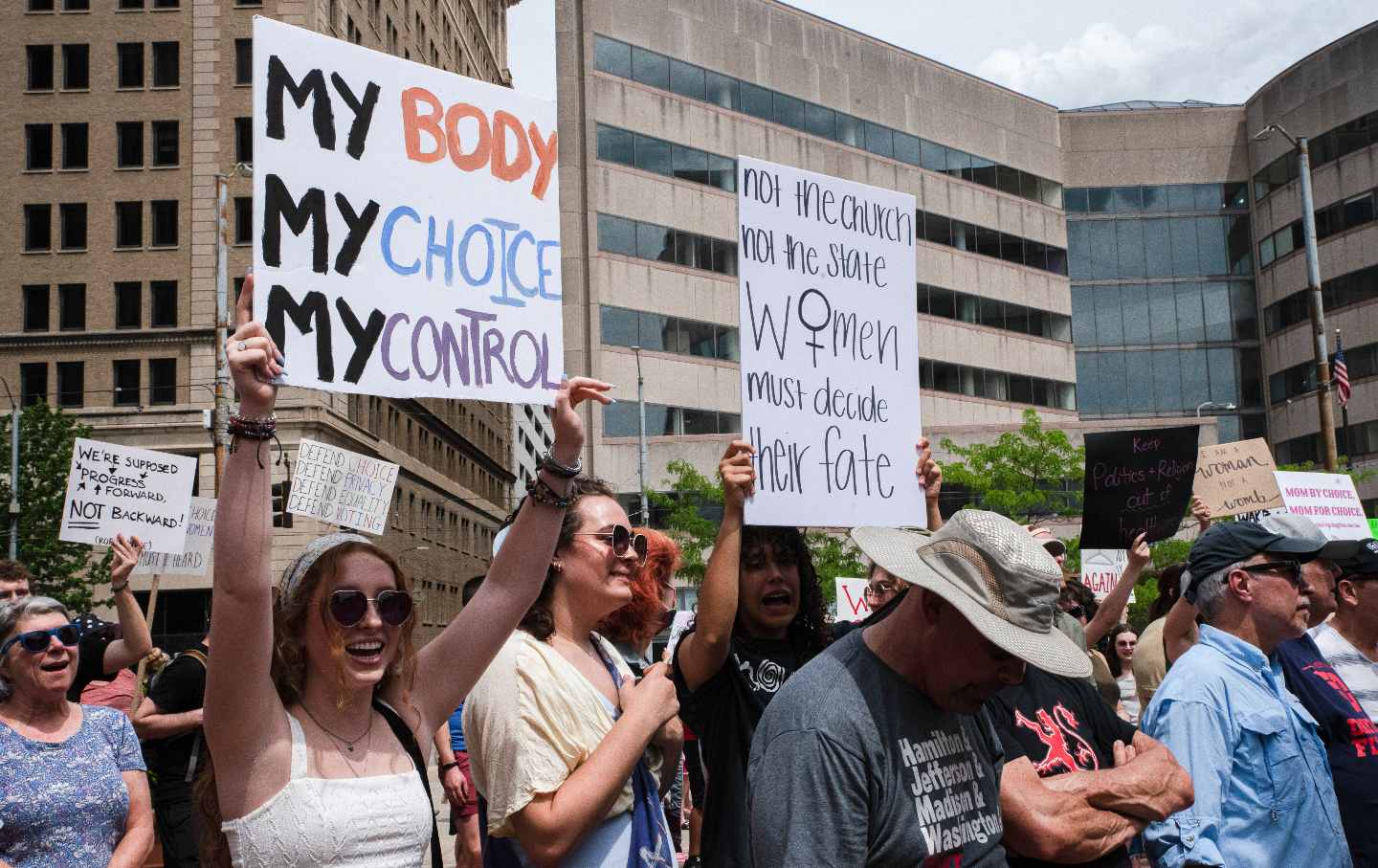
On November 7, voters in Ohio will decide on a constitutional amendment known as Issue 1, which would establish a right to abortion up to around 24 weeks. The question made it onto the ballot after proponents collected more than 495,000 valid signatures. “Every individual has a right to make and carry out one’s own reproductive decisions, including but not limited to decisions on contraception, fertility treatment, continuing one’s own pregnancy, miscarriage care, and abortion,” reads the proposed amendment.
Behind the campaign are three PACs: Ohioans for Reproductive Freedom, Ohio Physicians for Reproductive Rights, and Ohioans United for Reproductive Rights, with donors including the ACLU and the Planned Parenthood Action Fund. The opposition is led by Protect Women Ohio, with major funding from Susan B. Anthony Pro-Life America, the Archdiocese of Cincinnati, the Catholic Diocese of Cleveland, and the Catholic Diocese of Columbus.
Abortion is currently legal in Ohio up until 22 weeks. However, just after the Dobbs decision, a “Heartbeat Bill” from 2019 that banned abortion after six weeks went into effect. The bill was blocked by Hamilton County Common Pleas Judge Christian Jenkins in October 2022, a decision that was affirmed in December. Supporters of Issue 1 fear future attempts to reinstate the six-week ban in Ohio and hope to enshrine abortion rights in the state’s constitution.
Beyond collecting signatures, abortion rights supporters mobilized this year for the August special election, voting down a ballot measure that would have required 60 percent approval for future ballot initiatives—such as Issue 1—to pass, rather than a simple majority.
Ohio is the only state with a 2023 ballot initiative on abortion, but six 2022 ballot initiatives—in California, Michigan, Vermont, Kansas, Kentucky, and Montana—aimed to either restrict or expand abortion access. Voters in all six states voted in support of abortion access, affirming measures establishing a constitutional right to abortion in California, Michigan, and Vermont, rejecting measures that stated there was no constitutional right to abortion in Kansas and Kentucky, and rejecting the “Born-Alive Infant Protection Act” in Montana. In 2024, ballot measures related to abortion access are on the ballot in New York and Maryland, with 11 other potential initiatives in states like Colorado, Iowa, Missouri, and South Dakota.
An October poll from the Institute for Civics and Public Policy at Ohio Northern University found majority support for Issue 1. “Ohioans voice strong support for abortion rights, which is consistent with most every other poll conducted on abortion in the state over the past year,” said Dr. Robert Alexander, who led the project. “When faced with specific policy relating to abortion, respondents’ views are less firm.”
Ohio has also been riven by the debate over “partial-birth abortion,” the removal of an intact fetus from the uterus, which is done after miscarriages but also in abortions during the second and third trimesters. Opponents of the measure claim that the constitutional amendment would allow for the procedure, which is banned at the federal level, and Ohio Governor Mike DeWine has been an outspoken critic of Issue 1 for that reason. Constitutional scholars have debunked these fears, saying the amendment would not allow for the procedure since state law cannot override federal legislation.
These efforts to further undermine abortion rights—in Ohio and nationwide—come after recent research from WeCount data suggests that the number of abortions in the US did not fall nationwide after Dobbs, and that states bordering states with abortion bans saw a significant increase in the number of abortions. With a number of recent ballot initiatives and a slew of measures coming in 2024, Ohio is one of many states to allow its citizens to decide what abortion access in their state will look like in the future.
Read the rest of StudentNation’s dispatches on the 2023 election here.
Support independent journalism that does not fall in line
Even before February 28, the reasons for Donald Trump’s imploding approval rating were abundantly clear: untrammeled corruption and personal enrichment to the tune of billions of dollars during an affordability crisis, a foreign policy guided only by his own derelict sense of morality, and the deployment of a murderous campaign of occupation, detention, and deportation on American streets.
Now an undeclared, unauthorized, unpopular, and unconstitutional war of aggression against Iran has spread like wildfire through the region and into Europe. A new “forever war”—with an ever-increasing likelihood of American troops on the ground—may very well be upon us.
As we’ve seen over and over, this administration uses lies, misdirection, and attempts to flood the zone to justify its abuses of power at home and abroad. Just as Trump, Marco Rubio, and Pete Hegseth offer erratic and contradictory rationales for the attacks on Iran, the administration is also spreading the lie that the upcoming midterm elections are under threat from noncitizens on voter rolls. When these lies go unchecked, they become the basis for further authoritarian encroachment and war.
In these dark times, independent journalism is uniquely able to uncover the falsehoods that threaten our republic—and civilians around the world—and shine a bright light on the truth.
The Nation’s experienced team of writers, editors, and fact-checkers understands the scale of what we’re up against and the urgency with which we have to act. That’s why we’re publishing critical reporting and analysis of the war on Iran, ICE violence at home, new forms of voter suppression emerging in the courts, and much more.
But this journalism is possible only with your support.
This March, The Nation needs to raise $50,000 to ensure that we have the resources for reporting and analysis that sets the record straight and empowers people of conscience to organize. Will you donate today?