
Will the Progressive Insurgency in NY-17 Oust MAGA Loyalist Mike Lawler?
Local progressive groups have turned out a huge ground game to support Democratic nominee Cait Conley, despite her centrist leanings.
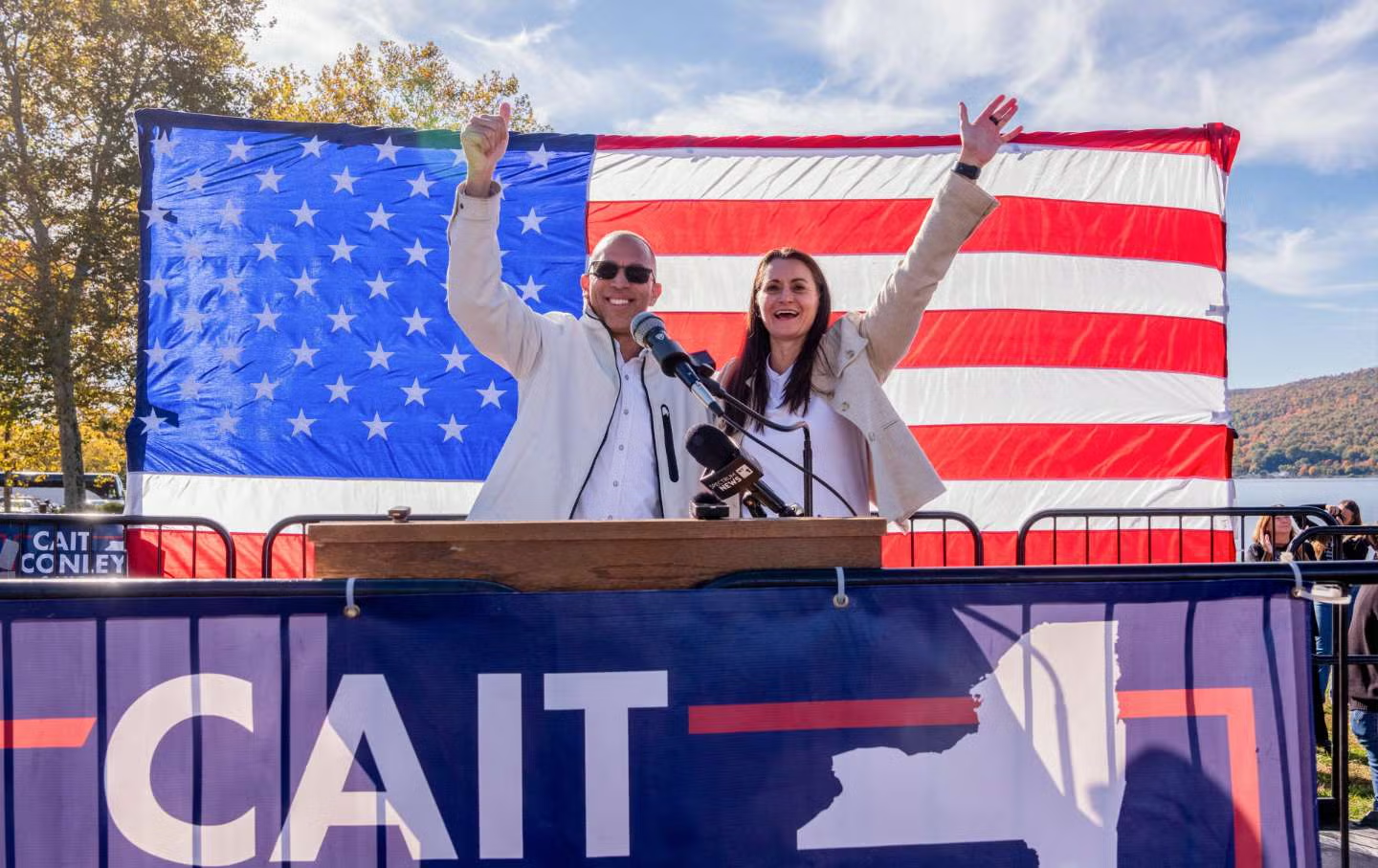
House Minority Leader Hakeem Jeffries with Cait Conley, Democratic candidate for NY-17, during an early voting rally on the first day of early voting for the midterm election in Peekskill, New York, on October 24, 2026.
(Adam Gray / Bloomberg via Getty Images)“When you take on Mike Lawler, you take on organized labor,” Teamsters president Sean O’Brien told New York 17th Congressional District voters at a rally for Lawler in Westchester County last week. It was a false, even brazen claim: The state AFL-CIO backs the Republican Lawler’s Democratic challenger, Caitlin Conley. So do the Communications Workers of America, SEIU1199, local teachers’ unions, and many other labor groups who are, as usual, supporting the Democrat in the race.
That didn’t stop O’Brien. And he wasn’t chastened by the fact that Conley would be the first female special operations veteran from New York in the House of Representatives when he told her, condescendingly, it’s time “to put your helmet on and button your chin straps, it’s a full contact sport.”
Here’s the thing: Conley would seem to sleep with her helmet on. Given the reservations I’ve heard about her from progressive voters over the last year, the main one is that she can be reserved, not at all warm or fuzzy, and is by progressive standards a little bit hawkish. She comes off as the Army veteran she is. But in the district, no one doubts Conley’s bravery or readiness for battle. Conley snickers at the Teamster leader’s braggadocio in a phone call with me a few days later. “I love how people who never left the comfort of their couch after 9/11 want to talk about hard fights.” She regularly talks about how she vowed as a teenager to join the military after the 2001 attacks.
Lawler is a MAGA loyalist who has on occasion broken with the president. But in a district that voted for Kamala Harris two years ago, that may no longer be a winning record. So he plays up his differences with Trump, and his support from Democrats and union members, and he hopes he can get by Conley that way.
He may not. Conley beat two popular, progressive female rivals in the June primary, and some of those women’s supporters are still a little bitter over what they perceive as establishment Democrats’ behind-the-scenes support for the military veteran, who had no local political record, over two local politicos, Rockland County legislator Beth Davidson and Tarrytown Village Trustee Effie Phillips-Staley, who have served their communities legislatively for years. House Democratic leader Hakeem Jeffries didn’t prove to be the biggest draw when he appeared in Peekskill with Conley October 24. A crowd of maybe 200 people, many of them union members, milled about along the Hudson River and applauded, especially when Conley introduced him as “Speaker Jeffries” (his fervent wish). But elsewhere that day, Peekskill was teeming with activism, as the many local groups who’ve emerged in the district used the next-to-last election-season weekend to gather, train volunteers and canvas.
The paradox of Conley’s race is that if she wins, the centrist will at least partly owe her victory to a progressive insurgency that came together after Lawler’s 2024 victory vowing to defeat him with a Democrat. Many didn’t get their chosen candidate in the June primary, but they’re still hard at work. As Phillips-Staley herself told me, “What we are all aligned on, from the left to the moderate within the Democratic party, is that Mike Lawler needs to go.”
Most polls show Democrats winning the House, but Conley’s race is important. New York cost Democrats the House in 2022, losing five blue seats, when the party nationwide only came up short by four. This year’s primaries saw a lot of lefty victories in the Manhattan area–three DSA members, plus reliable progressives Brad Lander and Micah Lasher–but they’ll all win next week. Upstate near Conley, centrist liberal incumbents Pat Ryan and Josh Riley look safe. It’s Conley, plus somewhat vulnerable Democratic centrists Tom Suozzi and Laura Gillen on Long Island, and an unlikely Democratic victor in Elise Stefanik’s former seat, Democrat Blake Gendebien, who will make Tuesday night interesting.
NY 17 is a diverse district, with multiracial, fairly Latino Peekskill, Sleepy Hollow, and Tarrytown; still pretty white segments of Rockland, Putnam, and Dutchess Counties, plus miles of Westchester cities and towns, some of which are still 1960s alabaster, but most are not. Roughly 20 percent of the district is Jewish, and Conley’s self-described “balance” on Israel—some consider her to be rabidly pro-Israel—is helping the Democrat with many voters, but not with the energetic pro-Palestine left. “This is where I have been consistent, and as someone who has been to war, the last thing I want to see is more human suffering,” she tells me. “I do believe we have to get to a two-state solution, where there’s equal safety, security, and sovereignty for Israel and Palestine. And that America should be pushing to deliver on that and not just give it lip service.” Although Conley has opposed some Democratic moves to limit sales of weaponry to Israel, she insists that she “will criticize the Netanyahu administration or any administration I believe is doing the wrong thing for Israel and America.”
About half of the district’s voters are either veterans, law enforcement officials, or public employees (Conley’s mother was a postal worker). Conley’s military experience, as well as her family’s public service, resonates with many voters in the area. A white progressive volunteer told me she found that Conley’s military service was a draw to some Latino voters, and Phillips-Staley, whose mother is from El Salvador, said she wasn’t surprised. “My dad was a military veteran, and Latino cultures can sometimes be a little conservative, and that’s fine.”
Conley says her military service is a cross-racial, cross-party draw. “I have shown that I’m willing to do the right thing for this country in our community, even when it’s hard, even when it’s dangerous, I’m willing to put my life on the line, to protect this country and fight for our future. And there is a degree of trust that comes with that,” Conley told me in our interview.
“I’ve had Republicans come up to me and say, ‘I’ve never voted for a Democrat, but I’m voting for you because you’re a veteran.’”
Even though I could find plenty of progressives in the district with reservations about Conley—hey, I write for The Nation—virtually everyone I met united behind her, post-primary. Some believe they are helping her most by focusing on the low-propensity voters, low-income and/or Latino, that the Conley campaign may miss as it focuses on getting registered Democrats back in line, plus adding some independents and Republicans. Other progressives are focused on winning back Democrats who’ve fallen for Lawler’s bipartisan shtick. Another key group of voters to reach will be those who’ve been alienated by the party’s shenanigans in recent congressional races.
A Democratic seat since 1986, New York 17 elected progressive Mondaire Jones in 2020. But redistricting put DCCC head Sean Patrick Maloney, the representative in New York 18, in the newly drawn 17 for 2022, pushing Jones out of the race. Jones wound up moving to and running in New York 10, a lower Manhattan and Brooklyn district, against Working Families Party’s Yuh-Line Niou, and both progressives lost to the self-funding Levi’s family tycoon and liberal lawyer Dan Goldman. Maloney, widely accused of ignoring his own race to raise money for Democrats in Europe that October, lost to Lawler by 1,800 votes. When Jones ran again in NY-17 in 2024, the party was split, Lawler had made inroads with Democrats, and, despite Kamala Harris winning the district at the top of the ticket, Jones lost to Lawler by a depressing 24,000 votes.
After what many in the district call “the Mondaire mess”—and to be fair, Jones didn’t mainly make the mess—local progressives came together in a coalition of roughly 35 groups, known as the CD 17 Community Coalition. “The DCCC had run these last two campaigns and lost,” says its director, Tina Volz-Bongar. CD 17 Community Coalition committed to building a ground game that the DCCC had failed to create. Local progressives, including 20 small Indivisible chapters plus local nonprofits, got organized in 2025 and have been meeting almost weekly since. “People say we live in a purple district, but that’s because Democrats don’t come out to vote,” Volz-Bongar adds. In fact, the district has a one-point Democratic voter registration advantage, and is rated a toss-up by The Cook Political Report. But judging by demographics, it should be bluer than it is. The diverse coalition behind Conley is trying to figure out why it’s not.
So on the same Saturday that Jeffries visited Peekskill, the CD 17 Community Coalition hosted “Free Democracy Donuts and Coffee” events at the city’s public and Section 8 housing complexes. Working Families Party members were out knocking doors. In addition, Canvassing Connectors, a deep-canvassing group based in Peekskill, partnered with Plus One, which focuses on voters linking up with friends and neighbors over meals, for an open house at a local café. Plus One has found it challenging to meet its gathering goals, cofounder Emily Simoness tells me. “But once people actually do the work, they are thrilled, and they’re reminded of our shared humanity, and that we have more in common than the algorithm might tell us,” she says. “I really feel like part of how we get back to being a civil society is by being in person together.”
Canvassing Connectors likewise emphasises longer-term relationships and in-person gatherings. “We’ve been telling people we canvass that ‘we’re gonna have a party,’” Canvassing Connectors cofounder Ellen Chapnick told me, when she invited me to join them at the café. “Well, this is the party!” Food and Water Action sponsored a Stop Data Centers rally just before Jeffries’s waterfront gathering. You couldn’t walk the streets of the small, quaint Peekskill downtown that bright Saturday without spotting someone working to elect Conley.
Conley says she’s grateful for all the help. Despite ideological differences, she didn’t perceive her primary as a bitter one. “We shared a lot more than we differed on. And how we make a positive impact on people’s lives has to be our focus.” True to her brand, Conley added that she wasn’t only focused on Democrats but making a place in her coalition for independents and Republicans. Phillips-Staley, endorsed by the Working Families Party, also said the female candidates made common cause before the primary was over. “We could have been a lot nastier to each other. But for the most part all the candidates got along pretty well. Because we understood—and we said it repeatedly during the primary—that the mission is to defeat Mike Lawler. What we said in many debates and in many forums is that we would all be running against him in the general.” And so they are. The WFP endorsed Conley once she won the primary.
Even this late in the game, the polls are too close to call. The last Emerson College poll had Conley up by two points, within the margin of error. The good news for the Democrat was that Lawler was on target to lose some of the Democratic support he won away from Mondaire Jones in 2024. That year, according to Emerson, 20 percent of Democrats supported Lawler; this year it’s down to 12 percent, while Conley is grabbing 10 percent of Republicans, and Jones just 4 percent “Had Democrats stayed on the side of the Democratic Party, Mike Lawler would not have won,” Phillips-Staley told me. She is nonetheless working hardest on unaligned, low-propensity Latino nonvoters.
Popular
“swipe left below to view more authors”Swipe →Canvassing Connectors is focused on much the same voters as Phillips-Staley, especially Latinos. Ellen Chapnick is proud of “El Equipo,” the group’s Spanish-speaking canvassers, who can quickly turn out to help English speakers work with Spanish speaking voters. “You know, they’re used to having an experience where people knock on their door, ‘Oh, you don’t speak English. I’m so sorry. Well, here’s a Spanish language flyer,’” she told me. “That doesn’t work too well.They don’t feel like they have a voice. But we can have a 10-, 15-minute conversation with them in their own language, and often what happens is they’ll say, ‘Oh, you should talk to my children. You know, you should talk to my sister-in-law.’”
Chapnick was ecstatic when we met in Peekskill that Saturday: She had just met two Republicans who’d decided to vote for Conley. That hadn’t happened to many progressives while out knocking doors, though some told me they felt the campaign dynamics shifting, especially as Donald Trump stayed out on the trail (though not in New York), talking about the physique of Ohio Senator Jon Husted as well as GOP rapper Nicki Minaj while lying about inflation and the Iran War. Speaker Mike Johnson visited Lawler’s district a couple of days after Jeffries did, and insisted local and national polling is wrong.
“It feels like 2024 to us,” Johnson told a press gaggle in Rockland County’s Orangeburg October 26. “The polling is wrong. They are trying to suppress and depress Republican turnout in the elections. The polling has underestimated the Republican vote by an average of 4 percent. Don’t believe the polls. People are not responding to polls anymore in increasing numbers.” But Johnson also praised Lawler for supporting Trump’s One Big Ugly Bill, which gave tax cuts to the wealthy and will lead to Medicaid and SNAP cuts to lower-income and working-class District 17 residents.
Conley may win over some progressives with her pledge to impeach Defense Secretary Pete Hegseth, an issue on which Jeffries joined her in Peekskill. “Every day Pete Hegseth is in that seat, we are less safe,” she told me.“This man is single-handedly destroying our military institutions and driving out our best military leaders. The man needs to go.” Jeffries, not known for ideological fire and brimstone, told the Peekskill crowd he plans to “run Pete Hegseth out of town” if and when Democrats take the House.
Meanwhile, Phillips-Staley keeps working for Conley. “I see Cait’s role, and the way her campaign is structured, is to try to keep those Democrats [who voted for Lawler in 2024] in line with the Democratic Party, to try to retain them, to deny him victory.”
But she adds, “Unfortunately, that kind of message doesn’t work with a progressive base, but what does work is the truth that Mike Lawler is catastrophic for our democracy, right? We keep hammering home to remind people that harm reduction is real, and we have to deny him power. Not only do I want to see Mike Lawler go, I want to see communities that have been disenfranchised by the Democratic Party, standing up, using their power and firing Mike Lawler. That’s why I’m in it.”
More from The Nation
Massachusetts May Be the First State to Repeal Recreational Weed Massachusetts May Be the First State to Repeal Recreational Weed
It’s not only weed at stake. The whole legal apparatus that supports social equity marijuana businesses would disappear if ballot question 8 passes.

There Is No Moral Margin for Error on Tuesday There Is No Moral Margin for Error on Tuesday
It is a once-in-a-generation opportunity for voters to turn things around for American democracy.
Vote Like Your Life Depends on It Vote Like Your Life Depends on It
Because it does. The midterm elections are November 3, 2026, with control of the Senate and House at stake. Every vote matters.

How the Midterms Will Test Our Desire for Real Accountability How the Midterms Will Test Our Desire for Real Accountability
Sure, a Democratic win next Tuesday would be a relief—but we still need to repudiate all facets of MAGA authoritarianism.
Ro Khanna Is Making FDR Great Again Ro Khanna Is Making FDR Great Again
The California Democrat is renewing the Democratic Party’s vital connection to Roosevelt’s New Deal and the Economic Bill of Rights.

