Why No Labels Is the Fyre Festival of Politics
The self-described centrist alternative to the two major parties failed spectacularly this year—but such a lavishly funded shakedown operation may not be dead for good.
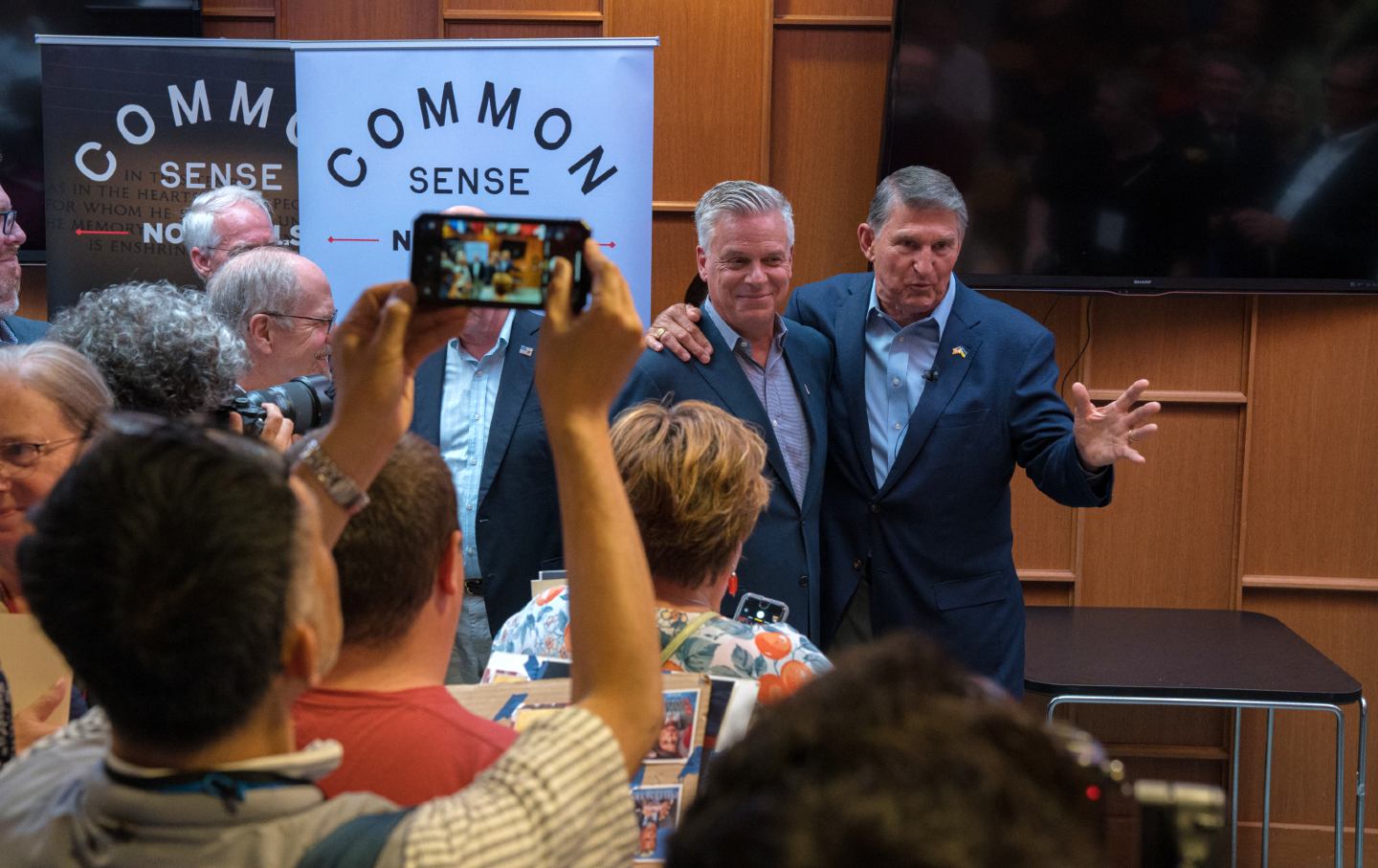
Senator Joe Manchin III (D) and former Utah governor Jon Huntsman (R) visit an overflow room after co-headlining the Common Sense Town Hall, an event sponsored by the bipartisan group No Labels, held on July 17, 2023, in Manchester, New Hampshire.
(John Tully / The Washington Post via Getty Images)Woe is us. No Labels, the “sensible centrist” alternative to partisan rancor, has shuttered its electoral operations for the balance of the 2024 campaign season, having failed to find a standard-bearer for a third-party presidential run. Efforts to enlist figures such as retiring West Virginia Senator Joe Manchin, former Maryland governor Larry Hogan, and failed GOP presidential hopeful Nikki Haley (who can only come across as a plausible centrist after your 40th bong hit) came to naught. The organization stockpiled more than $70 million in ready cash (mostly from big-ticket donors who lean Republican). It failed to come anywhere near achieving its political aims or policy goals, but in the meme-ified discourse now throttling our public life, it did succeed in a singularly perverse act of self-marketing. No Labels is the political equivalent of the Fyre Festival—a shakedown operation targeting absurdly wealthy and credulous patrons, with no underlying assets or product line of its own beyond its status as an all-purpose cultural punch line.
This was not how things were envisioned when the group launched back in December 2010, at the height of the Tea Party insurgency, as a growing number of oligarchs decided it was high time everyone in the country got along with each other. Their alighting on this message at precisely that moment was a tell: What was ailing the American body politic was not an all-sides descent into blind partisan rancor but rather the latest potent instance of asymmetrical polarization from the right. Even though it was grounded in ideas from the Heritage Foundation and legislation signed into law by Republican Massachusetts Governor Mitt Romney, the Affordable Care Act had been passed on a strict Democratic party-line vote in the Senate. The Obama White House had tried its best to contort itself to attract support from GOP lawmakers. (What’s more, the public option—the most effective cost-control mechanism in the draft version of the bill—was sentenced to death by none other than Senator Joe Lieberman, the recently deceased mascot for the No Labels vibes coalition.) Obama and the Democrats would go on to spend untold political capital seeking to assuage the unhinged budget austerity of the right by negotiating a “grand bargain” on spending with the leaders of the Republican House—exactly the sort of regressive initiative that the No Labels brain trust flogs in concert with its donors’ policy preferences. That overture was again scotched by the right—and to drive home just how extreme things were getting on the GOP side of the aisle, one of deal-killing principals, majority whip Eric Cantor, proceeded to lose his heavily gerrymandered seat in a primary challenge from a hard-right Christian economics professor.
Play-acting at bipartisan kumbaya politics in such an atmosphere is worse than delusional: It’s a gift to the forces of moneyed reaction, permitting them to take on an above-the-fray posture and enabling the continued upward distribution of wealth. Yet the inert procedural dogmas at the heart of the No Labels project have long exerted a zombie-like appeal to both the donor class and the professional commentariat. This beguiling vision resides in part in the sort of Cold War nostalgia that’s fueled the vogue for glorified word clouds such as “national greatness conservatism” and the too-savvy-by-half cult of “triangulation” in the house of Democratic neoliberalism. (It speaks volumes about No Labels’ allegiance to this formalist brand of oligarchy that its founder is Nancy Jacobson, a former big-ticket Democratic fundraiser married to trendspotting pollster Mark Penn, a tireless Beltway shill for neoliberalism.) In this view of things, capital-L Leaders take the errant political scene in hand, and remind its retinue of raging ideologues that we are all one country, animated by the better angels of our civic-minded natures. It’s far from an accident that this bloodless account of politics furnished the refrain for Obama’s reputation-making keynote speech at the 2004 Democratic convention.
More than that, though, the No Labels brand of political synthesis pivots on aesthetics. The problem with ideology and partisan thinking isn’t so much that it’s artificially divisive in a republic of otherwise serene peacemaking souls; it’s that it’s unseemly and vulgar—not the sort of thing that flies at blue-ribbon budget commissions, banking confabs, and Davos conferences. That’s why, for example, Senator Kyrsten Sinema, another leased corporate mouthpiece of a lawmaker in the No Labels fold, recently announced her decision not to seek another Senate term by heaping scorn on the public she nominally serves: “Because I chose civility, understanding, listening, working together to get stuff done,” she announced petulantly in her farewell video, “I will leave the Senate at the end of this year.”
Of course, what Sinema endorses as civility, understanding, and comity is an agenda of oligarchic rule, from her stalwart efforts (along with Manchin) to shut down the main social-democratic provisions of the Build Back Better legislation to her eternal vigilance in securing every last tax write-off for her Wall Street donors. It’s the sort of record that Lieberman would enthusiastically second—and it earned Sinema a speaking gig extolling the neglected verities of bipartisanship at… wait for it… The McConnell Center at the University of Louisville.
You’d think that a shame-allergic figure like Sinema would be a natural recruit to a No Labels presidential ticket, but even she turned the group down ahead of its final meeting to settle on a 2024 campaign strategy. And that is the new quandary for the post-ideological know-it-all class; the asymmetrical polarization of our politics has advanced so far in the age of Trump that all the sentimental selling points of elite bipartisanship are now laughably dead-letter. Had the group managed to talk some feckless soul into mounting a third-party run under its aegis, the maneuver would almost have certainly thrown the November election to Trump—who very much prefers to pursue oligarchic control of all facets of life without any boring talk of civics, or any aesthetic politics other than his own kitsch-laden brand of white nationalist Kulturkampf.
That’s why the No Labels project, which like many goo-goo undertakings awash in corporate funding has reliably attracted fawning press coverage, suffered a rough tour in the spotlight as the 2024 campaign season lurched into gear. “Social welfare organization or political party?” CBS News wondered about the group in February. Even The Atlantic, a bible of difference-trimming Beltway doublespeak, marveled at “the brain-breaking logic of No Labels.” In a Slate obituary for the group’s presidential ambitions, David Faris archly sums up its cul-de-sac brand of policy wonkery: “It almost seems as if the economic ‘moderation’ that No Labels supports is not some happy middle ground that includes some of what Democrats want and some of what Republicans want. Instead, what No Labels has advocated for is mostly vague, Simpson-Bowles–style austerity that has very little actual support among American voters, and for good reason—it sucks.”
Indeed it does, and the public face-plant of the group’s presidential initiative is a lesson in the perils of getting high on one’s own supply. Still, it’s a safe bet that any vanity operation as lavishly overcapitalized as this one isn’t simply going to fade into the sunset. After all, there are already reported plans in the works for a Fyre Festival II.
Support independent journalism that does not fall in line
Even before February 28, the reasons for Donald Trump’s imploding approval rating were abundantly clear: untrammeled corruption and personal enrichment to the tune of billions of dollars during an affordability crisis, a foreign policy guided only by his own derelict sense of morality, and the deployment of a murderous campaign of occupation, detention, and deportation on American streets.
Now an undeclared, unauthorized, unpopular, and unconstitutional war of aggression against Iran has spread like wildfire through the region and into Europe. A new “forever war”—with an ever-increasing likelihood of American troops on the ground—may very well be upon us.
As we’ve seen over and over, this administration uses lies, misdirection, and attempts to flood the zone to justify its abuses of power at home and abroad. Just as Trump, Marco Rubio, and Pete Hegseth offer erratic and contradictory rationales for the attacks on Iran, the administration is also spreading the lie that the upcoming midterm elections are under threat from noncitizens on voter rolls. When these lies go unchecked, they become the basis for further authoritarian encroachment and war.
In these dark times, independent journalism is uniquely able to uncover the falsehoods that threaten our republic—and civilians around the world—and shine a bright light on the truth.
The Nation’s experienced team of writers, editors, and fact-checkers understands the scale of what we’re up against and the urgency with which we have to act. That’s why we’re publishing critical reporting and analysis of the war on Iran, ICE violence at home, new forms of voter suppression emerging in the courts, and much more.
But this journalism is possible only with your support.
This March, The Nation needs to raise $50,000 to ensure that we have the resources for reporting and analysis that sets the record straight and empowers people of conscience to organize. Will you donate today?