AI Is a Kitchen-Table Issue
And with the Trump administration encouraging unregulated growth in the industry, Democrats need to start acting like it.
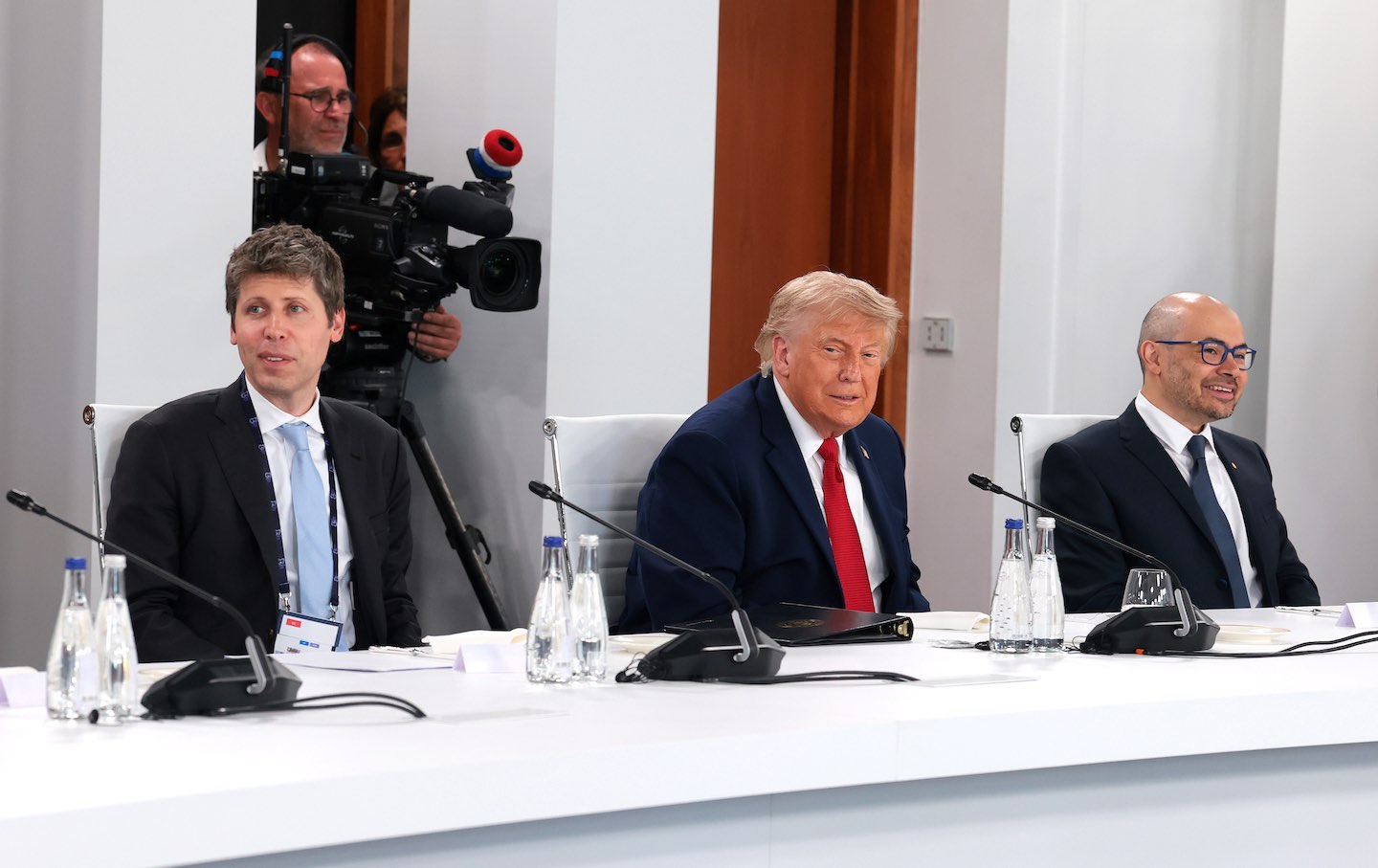
CEO of OpenAI Sam Altman, President Donald Trump, and CEO of DeepMind Demis Hassabis at a working lunch during the G7 Summit on June 17 in Évian-les-Bains, France.
(Anna Moneymaker / Getty Images)The Republican Party sports a glaring weakness in the pitched battle over regulating the rapidly multiplying abuses of AI, and its name is Donald John Trump. The president sought to dismiss the growing furor about the multitude of threats the unregulated new technology poses to our basic quality of life by proclaiming on Truth Social that “the only control or ‘guardrails’ that AI needs is a STRONG AND SMART (High IQ!) PRESIDENT, and the U.S.A. has that, in spades!”
But while the MAGAfied GOP is ambling cluelessly into yet another political firestorm, the Democratic Party is lapsing once more into its resting-shrug posture. Yes, there are serious hazards associated with the blind lunge into all things AI—up to and including species extinction—party elders and strategists concede, but it’s important not to get carried away on the tide of public outrage. So, as Trump fulminated and flattered himself, House minority leader Hakeem Jeffries announced the appointment of a new AI policy panel made up mostly of flacks and shills for the industry. Because whenever the leaders of an economic sector let it slip that they may well be programming the imminent demise of humanity, the first thing you do is grant them the authority to make up their own rules of oversight.
Jeffries’s gambit was, alas, a continuation of the party’s dilatory-to-negligent approach to all things AI. During the 119th Congress, Democratic lawmakers have mostly marshaled themselves behind vague and airy bids to draft regulation of the industry through bipartisan task forces stressing broad alignment on the issue, an approach that has yielded much the same results the most such initiatives do. “Congressional leaders have let bipartisan working groups fall apart, dragging out progress on issues lawmakers from both parties say they could get a meaningful majority behind,” NOTUS reporter Samuel Larreal wrote late last year. Even though some 400 pending bills in 2025 had addressed the many threats poised by untrammeled AI development, none gained traction; indeed, the most dogged GOP-driven campaign was to deregulate the industry further, via language in both the tax-and-spending and defense authorization bills that would have preempted state and local governments from curbing the growth of AI data centers and applications in their midst.
This lost opportunity stands out in high relief now, as Democratic leaders try to launch belated new bids to rein in the excesses of the AI sector before Congress adjourns for the midterms—and as a new cohort of Democratic-aligned PACs push for a more robust Democratic response to the uprising against it. (Lest you think this latter development signals any sort of fundamental change in establishment thinking, the party’s lead consultants and strategists are still urging candidates to avoid angering AI moguls in the homestretch of the midterms, lest they unleash their well-funded PACs on rebellious Democratic candidates in tight races.) The specter of yet more legislative hand-waving in the face of a mounting oligarchic assault on the basic quality of life in thousands of American communities is especially hard to take, the industry’s predations fall into the category that Democrats continually insist is the topic of their laser-focused attention: the frantic, unsupervised buildout of AI capacity is the essence of a kitchen-table issue.
Leaving aside the speculative forecasts of the technology’s potential role in snuffing out humanity, AI is already acting as a fearsome accelerant on the growth of inequality in the United States. It’s not hard to see why: The AI investment bubble, which has been set aloft on a series of circular financing schemes benefiting the tech power elite, has created an upward surge in the distribution of wealth that makes the run-up to the 2008 Great Recession look like the Paris Commune. JPMorgan estimates that just 30 AI stocks have added $5.2 trillion in paper wealth to US households—with most of that return confined to the top 10 percent of investors. Indeed, the bubble has accounted for an additional $180 billion in spending from these rarefied households, the Morgan analysts found, as most middle- and working-class households fend off higher energy and healthcare costs while sinking ever deeper into debt. While reports claim that AI investment now accounts for 40 percent or more of the country’s GDP growth, the subset of economic actors actually benefiting from the bubble is vanishingly small—and are mostly confined to the charmed circle of the tech oligarchy. Fully 80 percent of the enterprise revenues claimed by Anthropic and OpenAI, writes industry critic Ed Zitron, “are dependent on what are likely hundreds of customers spending outsized amounts of money on AI tokens, with an indeterminately-large chunk of them being AI startups that can only do so as long as venture capital supports them.”
And just like the mid-aughts housing bubble, the AI investment stampede is creating acute conditions of inequality on the ground—in towns, school districts, and workplaces. To begin with, there’s the push to cram data centers into virtually any low-tax, underregulated jurisdiction that can be cajoled into housing them. These engines of water scarcity, electricity-bill spikes, and noise pollution are the prime mover behind the populist uprising against AI in red and blue states alike, with hapless elected officials and candidates awkwardly vying to keep up. Polling shows that 75 percent of Americans oppose the erection of data centers in their communities, with just 15 percent supporting them.
The runaway appropriation of resources, land, and capital by the AI sector is, in other words, the mother of all kitchen-table issues—and by extension, shopfloor, roadway, and classroom ones, as our data lords seek to annex virtually every facet of our productive and civic life into their feverishly privating hands. Public education, long held to be the magic elixir of upward social mobility in the US economy, is rapidly becoming a bot playground, with predictably harmful fallout for students’ cognitive development while fomenting an epidemic of cheating and fraud. While early forecasts of an AI job apocalypse appear overblown, the technology’s role in promulgating surveillance-state protocols on the job decidedly is not.
So why is it that Democrats remain on their back heels in the midst of the AI uprising? One key explanation is that they benefit from the same Big Tech donations that have juiced Republican campaign coffers. Hakeem Jeffries has opposed a moratorium on data-center construction, and has detailed industry mouthpieces like California Representative Zoe Lofgren to draw up the Democratic caucus’s AI policy. This disconnect between the party’s leadership caste and the specter of a grassroots revolt in an election cycle has become so pronounced that former president Barack Obama has intervened. “This is something that is moving very fast in private hands, and if we don’t get on top of it, I think can be dangerous,” Obama told Jeffries at a New York City donors’ event last week. Looking ahead to the 2028 presidential cycle, he cautioned that Democratic candidates must have a “very clear plan” to address the imminent risks posed by the technology. “I would talk about this, and I would say, ‘Here’s our plan for safety. Here’s our plan for making sure our kids are not corrupted by this.’”
Obama, a longtime confrere of Big Tech titans, explained that he regards himself as neither a “doomer” or “accelerationist” on the AI front—but his political advice recalls the same lurch into populist rhetoric that attended his 2012 reelection campaign, when he had the great good fortune of drawing private capital baron Mitt Romney as his opposing candidate. As was the case then, Democrats have a terminally out-of-touch apostle of the investment class symbolizing the rush to adopt AI at all costs: President Donald Trump, who has fruitlessly sought to tamp down the rebellion against data centers in the house of MAGA. At the outset of his second term, Trump issued an executive order dismantling the Biden White House’s body of safety protocols governing the industry, while his Environmental Protection Agency and Justice Department have dedicated themselves to speeding along the unregulated rollout of data centers.
Trump is also, as a majority of polled respondents now acknowledge, staggeringly corrupt, so it shouldn’t be a heavy lift for Democrats to make the case that his desperate shilling for data centers—like his self-interested reversal on crypto and a fetid run of stock trades outpacing the investment calls of every member of Congress during his second term—serves to line his pockets and shower more pelf on his inner circle of cronies. Just for starters, Donald Trump Jr.’s venture-capital fund 1789 Capital has realized returns of more than 200 percent as of the end of this June, with many of the gains coming from aggressive AI investments.
The attack ads pretty much write themselves: Donald Trump is despoiling your communities, spiking your utility bills, rationing your water, and leaving your kids at the mercy of robots so he can clean up even more on the AI bubble. All we need now is a political party with the backbone to make them credible.
Become a Sustaining Donor This September
Between the reemergence of right-wing red-baiting and Donald Trump’s use of the chilling National Security Presidential Memorandum–7 to criminalize left political organizing, we’re seeing McCarthyism reborn before our eyes.
This assault on democracy cannot be ignored or wished away. Resisting it requires bravery in the face of threats and repression, a steadfast commitment to the truth, and the unwavering belief that we can—and will—overcome this darkness.
We must have an independent media that sets the record straight, unearths corruption and abuses of power, and advances a politics of justice and dignity for all if we’re to win this fight.
That’s why I’m writing to you today. This September, The Nation needs to add 100 monthly donors to sustain our progressive journalism. Your contribution makes the next investigative report, the next truth-speaking column, and the next pathbreaking essay all possible.
I hope you’ll support our work with a recurring donation today. If you donate $10 or more a month, we’ll send you a brand new “Hands Off the Free Press!” sticker to recognise your commitment to our cause. Please, donate today.
Onward,
Katrina vanden Heuvel
Editor and Publisher, The Nation