
Liz Cheney Was an Electoral Fiasco for Kamala Harris
Conservatives backed Trump by bigger percentages than in 2020. And time spent with Cheney prevented Harris from reaching out to the voters she needed.
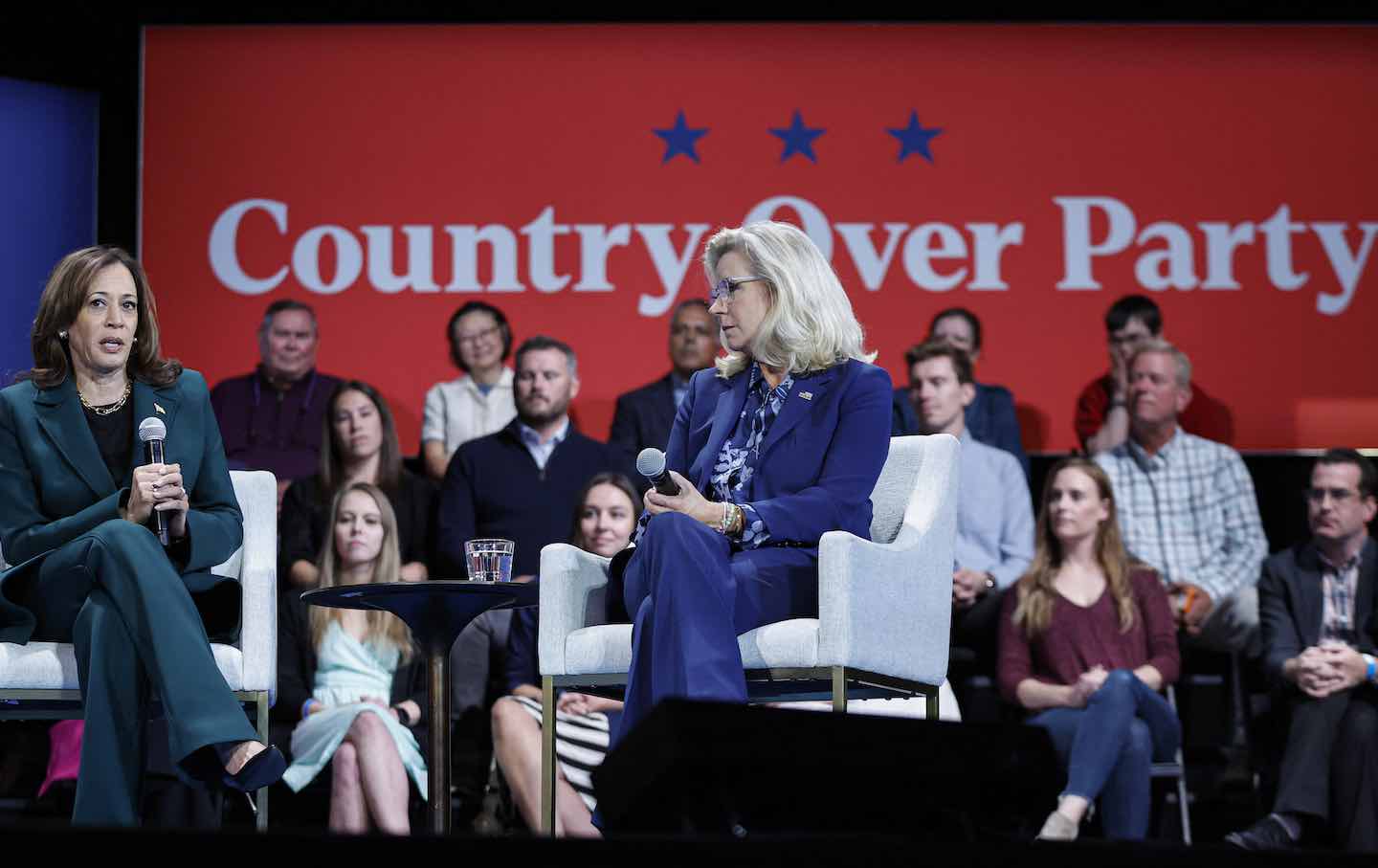
Democratic presidential candidate Vice President Kamala Harris speaks during a moderated conversation with former US Representative Liz Cheney on October 21, 2024.
(Kamil Krzaczynski / AFP)
Kamala Harris made her first campaign appearance with Liz Cheney in Ripon, Wisconsin, the birthplace of the Republican Party, one month and two days before the 2024 election. The point of the visit was to signal to conservatives that they could split with Donald Trump’s Republican Party over their concerns about the former president’s election denialism, authoritarian rhetoric, and embrace of global strongmen. Republicans could, Cheney argued, cast a “Country Over Party” vote for the Democratic presidential nominee—just like the former chair of the House Republican Conference, who broke with Trump over his refusal to accept the results of the 2020 election, planned to do.
The media loved the story. Lavish attention was paid to the event. Cable channels went live. Ponderous essays were written in the great newspapers of the nation about the prospect that Harris would attract enough Republican votes to upend Trump’s bid for a second term.
Unfortunately, while many Democratic tacticians were enthusiastic about Cheney’s jumping on board as a Harris backer, Republican voters couldn’t have cared less. The Cheney strategy was an abject failure that added few if any votes to the Democratic total, alienated voters who have no taste for the former GOP representative’s neocon extremism, and stole precious time from an agonizingly short campaign schedule.
While it is certainly not the sole explanation for why Democrats fared as poorly as they did, the Cheney detour was a political fiasco.
This reality is most apparent in the election results from Ripon. The east-central Wisconsin city where abolitionists, land reformers, and utopian socialists founded the Republican Party in 1854 seemed ripe for a cross-party appeal. Ripon has been a Republican stronghold for 170 years, but the city is also a college town that in the past has shown a good measure of enthusiasm for Democrats such as Barack Obama. But that’s not how things played out on Election Day.
On November 5, Trump won 53.8 percent of the vote (2,097 ballots) in the city of Ripon, while 45 percent (1,753 ballots) voted for Harris.
That was a worse finish for the Democratic ticket than in 2020, when Joe Biden won 46.6 percent (1,820 ballots), while 51.7 percent (2,019 ballots) voted for Trump.
But, surely, Ripon was an anomaly.
No. Definitely and unequivocally no.
After the Ripon rally, Harris returned to Wisconsin for an event with Cheney in Waukesha County in the vote-rich Milwaukee suburbs. The historically Republican county had seen some movement toward the Democrats in 2020 and 2022, and the Harris campaign imagined that a visit to the region by their candidate and Cheney—on a day when the pair also appeared together in Pennsylvania and Michigan—might yield benefits this year. It didn’t.
Despite the fact that much attention was paid to the prime-time visit, Trump’s percentage of the vote held steady in Waukesha County, at 59 percent.
In a state where Trump lost by around 20,000 votes in 2020 and won by around 30,000 votes in 2024, his Waukesha County advantage in each year was around 54,000.
So all that time spent hanging around with Liz Cheney moved few if any votes. And it was even worse nationwide.
In 2020, according to the NBC News assessment of exit polling date, 14 percent of self-identified conservatives said they voted for Biden, while 5 percent of self-identified Republicans said they did the same.
In 2024, 9 percent of conservatives said they voted for the Democratic ticket, while just 4 percent of Republican voters said they backed Harris.
The notion that spending day after day with Liz Cheney—who publicly trumpeted an endorsement from her father, former vice president Dick Cheney, and other right-wing Republicans—would benefit Harris turned out to be a damaging distraction for Democrats.
Even before Harris began making appearances with Cheney in key battleground states, conservative commentator Jonah Goldberg, an astute observer of Republican Party patterns, observed, “The universe of undecided and persuadable voters in the relevant swing states is small. Those who have been swayed by Cheney’s well-known arguments about Trump’s unfitness for office have probably already been swayed. How many voters might yet be persuaded by her formal endorsement of Harris? Dozens? Hundreds? Maybe.”
Goldberg’s skepticism was proven right by the exit polls. But that wasn’t the worst of it for the Harris campaign.
Unfortunately for the Democrats, the embrace of the Cheneys came at a cost that has been too rarely noted in the postelection analyses of the party’s defeat on November 5.
Because President Biden delayed his decision to end his reelection bid until late July, at a point when Democratic poll numbers had collapsed, Harris was left with just 107 days to mount a presidential bid.
Popular
“swipe left below to view more authors”Swipe →Every day was precious, and every signal sent to potential voters was significant. The days spent with Cheney, and the resources expended to promote endorsements from neoconservative Republicans, cost the Democrats in significant ways. They sent a signal to potential Democratic voters, many of who recalled the Iraq War and other Cheney projects, that the focus of the campaign was on outreach to the right, They ate up time that could have been spent campaigning in union halls in working-class communities with figures such as United Auto Workers union president Shawn Fain and Vermont Senator Bernie Sanders. They burned up time that could have been devoted to sincere, if difficult, conversations about Gaza. They foreclosed opportunities to reach out to Latino communities in swing states. The list goes on and on.
But the bottom line is constant: Every minute that Kamala Harris spent with Liz Cheney was a colossal waste of the candidate’s time.
Kamala Harris made her first campaign appearance with Liz Cheney in Ripon, Wisconsin, the birthplace of the Republican Party a month and two days before the 2024 election. The point of the visit was to signal to conservatives that they could split with Donald Trump’s Republican Party over their concerns about the former president’s election denialism, authoritarian rhetoric and embrace of global strongmen. Republicans could, Cheney argued, cast a “Country Over Party” vote for the Democratic presidential nominee – just like the former chair of the House Republican Conference, who broke with Trump over his refusal to accept the results of the 2020 election, planned to do.
The media loved the story. Lavish attention was paid to the event. Cable channels went live. Ponderous essays were written in the great newspapers of the nation about the prospect that Harris would attract enough Republican votes to upend Trump’s bid for a second term.
Unfortunately, while many Democratic strategists were enthusiastic about Cheney jumping on board as a Harris backer, Republicans couldn’t have cared less. The Cheney strategy was an abject failure that added few if any votes to the Democratic total, alienated voters who has no taste for the former GOP representative’s neocon extremism, and stole precious time from an agonizingly short campaign schedule. While it is certainly not the sole explanation for why Democrats fared as poorly as they did, the Cheney detour was a political fiasco.
This reality was writ large in the results from Ripon, the east-central Wisconsin city where abolitionists, land reformers and utopian socialists founded the Republican Party in 1854. A Republican stronghold for 170 years, but also a college town that had in the past shown a good measure of enthusiasm for Democrats such as Barack Obama, Ripon seemed ripe for a cross-party appeal. But that’s not how things played out on election day.
On November 5, Trump won 53.8 percent of the vote (2,097 ballots) in the city of Ripon, as compared to 45 percent (1,753 ballots) for Harris.
That was a worse finish for the Democratic ticket than in 2020, when Joe Biden won 46.6 percent (1,820 ballots), as compared with 51.7 percent (2,019 ballots) for Trump.
But, surely, Ripon was an anomaly.
No, definitely and unequivocally, no.
After the Ripon rally, Harris returned to Wisconsin for an event with Cheney in Waukesha County in the vote-rich Milwaukee suburbs. The historically Republican county had seen some movement toward the Democrats in 2020 and 2022, and the Harris campaign imagined that a visit to region by their candidate and Cheney — on a day when the pair also appeared together in Pennsylvania and Michigan — might yield benefits this year. It didn’t.
Despite the fact that lavish attention was paid to a primetime discussion at the Sharon Lynne Wilson Center for the Arts in the upscale suburb of Brookfield, Trump’s percentage of the vote held steady in Waukesha County – at 59 percent.
In a state where Trump lost by around 20,000 votes in 2020 and won by around 30,000 votes in 2024, his Waukesha County advantage in each year was around 55,000.
So all that time with Liz Cheney moved few if any votes. And it was even worse nationwide.
In 2020, according to the NBC News assessment of exit polling date, 14 percent of self-identified conservatives said they voted for Biden, while five percent of self-identified Republicans said they did the same.
In 2024, nine percent of conservatives said they voted for the Democratic ticket, while just four percent of Republican voters said they backed Harris.
So, the notion that spending day after day with Liz Cheney – while publicly trumpeted an endorsement from her father, former Vice President Dick Cheney, and other right-wing Republicans — benefited Harris is a fallacy.
Even before Harris began making appearances in Wisconsin, Michigan and Pennsylvania with Cheney, conservative commentator Jonah Goldberg, an astute observer of Republican Party patterns, observed that, “The universe of undecided and persuadable voters in the relevant swing states is small. Those who have been swayed by Cheney’s well-known arguments about Trump’s unfitness for office have probably already been swayed. How many voters might yet be persuaded by her formal endorsement of Harris? Dozens? Hundreds? Maybe.”
Goldberg’s skepticism was proven right by the exit polls. But that wasn’t the worst of it for Harris and her supporters.
Unfortunately for the Democrats, the embrace of the Cheneys came at a cost that has been too rarely noted in the post-election analyses of the party’s defeat on November 5. Because President Biden delayed his decision to end his reelection bid until late July, at a point when Democratic poll numbers had collapsed, Harris was left with just 107 days to mount a presidential bid.
Every day was precious, and every signal sent was significant. The days spent with Cheney, and the resources expended to promote endorsements from neoconserative Republicans, cost the Democrats in two ways. They sent a signal to potential Democratic voters, many of who recalled the Iraq War and other Cheney projects, that the focus of the campaign was on outreach to the right, They ate up time that could have been spent campaigning in union halls in working-class communities with figures such as United Auto Workers union President Shawn Fain and Vermont Senator Bernie Sanders. They burned up time that could have been devoted to sincere, if difficult, conversations with Arab Americans, students and others about Gaza. They foreclosed opportunities to reach out to Latino communities in swing states. The list goes on and on.
But the bottom line is constant: every minute that Kamala Harris spent with Liz Cheney was wasted.
More from The Nation
We Don’t Need an Autopsy to Tell Us the Democrats Failed on Gaza We Don’t Need an Autopsy to Tell Us the Democrats Failed on Gaza
The DNC is allegedly hiding a report showing that Kamala Harris’s Gaza policy helped cost her the 2024 election. But that report won’t tell us anything we don't already know.
Texas’s Senate Primary Has Already Made History—and It’s Not Over Yet Texas’s Senate Primary Has Already Made History—and It’s Not Over Yet
Democratic nominee James Talarico is getting national media attention, but the real story is sky-high voter turnout, even amid GOP bids to suppress balloting
Quilted Messages Quilted Messages
Sunbonnets carrying not-so-sunny truths.
How the Theatrics of Mamdani’s Trump Meeting Backfired How the Theatrics of Mamdani’s Trump Meeting Backfired
By pandering to the president’s vanity, the New York mayor reinforced Trump’s image as a strongman commanding deference—an especially bad look on the eve of Trump’s war with Iran
Students in New York Are Going Hungry. How Can Mamdani Help? Students in New York Are Going Hungry. How Can Mamdani Help?
With plans for city-owned grocery stores and a focus on affordability, the new mayoral administration offers fresh hopes of successfully confronting the food crisis among students...

We Are the Fire That Melts the ICE We Are the Fire That Melts the ICE
Oaxaca, Mexico, street art.

