Shawn Fain, Raphael Warnock, and AOC Emerge as the Future of the Democratic Party
The convention in Chicago is both a forum for past fights and a showcase of tomorrow’s stars.
Anyone who thinks the two major political parties are basically the same just needs to watch the competing political conventions to understand what radically different creatures they are. The GOP is a monologue, whereas the Democratic Party is a cacophony of contending voices. At the Republican National Convention (RNC), it was striking how much the entire party had become a MAGA-echo chamber, with every major political figure adopting the rhetoric of Trump. Conversely, the Democratic National Convention (DNC) reflected a much more heterogeneous party, with centrists and leftists both coming out in support of Kamala Harris—but for different reasons and with varied accents and arguments.
Another way to frame the difference is that the RNC took place only in the present, while the DNC contained both the past and future of the party. At the RNC, the traditional convention invocation of the party’s heritage was at a minimum: scarce references to Abraham Lincoln, Theodore Roosevelt—or even Ronald Reagan. All that mattered was Trump. Even the living Republican nominees for president (George W. Bush and Mitt Romney) were excluded from the RNC.
The absence of the past—or any non-Trump future—at the RNC is a negative version of the DNC, where the stage was shared both by representatives of earlier iterations of the party (on the first night notably, Hillary Clinton and Joe Biden) and the emerging stars who represent the party’s future (notably Alexandria Ocasio-Cortez and Raphael G. Warnock). The first night also featured many labor leaders, most notably Shawn Fain, the president of the United Automobile Workers. These labor leaders aren’t the political future of the party, but they do indicate a major change, as elected Democrats have embraced not only unions themselves but even some of the language of union militancy.
To underscore this embrace of organized labor, Joe Biden in his speech said:
“I’m proud to be the first president to walk a picket line, and (to) be labeled the most pro-union in history. I accept it, its a fact. When unions do well, we all do well.”
But Biden’s praise of unions was a rare case of Biden acknowledging the future. Most of his speech was a backward look at his achievements and motives for running, with a strong emphasis on Donald Trump’s embrace of racism at the Unite the Right rally in Charlottesville, Virginia, in 2017. Similarly, Hillary Clinton’s speech evoked many of the themes of her 2016 campaign, notably the importance of breaking the glass ceiling on women’s achievements. Clinton has earned her medals as a political warrior, so it’s easy to allow her a moment to bask in the applause of the assembled Democrats and her sly smile when the crowd started yelling “Lock him up!”
The voice of an earlier politics could also be heard in a fine speech by a non-politician, Steve Kerr, the coach who oversaw the winning Olympics men’s basketball team. Kerr offered a message of national unity that called to mind the Barack Obama of 2008, who promised a transcendence of the divide between red and blue America. Kerr said, “The joy, the compassion, the commitment to our country that we saw at the Olympics, that is what Kamala Harris and Tim Walz have, and it is what our country needs. Leadership, real leadership, not the kind that seeks to divide us, but the kind that recognizes and celebrates our common purpose.” Kerr added, “Imagine what we could do with all 330 million of us playing on the same team. Not as Democrats, not as Republicans, not as Libertarians, but as Americans.”
This vision of a Harris/Walz administration reuniting a fraying nation is of course the standard boilerplate of centrist Democrats. But it’s the talk of a moment from the past that isn’t relevant anymore given the radicalization of the GOP and the fighting spirit needed to actually address the problems of the present.
What made Shawn Fain and Ocasio-Cortez both voices of the present is that they didn’t eschew partisanship but openly embraced it. Their Donald Trump wasn’t objectionable just because he was crude, vulgar, and divisive but also, more importantly, because he embodied the class interests of the rich. Fain framed politics with the classic union question, which is also a throwing down of the gauntlet: “Which side are you on?” By denouncing Trump as a scab and union-buster, Fain made clear that the goal was not national unity but the decisive victory of the party of workers.
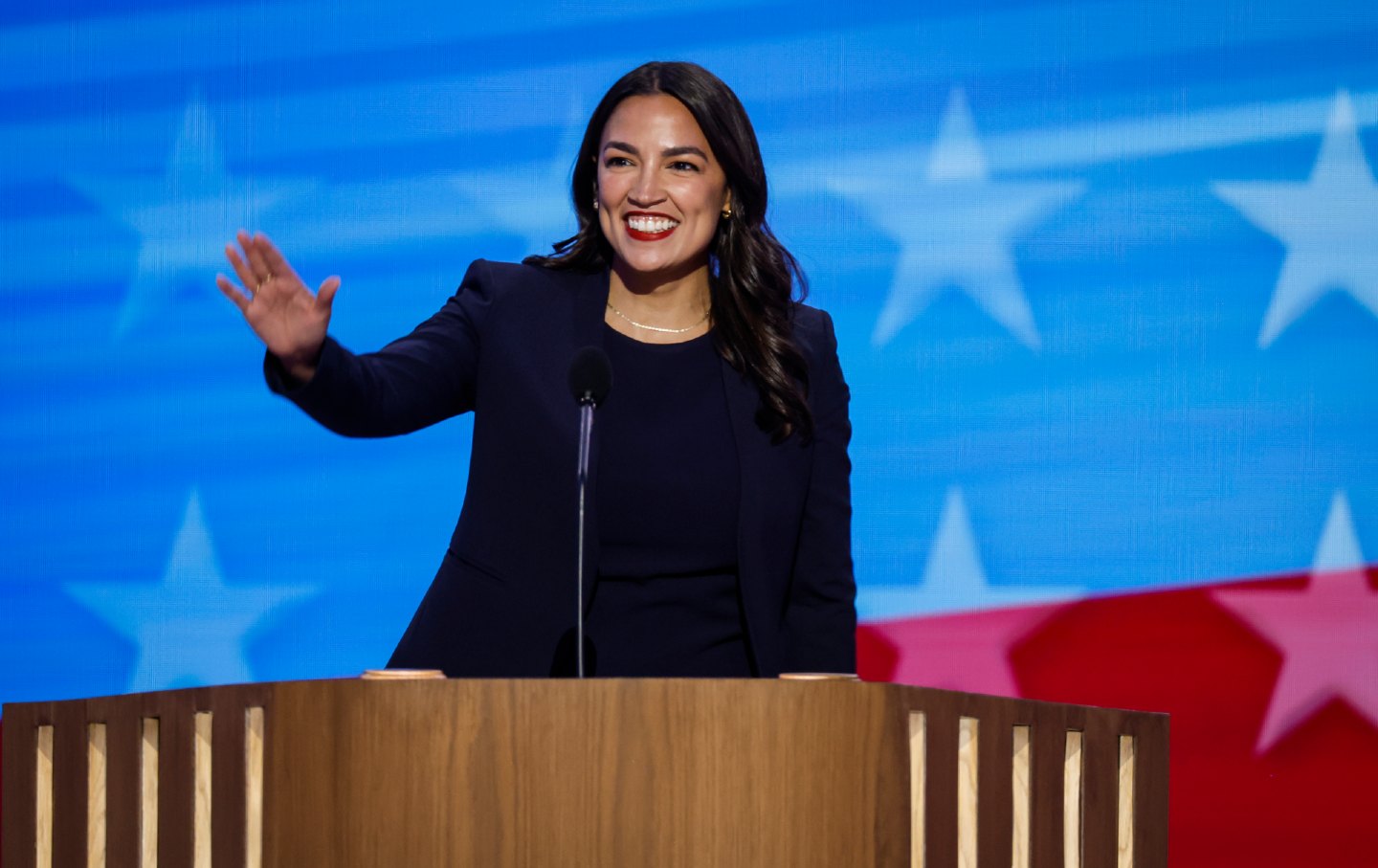
Ocasio-Cortez also took a strong class position, contrasting the middle-class struggles of Kamala Harris (as well as Ocasio-Cortez herself) with Trump’s wallowing in inherited wealth and privilege.
Ocasio-Cortez argued, “We know Trump would sell this country for a dollar if it meant lining his own pockets and greasing the palms of his Wall Street friends.” She added, “I, for one, am tired of hearing about how a two-bit union buster thinks of himself as more of a patriot than the woman who fights every single day to lift working people out from under the boots of greed trampling on our way of life.”
Ocasio-Cortez was one of two speakers, along with Warnock, to bring up Israel’s onslaught in Gaza. Disappointingly, she brought it up in a way that was too flattering to Kamala Harris (optimistically but without proof claiming that Harris was working for a ceasefire). But Ocasio-Cortez and Warnock do deserve credit for breaking the silence on this crucial issue.
The Democrats are an ideologically diverse party, and the first night of the convention could be confusing—a hodgepodge of arguments that don’t fully cohere. This sense of muddle was reinforced by poor planning that led to too many speakers on stage. Because singularly talentless speakers (notably New York Governor Kathy Hochul) took up much of the evening, Joe Biden himself didn’t speak until after 11 pm ET and continued speaking until after midnight.
But if a theme could be found in the din of contending voices at the DNC, it was that the future of the Democratic Party is emerging before our eyes. The future looks like Fain, Ocasio-Cortez, and Warnock. It’s a party that is much more vigorous in pursuing class politics. This shift is so marked that even the centrist Commerce Secretary Gina Raimondo styled herself an economic populist in her speech.
The impact of the first night of the DNC will be muffled by the poor planning that allowed the energetic eloquence of Warnock to be followed by the drone of fellow Senator Chris Coons. If the Democrats actually want to win this election, they’d be well advised to do more to highlight the voices of the future.
Popular
“swipe left below to view more authors”Swipe →Become a Sustaining Donor This September
Between the reemergence of right-wing red-baiting and Donald Trump’s use of the chilling National Security Presidential Memorandum–7 to criminalize left political organizing, we’re seeing McCarthyism reborn before our eyes.
This assault on democracy cannot be ignored or wished away. Resisting it requires bravery in the face of threats and repression, a steadfast commitment to the truth, and the unwavering belief that we can—and will—overcome this darkness.
We must have an independent media that sets the record straight, unearths corruption and abuses of power, and advances a politics of justice and dignity for all if we’re to win this fight.
That’s why I’m writing to you today. This September, The Nation needs to add 100 monthly donors to sustain our progressive journalism. Your contribution makes the next investigative report, the next truth-speaking column, and the next pathbreaking essay all possible.
I hope you’ll support our work with a recurring donation today. If you donate $10 or more a month, we’ll send you a brand new “Hands Off the Free Press!” sticker to recognise your commitment to our cause. Please, donate today.
Onward,
Katrina vanden Heuvel
Editor and Publisher, The Nation
More from The Nation
Even Republicans Are Figuring Out That Pete Hegseth Is a Disaster Even Republicans Are Figuring Out That Pete Hegseth Is a Disaster
Hegseth was always a horrible choice for defense secretary. At long last, some in the GOP are admitting it.
Clear Sign: Stop Gun Violence Clear Sign: Stop Gun Violence
Claiming over 130 American lives daily, a lethal epidemic is scarring our communities.
Mike Johnson Is the Most Dangerous House Speaker in American History Mike Johnson Is the Most Dangerous House Speaker in American History
His decision to shut the House down at a moment of crisis around AI is the act of a reckless charlatan.
The Ed Sheeran Controversy The Ed Sheeran Controversy
In a society that claims to promote free speech, what crosses the line from controversial to unacceptable? Who gets to define where the line begins and ends?
We Need to Protect College Sports From Ted Cruz We Need to Protect College Sports From Ted Cruz
In this week’s Elie v. U.S., our justice correspondent looks at the many ways Cruz’s bill threatens athletes’ labor rights. Plus: why our mail-in voting nightmare isn’t over.