
America’s Most Popular Democrat Can’t Wait to Vote for Kamala Harris
Jimmy Carter was born at the height of Jim Crow. Now, he wants to live long enough to help send a Black woman to the White House.
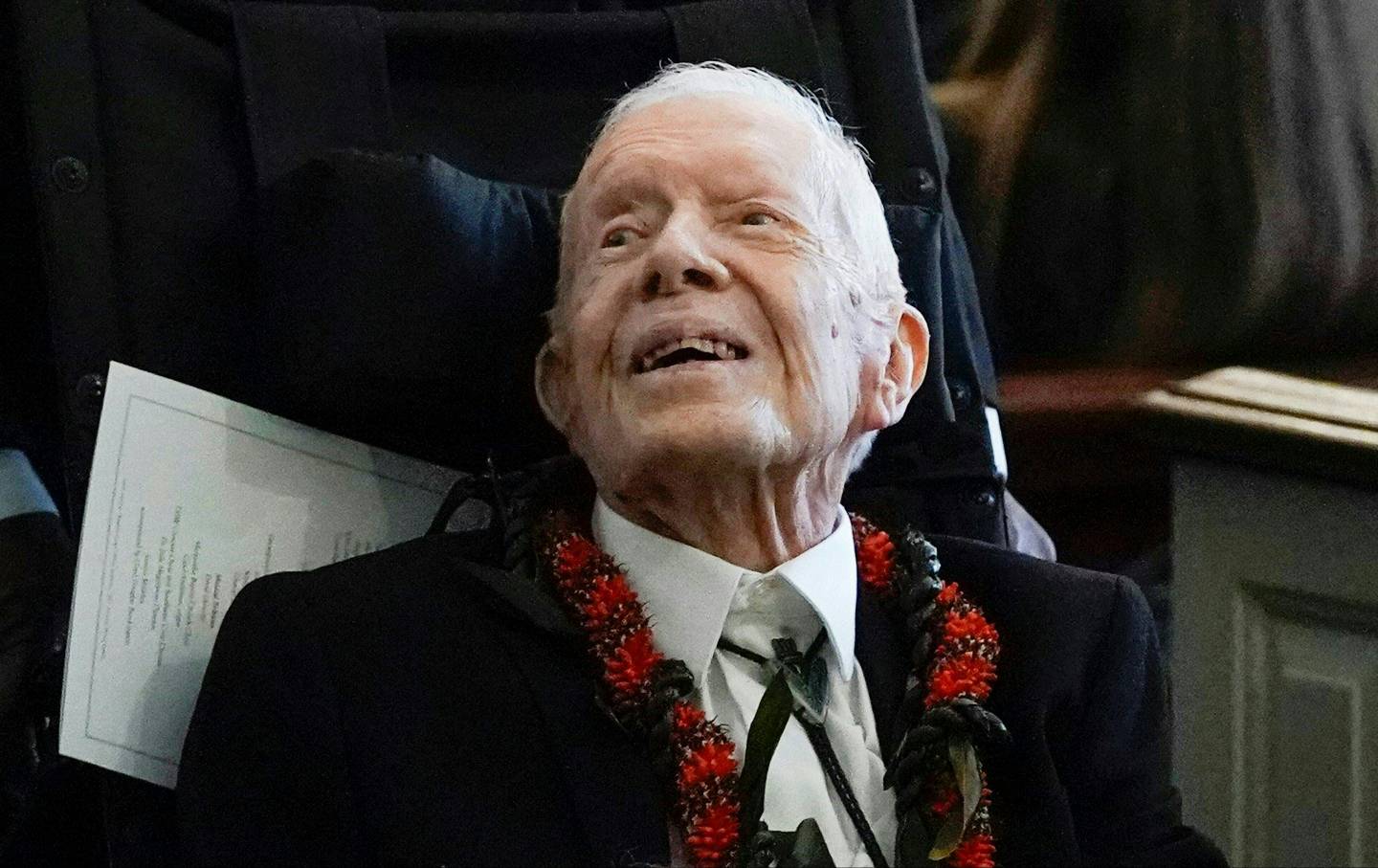
Former president Jimmy Carter departs after the funeral service for former first lady Rosalynn Carter at Maranatha Baptist Church, in Plains, Georgia, on November 29, 2023.
(Alex Brandon / Pool / AFP via Getty Images)This week’s Democratic National Convention in Chicago will be heavy on speeches from former Democratic presidents, nominees, and candidates. That’s a display of political harmony unlike anything seen at the Republican National Convention in Milwaukee, which nearly every living member of a past GOP presidential ticket—including former president George W. Bush, former vice presidents Dan Quayle, Dick Cheney, and Mike Pence, and 2012 party nominees Mitt Romney and Paul Ryan—refused to even attend, much less address.
It’s also a reflection of a party at peace with the decision to replace President Joe Biden with Vice President Kamala Harris at the top of the ticket. Thursday night’s address, in which Harris will claim the nomination that until just a few weeks ago was reserved for Biden, will be the centerpiece of the convention—an essential moment for framing the economic and foreign-policy messages of her already energetic campaign to defeat former president Donald Trump.
The cheering, inspired by genuine enthusiasm and equally genuine relief, will undoubtedly be loud and sustained.
It will be the same when Biden speaks tonight, delivering an opening-night address that’s scheduled to follow this evening’s tribute to the 81-year-old president—a tribute that will showcase not just his record but also his popularity with the delegates. Former secretary of state Hillary Clinton will deliver what is likely to be a well-received “I told you so!” rebuke to Trump and Trumpism. On Tuesday night, former president Barack Obama will top the bill, and on Wednesday night, before vice presidential nominee Tim Walz speaks, former president Bill Clinton will deliver remarks.
But the man who polls suggest is the most popular Democrat among Americans of all partisanships and ideologies won’t be at the podium in Chicago—not because he doesn’t want to be there, but because he doesn’t travel these days.
Born less than 60 years after the Civil War, and raised in an apartheid South where racist Democrats maintained “Jim Crow” segregation into the 1960s, Jimmy Carter has spent most of the past century trying to bend the arc of history toward progress. Now, on the eve of his 100th birthday, he has lived long enough to see his native Georgia, once a citadel of the Confederacy, turn into a state that could play a key role in electing a Black woman as president of the United States—and he is determined to do his part. “I’m only trying to make it to vote for Kamala Harris,” Carter told his son Chip, according to a report published earlier this month in The Atlanta Journal-Constitution.
Though Carter won’t be attending this week’s Democratic National Convention in Chicago, he plans to cast his ballot for the Democratic nominee as soon as early voting begins in Georgia in mid-October.
According to Carter Center board chair Jason Carter—a former Georgia state senator and Democratic gubernatorial candidate who is expected to address this week’s convention on his grandfather’s behalf — the 39th president of the United States is looking forward to celebrating his 100th birthday on October 1. But what’s really got the elder Carter energized—watching the news, talking politics, and making plans for the fall—is his enthusiasm about casting an early vote for Kamala Harris. On Thursday, Harris will accept the Democratic presidential nomination that Carter twice accepted in New York City—for the 1976 campaign in which he beat Republican President Gerald Ford, and for the 1980 campaign in which he was defeated by Ronald Reagan and the conservative movement that would transform not just the GOP but American politics as well.
Now, as America prepares to vote in what could be another transformational election, Carter is a swing-state voter. Georgia, where he served as a state legislator and governor before his election to the presidency, was a solid-red Republican stronghold for decades, but it voted narrowly for the Democratic ticket of Joe Biden and Kamala Harris in 2020—and then, in January 2021, Georgians elected a pair of Democrats who gave their party control of the US Senate.
The surge of excitement about Harris’s 2024 candidacy has again put the Peach State in play.
As in 2020, the presidential numbers are likely to be close. Every vote will matter, including that of Plains resident James Earl Carter.
A cancer survivor who last year lost his wife of 77 years, former first lady Rosalynn Carter, Jimmy Carter entered hospice care in February of 2023 and was reportedly declining earlier this year. But Jason Carter said early this month that his grandfather has been “more alert and interested in politics and the war in Gaza” of late.
In other words, Carter is like a lot of Americans who have been energized in recent weeks, following the decision of President Joe Biden—Carter’s longtime friend and ally—to end his own reelection bid and endorse Harris.
Carter’s enthusiasm is worthy of particular note for practical political reasons. Not least among them is the fact that the former president has over the past four decades emerged as the conscience of the Democratic Party—and the United States.
While his presidency tended toward centrism, Carter has, since his own defeat for reelection in 1980, often stood to the left of the Democratic Party on domestic and foreign policy issues. That’s put him at odds with a number of Democratic presidential candidates and officeholders—most notably Bill Clinton. In 2016, Carter voted for Vermont independent Senator Bernie Sanders for the Democratic presidential nomination, and he has over the years sought to push the party toward more progressive positions on a host of issues, most notably Middle East policy. A longtime supporter of Palestinian rights, Carter has for decades been a sharp, prescient critic of Israeli policies toward Palestinians in Gaza and on the West Bank—using terms such as “apartheid” and “oppression” to characterize the approaches of Prime Minister Benjamin Netanyahu and other Israeli leaders long before they entered mainstream discourse.
Though Carter may have some policy differences with the current administration—the Carter Center called in October of last year for a ceasefire in Gaza to save Palestinian and Israeli lives, for instance—he’s got no hesitancy about the 2024 Democratic ticket.
The news that Carter is not just backing Kamala Harris but is genuinely excited about her candidacy helps the 2024 Democratic nominee by offering evidence of party unity that has not always been on display on the Democratic side of the aisle—and that is definitely not on display on the Republican side this year.
Since emerging as the presumptive Democratic nominee, Harris has secured enthusiastic endorsements from the current Democratic president and from every living former Democratic president, vice president, and national party nominee—including Carter, whom the YouGov polling service ranks as the most popular Democrat in America.
Carter’s the only prominent Democrat to consistently maintain an approval rating above 60 percent among voting-age adults. Only two other Democrats have overall approval ratings over 50 percent: former president Barack Obama and Sanders, an independent who caucuses with Senate Democrats and who finished second in the 2016 and 2020 races for the party’s presidential nomination.
Popular
“swipe left below to view more authors”Swipe →While Carter and other popular and prominent Democrats are united in their enthusiasm for Harris and Walz, deep divisions remain among Republicans with regard to the ticket led by Donald Trump and the much-lamented JD Vance.
At this point, only one former Republican president, vice president, or party nominee appears to be actively supporting Trump. That’s Sarah Palin, the former governor of Alaska who was the vice-presidential candidate on the 2008 GOP ticket led by Arizona Senator John McCain.
Both of the party’s 2012 nominees, presidential candidate Mitt Romney and vice-presidential candidate Paul Ryan, have announced that they will not be voting for Trump and Vance. Trump’s running mate in 2016 and 2020, former vice president Mike Pence, says he won’t endorse this year’s GOP ticket.
Former president George W. Bush says he wrote in the name of former secretary of state Condoleezza Rice in 2020. This year, he has joked about writing in his brother, Jeb, whom Trump beat for the 2016 Republican presidential nod, or perhaps his late Scottish terrier, Barney, as an alternative to Trump.
Former vice president Dick Cheney, the most ardent anti-Trumper of the bunch, said in 2022: “In our nation’s [long] history, there has never been an individual who is a greater threat to our republic than Donald Trump. He tried to steal the last election using lies and violence to keep himself in power after the voters had rejected him. He is a coward. A real man wouldn’t lie to his supporters. He lost his election, and he lost big. I know it. He knows it, and deep down, I think most Republicans know
Dick Cheney managed the Republican campaign against Jimmy Carter in 1976. They’ve both lived long enough to agree on something: As Cheney says, and Carter would affirm, it’s vital “to make sure Donald Trump is never again near the Oval Office.”
Support independent journalism that does not fall in line
Even before February 28, the reasons for Donald Trump’s imploding approval rating were abundantly clear: untrammeled corruption and personal enrichment to the tune of billions of dollars during an affordability crisis, a foreign policy guided only by his own derelict sense of morality, and the deployment of a murderous campaign of occupation, detention, and deportation on American streets.
Now an undeclared, unauthorized, unpopular, and unconstitutional war of aggression against Iran has spread like wildfire through the region and into Europe. A new “forever war”—with an ever-increasing likelihood of American troops on the ground—may very well be upon us.
As we’ve seen over and over, this administration uses lies, misdirection, and attempts to flood the zone to justify its abuses of power at home and abroad. Just as Trump, Marco Rubio, and Pete Hegseth offer erratic and contradictory rationales for the attacks on Iran, the administration is also spreading the lie that the upcoming midterm elections are under threat from noncitizens on voter rolls. When these lies go unchecked, they become the basis for further authoritarian encroachment and war.
In these dark times, independent journalism is uniquely able to uncover the falsehoods that threaten our republic—and civilians around the world—and shine a bright light on the truth.
The Nation’s experienced team of writers, editors, and fact-checkers understands the scale of what we’re up against and the urgency with which we have to act. That’s why we’re publishing critical reporting and analysis of the war on Iran, ICE violence at home, new forms of voter suppression emerging in the courts, and much more.
But this journalism is possible only with your support.
This March, The Nation needs to raise $50,000 to ensure that we have the resources for reporting and analysis that sets the record straight and empowers people of conscience to organize. Will you donate today?
More from The Nation
An Argument Against Voting for the “Electable” Guy An Argument Against Voting for the “Electable” Guy
In this week’s Elie v. US, The Nation’s justice correspondent shares his thoughts on the Texas primaries. Plus, a terrible Supreme Court decision and a bad play by Major League Ba...

A Conflict Without Reason Has Become a Dangerous Holy War A Conflict Without Reason Has Become a Dangerous Holy War
Lacking a clear rationale for the attack on Iran, Trumpists are increasingly talking like crusaders.
RFK Jr.: America’s Snake Oil Salesman RFK Jr.: America’s Snake Oil Salesman
Raw truth: MAHA is NUTS.
The Unfathomable Toll of the Syrian Civil War The Unfathomable Toll of the Syrian Civil War
How to make sense of the 13-year conflict?
Celebrate Kristi Noem’s Firing. But Keep Protesting ICE. Celebrate Kristi Noem’s Firing. But Keep Protesting ICE.
Finally, someone in the administration is paying for their cruelty and incompetence.

