
An Irish Rebel Socialist Is Stirring Up New York City Politics
Why Zohran Mamdani and Claire Valdez are quoting James Connolly.
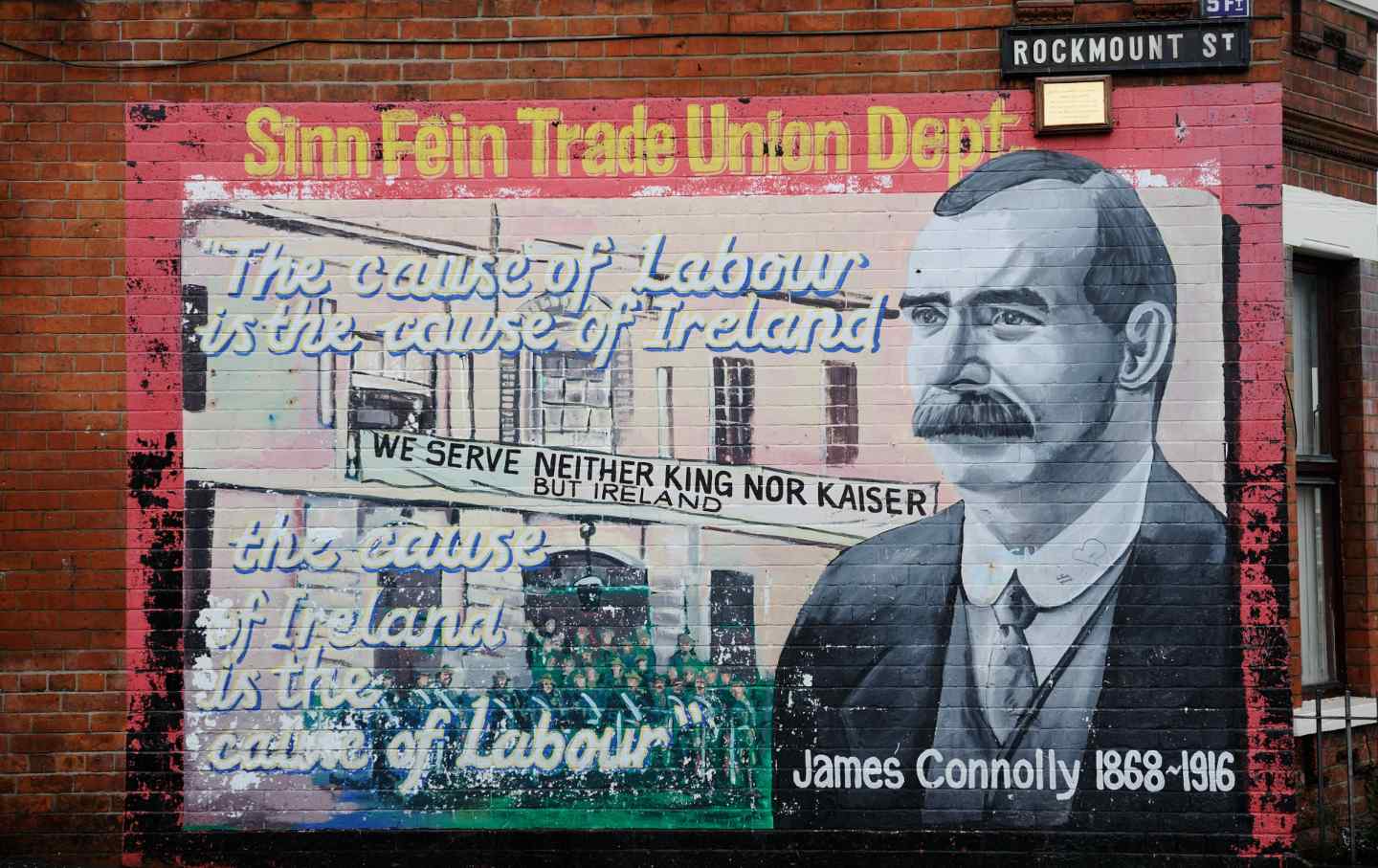
A mural in Belfast depicting James Connolly.
(Soltan Frédéric / The Image Bank via Getty Images)Zohran Mamdani memorably began his election-night victory speech by announcing, “The sun may have set over our city this evening, but as Eugene Debs once said: “I can see the dawn of a better day for humanity.”
That reference to Debs—the heroic railroad union leader, socialist icon, and five-time presidential candidate—drew cheers from Mamdani’s supporters. They understood it as a signal that the newly elected mayor of New York City was serious about his democratic socialist politics. They also understood it as a sign that, like Deb’s Socialist Party, which elected members of Congress, mayors, and legislators in states across the country, Mamdani was serious about putting government on the side of the working class.
Mamdani, who, like many of those who were cheering, is a member of New York City’s surging Democratic Socialists of America movement, chose the right quote at the right moment on that November night. And he did so, again, shortly before St. Patrick’s Day, when he attended a luncheon hosted by the James Connolly Irish American Labor Coalition—a group named for the radical labor leader who is remembered 110 years after his execution by the British as an unflinching champion of Irish independence and a proud socialist campaigner for overturning the rule of “capitalists, landlords and financiers.”
The mayor spoke in the language of the group he was addressing, quoting Connolly’s epic declaration: “The cause of labor is the cause of Ireland and the cause of Ireland is that cause of labor.”
Several days later, Mamdani took some hits for replying cautiously to a question about whether he embraced Connolly’s vision of a united Ireland. “I gotta be honest,” he said, I haven’t thought enough on that question.”
But the mayor came back on St. Patrick’s Day itself with a more robust response, explaining that “as someone who believes deeply in the principle of self-determination…I think that should also be extended to the Irish.” Most people took that to mean that Mamdani supports the push to hold a referendum on whether the six counties of Northern Ireland should be taken out of the hands of the British and reunited with the 26 counties of the Republic of Ireland. That’s not some far-off prospect; the leader of Ireland’s Sinn Féin party, Mary Lou McDonald, has been calling for “proposals for delivering legal, fair and decisive referenda and a negotiated timeframe by the end of this decade.”
Mamdani then issued a St. Patrick’s Day video in which he hailed Irish solidarity with anti-colonial struggles in Africa, the fight against apartheid in South Africa, and the cause of Palestinian freedom.
“Irish solidarity is no coincidence, as it was on Irish soil that the British Empire developed their colonial project. So much of the exploitation later imposed elsewhere across the world was honed first in the plantations in Ireland,” explained the mayor. “Who can better understand those who weep than those who have wept for so long? And yet, the story of the Irish is not merely one of violent oppression, of subjugation, of attempted domination. It is one of resistance, too. For centuries, generation after generation waged a lonely effort for independence, year after year, uprising after uprising, they were brutally beaten back, and still they kept coming.”
Decrying Britain’s “imperial callousness,” Mamdani name-checked Connolly (along with Patrick Pearse), “who roused hundreds of thousands with demands of political freedom and economic self-determination.”
A statue in Dublin recalls how Connolly organized, fought, and died for Irish liberation, a cause he championed as a signer of the 1916 Proclamation of the Irish Republic. Captured and executed in Dublin by a British colonial authorities because of his role in the April 1916 Easter Rising, he is an epic figure in the island’s long history.
Yet Connolly was also, for a number of years, a leading figure in the labor union and socialist circles of New York City, where he edited the newspaper The Harp. That history was recalled on St. Patrick’s Day by Claire Valdez, a longtime United Auto Workers local union organizer, New York state legislator, and NYC-DSA activist, who this year is running as a Mamdani-backed candidate for Congress in New York’s Seventh Congressional District.
“Just six years before the Easter Rising—and his execution by the British—Irish republican and socialist James Connolly gave a speech right here in NY-7, at an open-air meeting on the corner of Manhattan Ave and Huron Street in Greenpoint,” Valdez said. “Connolly emigrated to New York in 1903 and organized with the IWW, a revolutionary movement built around bringing the entire working class into ‘one big union.’”
Highlighting clippings from The New York Call, the city’s socialist daily newspaper in the era, Valdez noted, “His Greenpoint talk in July 1910 was titled ‘Socialism in Ireland and the United States.’ Over 1,000 workers showed up. But it almost didn’t happen. The NYPD had arrested a Socialist Party leader on that same corner the week before. This time, the rally went off without a hitch. ‘Long before the meeting opened there were hundreds of people waiting on the corner to hear what the Socialists had to say to them,’ reported socialist newspaper The New York Call. The police behaved well and every disturbance by the hired thugs was suppressed by them.”
Said Valdez: “Connolly understood that Irish liberation and working-class liberation were the same struggle. The British Empire exploited Ireland the same way capital exploited workers in the factories and docks of Brooklyn and Manhattan. You couldn’t win one fight without winning the other. That tradition lives in NY-7 every time the people stand against the powerful.”
Popular
“swipe left below to view more authors”Swipe →Connolly did not just fight for independence. He also sought “a reorganization of society,” writing, “As a Socialist I am prepared to do all one man can do to achieve for our motherland her rightful heritage—independence, but if you ask me to abate one jot or tittle of the claims of social justice, in order to conciliate the privileged classes, then I must decline.”
That clarity inspired Debs, who in mourning Connolly’s death declared, “The seed that James Connolly sowed in the brains and hearts of his enslaved countrymen will germinate now that his precious blood has fertilized the soil and in due time the social revolution will accomplish what the Irish rebellion failed in, and sweep landlordism and capitalism and every other form of oppression from the Emerald Isle and from the face of the earth.”
One hundred and ten years on, James Connolly still inspires enthusiasm among campaigners for economic and social justice, in Ireland, and in New York City.
Become a Sustaining Donor This September
Between the reemergence of right-wing red-baiting and Donald Trump’s use of the chilling National Security Presidential Memorandum–7 to criminalize left political organizing, we’re seeing McCarthyism reborn before our eyes.
This assault on democracy cannot be ignored or wished away. Resisting it requires bravery in the face of threats and repression, a steadfast commitment to the truth, and the unwavering belief that we can—and will—overcome this darkness.
We must have an independent media that sets the record straight, unearths corruption and abuses of power, and advances a politics of justice and dignity for all if we’re to win this fight.
That’s why I’m writing to you today. This September, The Nation needs to add 100 monthly donors to sustain our progressive journalism. Your contribution makes the next investigative report, the next truth-speaking column, and the next pathbreaking essay all possible.
I hope you’ll support our work with a recurring donation today. If you donate $10 or more a month, we’ll send you a brand new “Hands Off the Free Press!” sticker to recognise your commitment to our cause. Please, donate today.
Onward,
Katrina vanden Heuvel
Editor and Publisher, The Nation
More from The Nation
CEOs Are Losing Control of AI CEOs Are Losing Control of AI
With no slowdown from Trump’s administration.

Trump Wants to Keep Journalists Out of the White House. He Should Get His Wish. Trump Wants to Keep Journalists Out of the White House. He Should Get His Wish.
The president has banned MS NOW, CNN, and Politico from attending press briefings. The rest of the media should respond with a boycott.

The GOP’s Incredible Shrinking Senate Map The GOP’s Incredible Shrinking Senate Map
Trump has so badly damaged the Republican Party’s brand that strategists are contemplating bitter fights—and losses—in races they’d been banking on as sure things.

Gina Hinojosa: “We Flip Texas, and It’s Over” Gina Hinojosa: “We Flip Texas, and It’s Over”
Talking to Texas gubernatorial candidate Gina Hinojosa about what redistricting could mean and how a new generation of Democrats is speaking more directly to voters.
Bernie Sanders: “People Are Sick and Tired of the Status Quo. People Want Change” Bernie Sanders: “People Are Sick and Tired of the Status Quo. People Want Change”
Exclusive: Read the text of a major foreign-policy address delivered by the independent senator at Riverside Church.

Even Republicans Are Figuring Out That Pete Hegseth Is a Disaster Even Republicans Are Figuring Out That Pete Hegseth Is a Disaster
Hegseth was always a horrible choice for defense secretary. At long last, some in the GOP are admitting it.

