
Maine’s Case of Platner Fasciitis
The scandals engulfing the Democratic Senate hopeful expose a rift between the state’s provincial and national identities
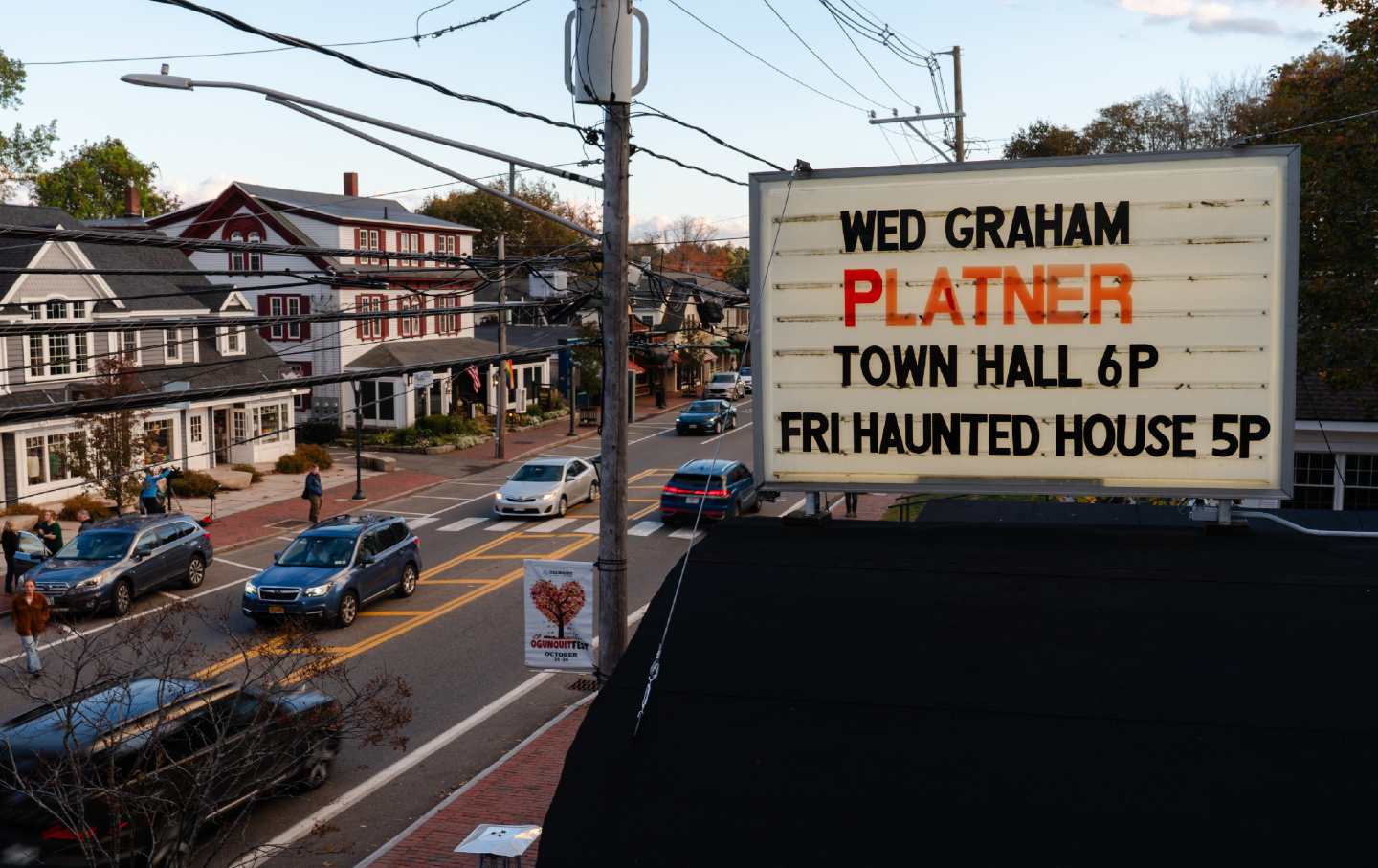
A sign advertising a Graham Platner town hall in Ogunquit, Maine
(Sophie Park / Getty Images)
Since I moved to Maine half a decade ago, I’ve found that my friends in other places don’t really keep up with the comings and goings of Maine life. For me, that’s kind of the point of living here: It’s nice being out of the way, and to hear my friends muse wistfully, “I’ve always wanted to visit Maine.” These are attempts to solicit invitations to come stay with us in Vacationland, and they’re about as close as my friends to the west and the south get to asking about my new life here. But that all changed in August, with the surprise, flash-bang Democratic Senate candidacy of 41-year-old oyster farmer Graham Platner.
Platner stormed into the 2026 Maine Senate race, which finds Democrats once more trying to unseat the five-term GOP poster lawmaker of ineffectual “concern,” Susan Collins, with a viral video that said all the right things about healthcare and oligarchs. Just as important, the video had a vibe—it made progressive Mainers’ phones light up with pings from folks we know in other states. “What’s the deal with the oyster guy?” my buddies in North Carolina and New York asked. “Is this guy for real?”
Had we stumbled across our own axe-handled baritone Mamdani—a handsome young person pointing the finger at the right enemies while wielding remarkable message discipline? Even if we haven’t yet located the Joe Rogan of the left, perhaps Maine had a passable (if decidedly male) version of what area leftists fondly hoped would be a lobsterwoman AOC—or in the worst case, an Oliver Anthony (of “Rich Men North of Richmond” fame) with better posture and some good stuff to say about universal healthcare and the VA.
To me and many of my neighbors, our fascination with Platner was less about duck boots and aquaculture and more about what he was saying. But there’s a very fuel-efficient locomotive in DC and the national political media that runs on the fetishization of blue-collar politicians as outsider challengers. Put a Graham Platner in the furnace and it’ll run for months. Never mind the fuzzy mistake of always mistaking the “working class” for “white”—and never mind Platner’s own attempts to insist on the distinction between the two. The dictum is simply to find a handsome rugged white guy in the right sort of flannel shirt, and this train’s leaving on time, and fast.
Many obligingly hopped aboard, myself included. I’ll admit that even though I used to work in advertising I found myself swept up and persuaded by Platner’s announcement video. Before I knew it, I was talking the ear off a poor Democratic Party volunteer at the Common Ground Festival in Unity, Maine, putting my name on one more endless e-mail list. There was a waiting list for yard signs.
Still, the nature of an unknown, non-politican bursting onto the scene meant that… he was an unknown non-politician bursting onto the scene. The fundraising e-mails and texts didn’t tell us much that his video hadn’t, so Mainers were mostly getting information on Platner via the same national coverage everyone else was following. I was not quoting Platner from the Portland Press-Herald to sell my mother-in-law on the candidate but instead citing his appearance on Chris Hayes’s popular podcast.
Still, our giddiness over Platner’s campaign launch was rooted in some grim regional political history. In 2020, we were told Collins was weak, less of a robust advocate for the state’s working families and more of a sentient Magic 8-Ball that can only say reply hazy, try again. But Collins won easily, and Democrats in Maine and beyond have been autopsying challenger Sara Gideon’s decisive—and expensive—2020 loss for some time now. For too long, Collins has brought attention to Maine for the wrong reasons—a Kavanaugh flip-flop here, a deep worry there—and so it was nice to get all those Hell yeah, Platner texts from friends. It was also nice to see the national press noticing Maine politics through the eyes of veteran and oyster fisherman, as opposed to the patina of Collins’s many shades of faux concern.
The New England strain of Live Free or Die libertarianism thrives in Maine. The state went for Biden in 2020, and split its electoral vote in Kamala Harris’s favor in 2024, but continues returning Collins to the Senate. Meanwhile, our Second Congressional District already has its own tattooed USMC firebrand in Representative Jared Golden (a centrist Democrat who votes with Republicans when he feels like it, which turns out to be fairly often). And then there’s our other US senator, Angus King, an independent who caucuses with the Democrats on the Bernie Sanders model. I think about how astroturfed culture-war stuff like school book bans often doesn’t fly here, or the support our Governor Janet Mills got defending trans athletes. While Maine voters may support a hand-wringing but right-voting “moderate” like Collins, bad-faith Republican nonsense gets swatted away at the rim.
All of this makes the intensive national political attention zeroing in on Maine in the wake of Platner’s bigoted Reddit comment history and news of his Totenkopf Nazi tattoo more than a little disorienting. All politics are weird, and the average voter often has at least one abstract and bizarre leaning, but I’ve learned quickly in my time here that Maine is less a state than a big small town. If you CTRL-F your way across most Platner pieces and only find the word Maine once or twice, it’s a safe bet that the analyst in question is more interested in evaluating and extolling Platner’s virtues as a symbol than in diagnosing his chances of winning what would be a difficult primary and even dicier general election.
The revelations about Platner’s online past and skin ink coincided with the official entry of Governor Mills into the Democratic primary, her Schumer-backed PAC in tow. Platner’s edgelord-style pronouncements on Reddit showed that he has had some atrocious takes and, his launch video to the contrary, some very bad vibes. But as our federal government is already run by the worst posters alive, the Reddit stuff didn’t really stick.
What does tend to hang around is a tattoo. Primary voting is not until next June, so it remains to be seen whether Platner’s Totenkopf chest display will be much of a factor then. Certainly, Platner himself hasn’t helped to distance himself from the scandal in his efforts to downplay the tattoo as a drunken mistake that he somehow kept in place, right next to his heart, for more than two decades. For now, we’re facing a choice between Is he secretly evil? or Is he very stupid?, which I hope I don’t need to belabor are both bad choices. Even doing the right thing can only get you so far, and Platner covering his spiritually ugly tattoo with a just plain old ugly tattoo means we’ve now seen his nipples more times than anyone bargained for. It’s embarrassing for him and us all that “Nazis are bad, but—” is now a menu option.
It appears Platner hasn’t lost much support post-Totenkopf (there’s a phrase, huh?). That’s probably because, while people outside of Maine know Mills as the governor who told Trump “I’ll see you in court” that one time and as a person who projects resolve and competence, we also are acutely aware of her unpopularity. These shows of strength have made her a target for MAGA grievance and Republican ire, giving her the worst net popularity of any Democratic governor. Many people in Maine like her, but many also dislike her. Throwing an old, established, and disliked candidate against an old, established, and disliked candidate isn’t a move sure to boost morale among Democratic voters.
One 2020 takeaway that has stuck with me was that despite how easily Collins’s hemming and hawing can be mocked as Beltway theater, it actually did put some distance between her and Trump for Maine voters. Paradoxically, the three-decade incumbent came across as more of an outsider candidate than Gideon. We can already see the strategy repeating, with programmatic and linear ads popping up to distance Collins from Trump’s least-popular policies; the last one I saw boasted of her bid to lower heating costs for Mainers ahead of winter—an appeal seemingly cribbed from the national Democratic Party’s fixation on “kitchen table issues.”
It’s true that born-and-bred Mainers regard such observations as feckless speculation from an interloper—the same sentiment that Platner himself has tried to tap into in claiming that the Democratic Party is “trying to destroy my life.” As a matter of both culture and geography, Maine is fiercely provincial, and people here instinctively distrust ideas and people “from away.” Yet in observing the rise, fall, stumble, and carrying on of Platner’s campaign, I feel like I’m understanding Maine politics better, even from the neophyte view of a mere five-year resident. It is a narrow gap to sluice through, but a good candidate needs to be known, authentic, and from here, while also representing prospective change and difference. The trick is not to be so new and different that you remind Mainers of the people like me who keep moving here and spiking housing prices.
Popular
“swipe left below to view more authors”Swipe →Still, if your party is losing the scrum for outsider status to Susan Collins, you’re in trouble. For my entire life (I’m Platner’s age, 41), the Democratic Party has felt like a franchise of the professional managerial class, throwing Ivy League law graduates at every presidential campaign and the same Sara Gideons at Senate races.
When my wife and I scare up the money for a sitter and head into town for a date, we are often frustrated to see our plans thwarted by a giant ocean liner docked in Portland Cruise Terminal. The cruise ships are instantly the tallest building in town, and their arrival means that our intimate drinks-and-dinner plans will be a frustrating test of tourist tolerance. They descend after Memorial Day, lavish our state with attention and money, and leave us with a better restaurant and bar scene than any similarly sized city. It’s a trade-off.
In the same vein, I understand that just because we don’t want to have these national discussions in Maine, it doesn’t mean it’s a bad place to have them. Just because we’ve got odd politics doesn’t mean lessons can’t be learned. We just need to calibrate our national lessons against the local ones, allowing for more provincial factors such as our affection for outsiders, how white and/or working-class we may be, how old we are, how established or experienced we want our leaders to be, together with many distinctions that just don’t carry over. One such distinction that we should hold on to, I think, is that we should not have to choose between a 77-year-old governor shaping up to be a Sara Gideon redux and a hubristic fortysomething oysterman who kept a Nazi tattoo for far too long as either a Maine senator or a galvanizing national figure. Even as I understand why Platner’s supporters are soldiering on, the Democratic Party has once more left me resenting that this is the choice we’re stuck with.
More from The Nation

This Minnesota Winter Is the New Prague Spring This Minnesota Winter Is the New Prague Spring
I’ve studied Czechoslovakia in 1968. I live in Minneapolis. The similarities between the historic invasion and the current ICE “surge” are scary.
Jesse Jackson Reshaped the Democratic Party Jesse Jackson Reshaped the Democratic Party
The candidate may have started as a long-shot contender, but The Nation always took him—and his impact on political history—seriously.
The State of the Game Show The State of the Game Show
In this week’s Elie v. US, our justice correspondent explores how Trump’s State of the Union turned authoritarian violence into a titillating event. Plus Kansas’s vile ban on driv...


Cuba’s Oil Crisis Cuba’s Oil Crisis
Much of Cuba goes dark as a US oil blockade chokes the island’s energy supply. Major carriers have halted services now that aviation fuel is no longer available at nine internation...
For 108 Minutes, Trump Gave a Tedious Mussolini Impersonation For 108 Minutes, Trump Gave a Tedious Mussolini Impersonation
It was most mendacious State of the Union in US history. It was also the longest.

